AKARI’s view on birth and death of stars
AKARI, the Japan Aerospace Exploration Agency (JAXA) infrared astronomical satellite with ESA participation, is continuing its survey of the sky and its mapping of our cosmos in infrared light. New exciting images recently taken by AKARI depict scenes from the birth and death of stars.
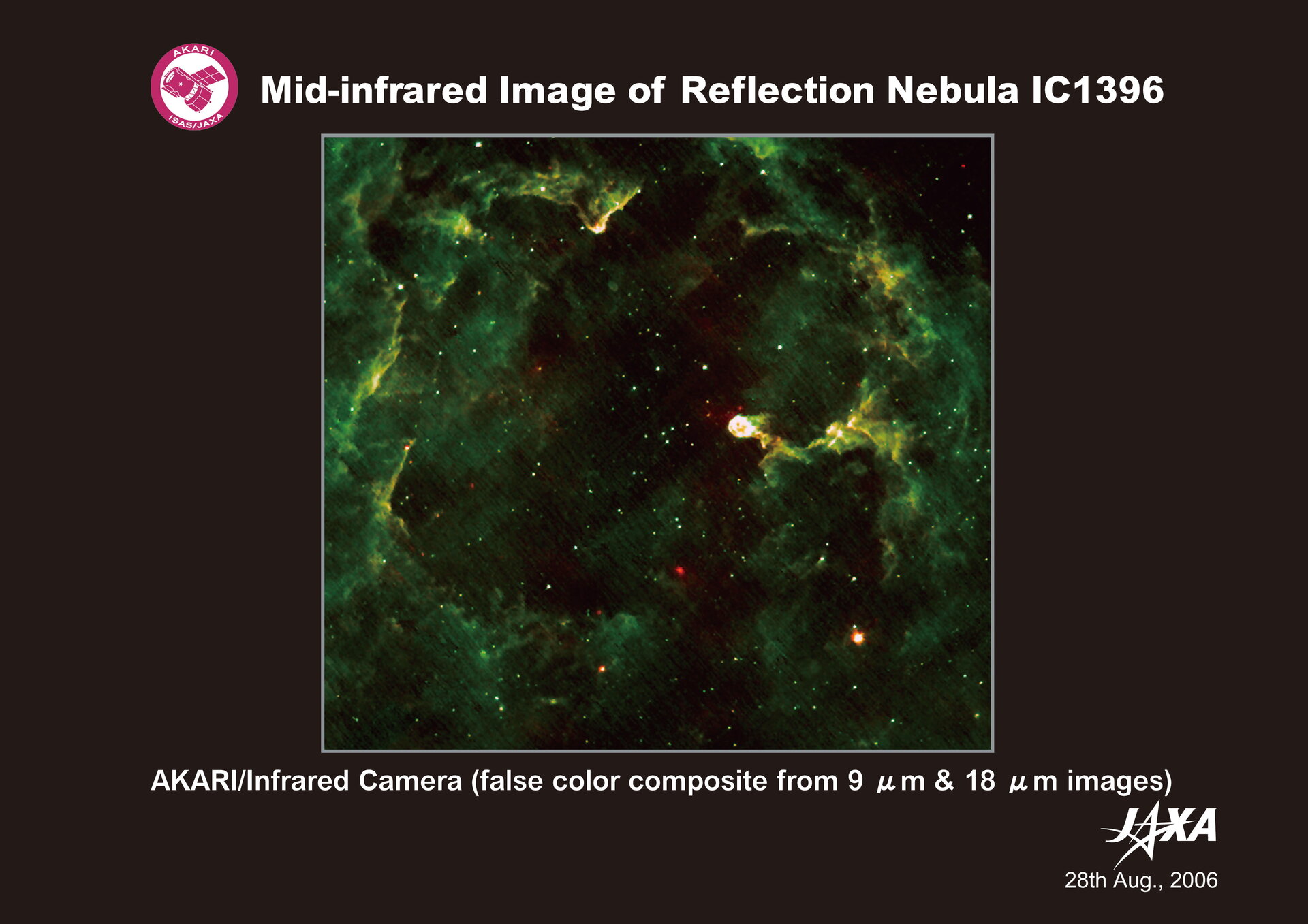
AKARI's Infrared Camera (IRC) imaged the reflection nebula IC 1396 in the constellation Cepheus (a reflection nebula is a cloud of dust which reflects the light of nearby stars). IC 1396 is a bright star-forming region located about 3000 light years from our Solar System, in a region where very massive stars – several tens of times as massive as our Sun - are presently being born. Massive young stars in the central region of the image have swept out the gas and dust to the periphery of the nebula, creating a hollow shell-like structure.
A new generation of stars is now taking place within the compressed gas in these outer shell structures. With this high-resolution and high-quality image of IC 1396, AKARI has revealed for the first time the detailed distribution of the gas and dust swept out over the entire nebula.
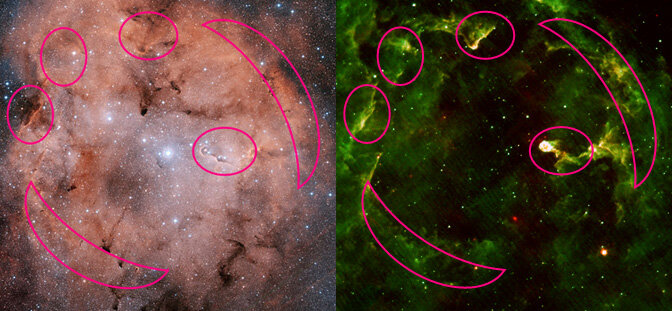
A comparison between a visible image of IC 1396 and AKARI's view of the same area shows that stars being born in regions that appear dark in visible light (left), do however appear bright if observed in infrared light (right).
The gas that has been swept out creates the bright filament-like structures seen in infrared in the surrounding regions. The dust in the gas is heated by the intense light coming from both the massive star at the centre of the nebula and the newly born stars in the dense gas itself, and emits infrared light.
The bright clump seen on the slightly off-centre right-hand side is known as the 'Elephant Trunk Nebula', a star forming region too. It appears as a dark nebula in the visible light (left image), but it is very bright in the infrared. It is a clump of dense gas that was not originally blown away because of its very high density.
Many recently born stars that were previously unknown are now expected to be detected thanks to AKARI's new image, while the detailed analysis of these data will reveal the story of the star formation in this area.
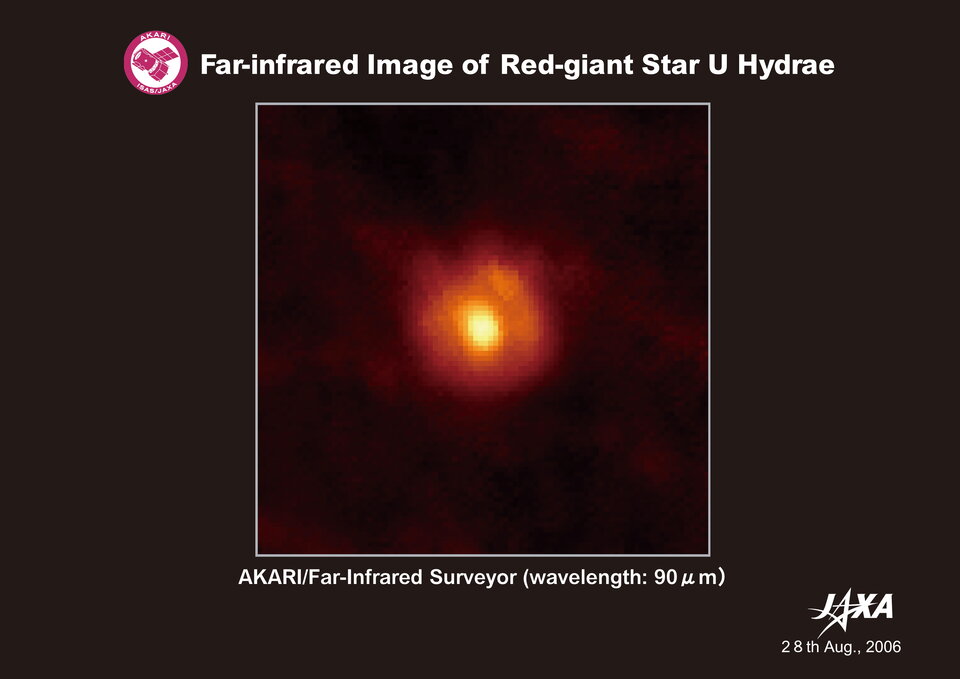
AKARI's Far-Infrared Surveyor (FIS) instrument imaged the red giant 'U Hydrae', a star located at about 500 light years from our Sun. AKARI’s observations have revealed very extended clouds of dust surrounding this object.
Stars with masses close to that of our Sun will expand during the later stages of their life becoming so-called 'red-giant' stars. During the final phase of their life such stars often eject gas from their surface into interstellar space - dust is formed in the ejected gas, and this mixture of gas and dust expands and escapes from the star.
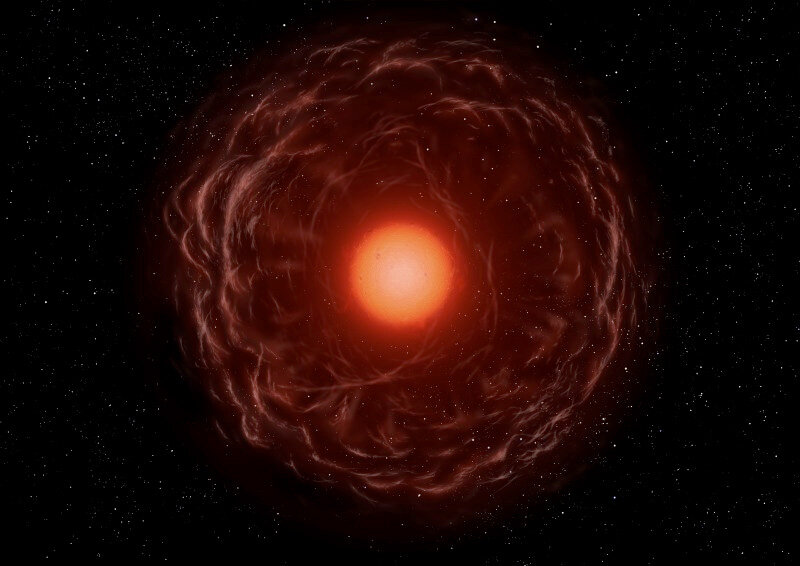
AKARI's superior quality and high-resolution imaging allowed the clear detection of a shell-like dust cloud surrounding U Hydrae at a distance of about 0.3 light years from the central star, implying that a short and violent ejection of mass took place in the star about 10 000 years ago.
Note to editors:
AKARI (formerly known as ASTRO-F) was launched on 21 February 2006 (UT) from the Uchinoura Space Centre, Japan, and started its complete sky survey in April 2006.
The mission is the result of an international effort. It was developed by the Japan Aerospace Exploration Agency (ISAS/JAXA), with the participation of Japanese universities and institutes. The FIS instrument is developed by Nagoya University, JAXA, the University of Tokyo & the National Astronomical Observatory of Japan and other institutes, with contributions of NICT to the development of the detectors. The IRC instrument is developed by JAXA and the University of Tokyo and other supporting institutes.
Including Seoul National University, South Korea, the project also draws on the involvement of ESA and a consortium of UK universities (Imperial College, London; The Open University & the University of Sussex) funded by the Particle Physics and Astronomy Research Council (PPARC), as well as the SRON Netherlands Institute for Space Research and the Groningen University (NL).
ESA/ESAC provides expertise and support for the sky-survey data processing, through the pointing reconstruction – this allows the determination of accurate astronomical positions for each of the new sources discovered. ESAC also provides user support for the observing opportunities distributed to European astronomers. ESA/ESOC is providing the mission with ground support through its ground station in Kiruna, for several passes per day.
For more information:
Alberto Salama, ESA Akari Project Scientist
Email: alberto.salama @ sciops.esa.int
Martin Kessler, ESA Akari Mission Manager
Email: martin.kessler @ esa.int