Particles and comet tails...
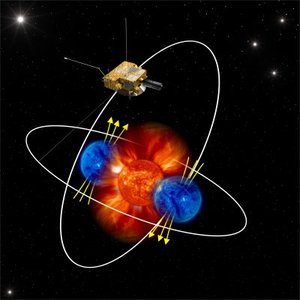
Ulysses has discovered that the energetic charged particles that make up the solar wind are able to move up in solar latitude much more easily than previously thought.
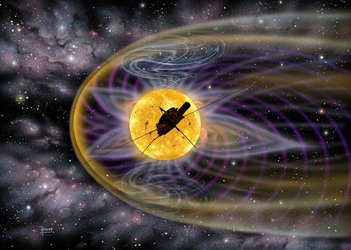
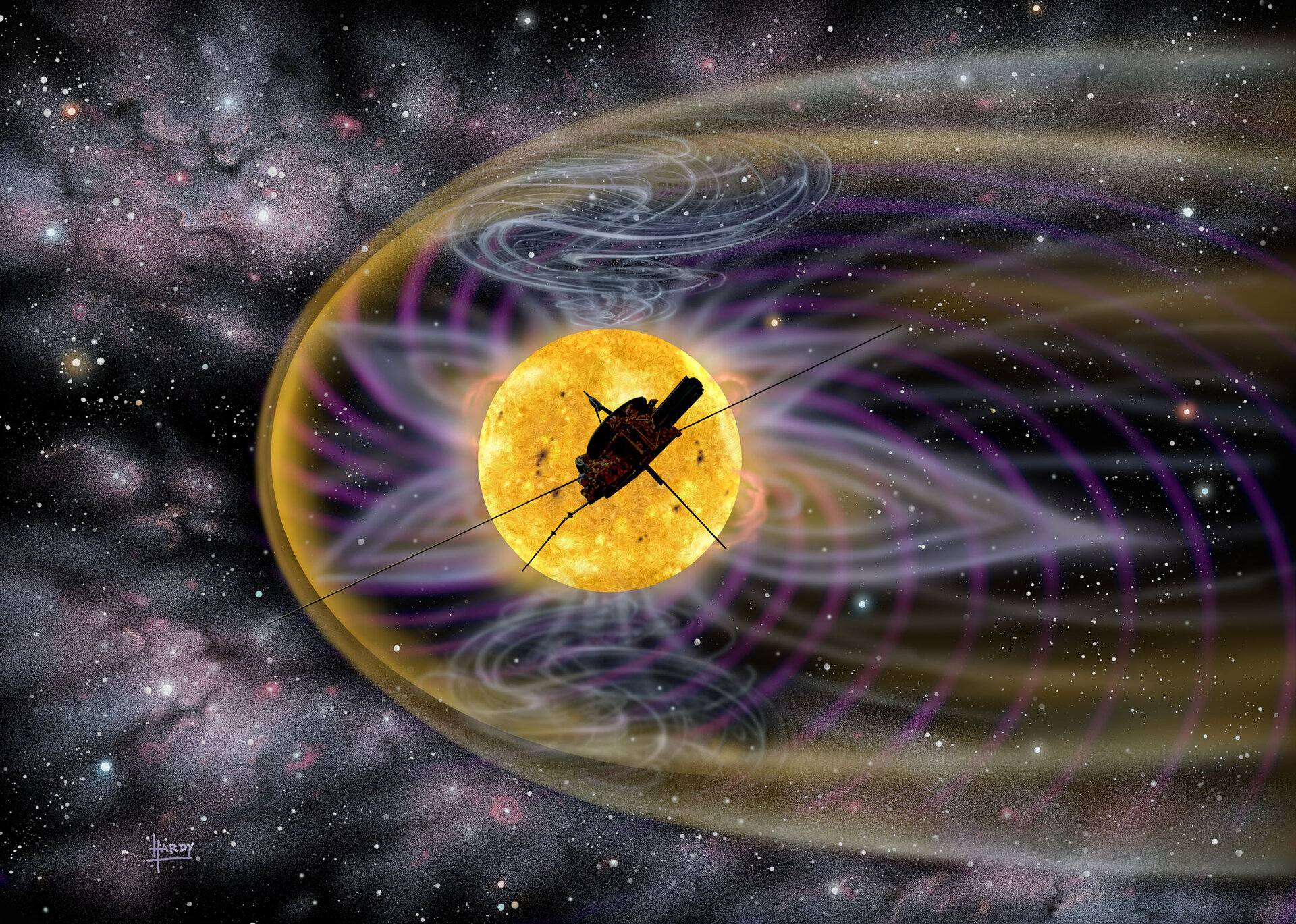
Charged particles are in fact ‘tied’ by electromagnetic forces and follow the magnetic field lines in space. In the case of the Sun, which is a rotating object, so the field lines are actually twisted into spirals like water from a garden sprinkler.
Under these conditions, charged particles would not be able to move in latitude very easily.
However, Ulysses observed large numbers of energetic particles over the solar poles, far away from the solar storms that created them. Either the particles were able to jump across the magnetic field, or the field lines themselves undergo large deviations, enabling low-latitude sources to be connected to high latitudes.
Scientists are still debating which explanation is correct. In any case, Ulysses has revealed that previous ideas as to how particles are transported in the heliosphere need a thorough revision.
This fundamental discovery is not only of academic interest. Astronauts in deep space could be exposed to radiation from sources that were previously considered to be safe locations.
How far can a comet tail reach?

An entire branch of science has been built around so-called ‘pick-up ions’ because of Ulysses observations.
Pick-up ions are charged atoms which are created in the heliosphere either when a neutral atom is subject to a ‘charge exchange’ with other charged particles carried by the solar wind, or by the direct action of solar radiation (called ‘photo-ionisation’).
With one of its pioneering instruments, Ulysses has detected pick-up ions, and even discovered new sources of them. For example, Ulysses found that solar wind particles appear embedded in dust grains when they are near the Sun, and then they are released to form a pick-up ion population known as the ‘inner source’.
Furthermore, Ulysses could measure the isotope Helium 3 (He3) in the population of pick-up ions created from the interstellar neutral gas present within the heliosphere. Measuring isotopes of helium, one of the very first atoms to be created, is very important as it provides important clues about the evolution of matter in the Universe.
Comets can form pick-up ions, by continuously emitting neutral atoms that can be charged. By observing these pick-up ions found the comet’s extended tail, scientists can determine the composition of the comet.
Thanks to pick-up ion measurements, Ulysses can make observations of comet tails at large distances from the Sun. Tails have been detected as far away as 3.5 Astronomical Units, or more than 500 million kilometres, from their nucleus!
For more information:
Richard Marsden, ESA Ulysses Project Scientist
E-mail: richard.marsden @ esa.int
Ulysses findings and science are being discussed in October 2005 at the 54th Ulysses Science Working Team meeting taking place in Pasadena, USA.