 |  |  |  |  |
| |  | |  | |
 |
Space Science About Space ScienceESA's 'Cosmic Vision'Science & Technology in-depthMultimedia Science imagesScience videosAnimationsDownloadsSounds from spaceMedia centre Press ReleasesPress kitsESA TelevisionResources Reference sectionGlossaryFAQs Science missions Services HelpLegal disclaimerCommentsSubscribeFollow us RSS feeds ESA Sci on Twitter
|  |  |  |  | | | Mars’s mysterious elongated crater 27 August 2010
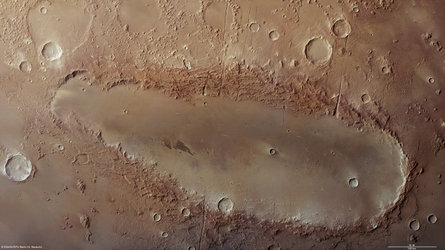
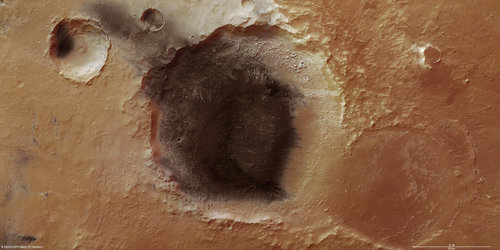
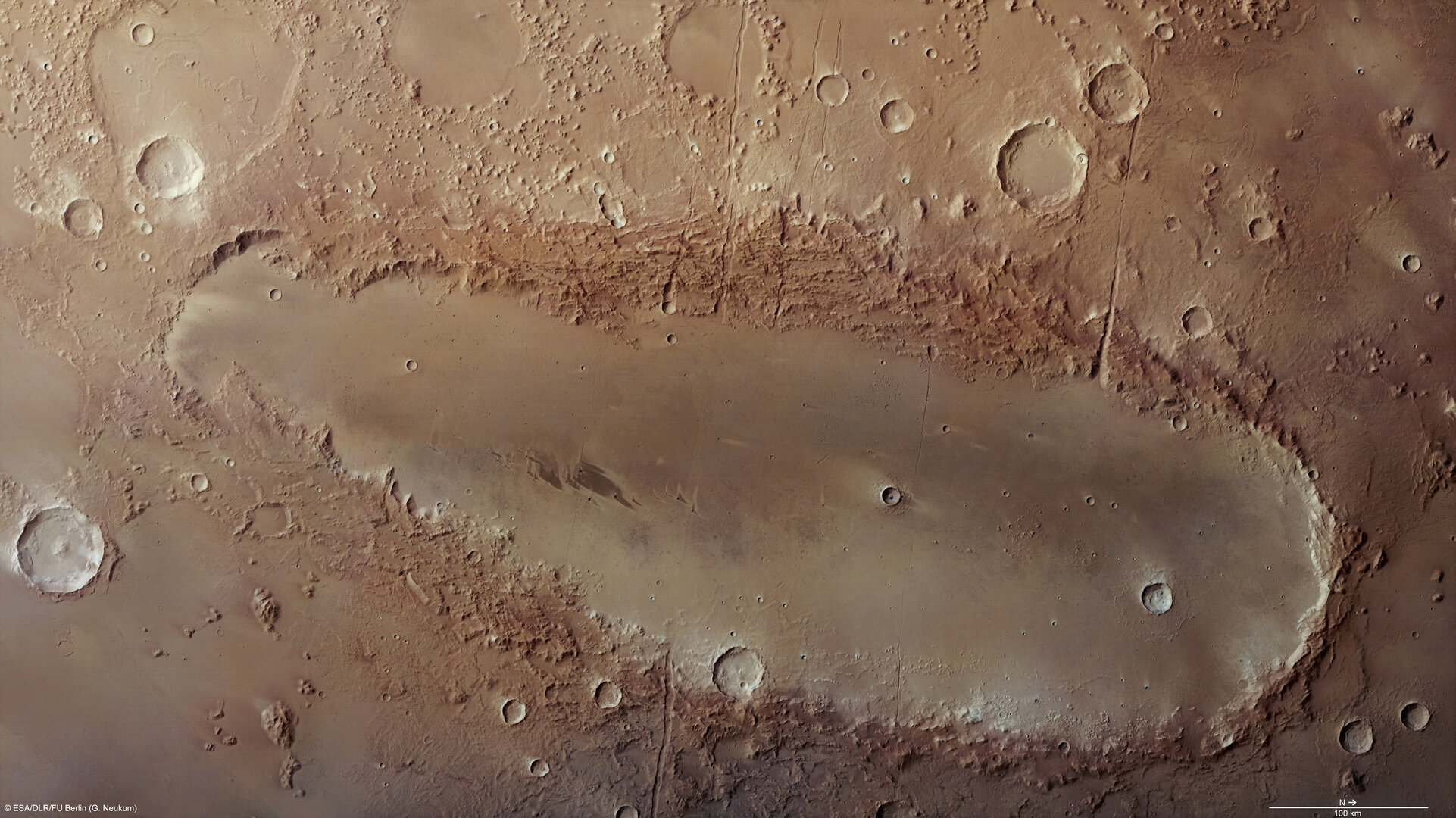
 | Orcus Patera is an enigmatic elliptical depression located between the volcanoes of Elysium Mons and Olympus Mons. This well-defined depression extends approximately 380 km by 140 km in a NNE–SSW direction. It has a rim that rises up to 1800 m above the surrounding plains, while the floor of the depression lies 400–600 m below the surroundings. The term ‘patera’ is used for deep, complex or irregularly shaped volcanic craters such as the Hadriaca Patera and Tyrrhena Patera at the north-eastern margin of the Hellas impact basin. However, despite its name and the fact that it is positioned near volcanoes, the actual origin of Orcus Patera remains unclear.
Credits: ESA/DLR/FU Berlin (G. Neukum) |  |  |  |  |
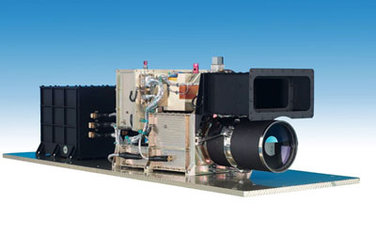
| | | |  | On 5 and 11 October 2005, the High-Resolution Stereo Camera (HRSC) on ESA’s Mars Express spacecraft obtained image data in the Orcus Patera region at approximately 14°N/177°E. The data were acquired during orbits 2216 and 2238 and with a ground resolution of approximately 30 m per pixel.
Credits: NASA MGS MOLA/FU Berlin |  |  |  |  |
| | | |  | Orcus Patera is an enigmatic elliptical depression located between the volcanoes of Elysium Mons and Olympus Mons. This well-defined depression extends approximately 380 km by 140 km in a NNE–SSW direction. It has a rim that rises up to 1800 m above the surrounding plains, while the floor of the depression lies 400–600 m below the surroundings.
Credits: ESA/DLR/FU Berlin (G. Neukum) |  |  |  |  |
| | | |  | Orcus Patera is an enigmatic elliptical depression located between the volcanoes of Elysium Mons and Olympus Mons. This well-defined depression extends approximately 380 km by 140 km in a NNE–SSW direction. It has a rim that rises up to 1800 m above the surrounding plains, while the floor of the depression lies 400–600 m below the surroundings. The straight graben that cut across its rim are clearly seen in this image.
Credits: ESA/DLR/FU Berlin (G. Neukum) |  |  |  |  |
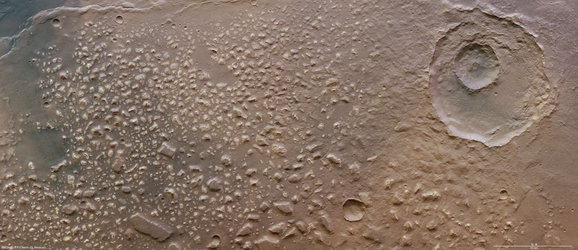
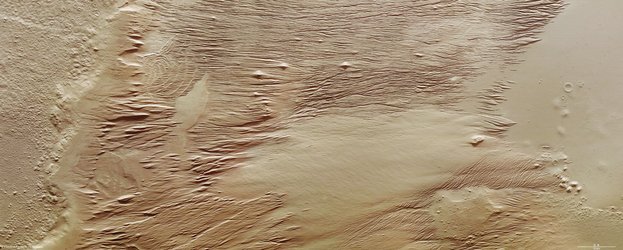
| | | |  | The existence of tectonic forces at Orcus Patera is evident from the numerous large graben that cut across its rim (Box 1) (Note: there is nothing unusual about this as tectonic forces are present everywhere). Up to 2.5 km wide, the graben are oriented roughly east–west and are only visible on the rim and the nearby surroundings. Large graben within the depression are not visible, having been covered by later deposits. However, smaller graben are present (Box 2). They indicate that several tectonic events have occurred in this region and also suggest that multiple episodes of deposition have taken place. The occurrence of ‘wrinkle ridges’ within the depression proves that not just extensional forces, as needed to create graben, but also compressive forces shaped this region (Box 3). The dark shapes near the centre of the depression were probably formed by wind-driven processes (Box 4), where dark material excavated by small impact events in the depression has been redistributed.
Credits: ESA/DLR/FU Berlin (G. Neukum) |  |  |  |  |
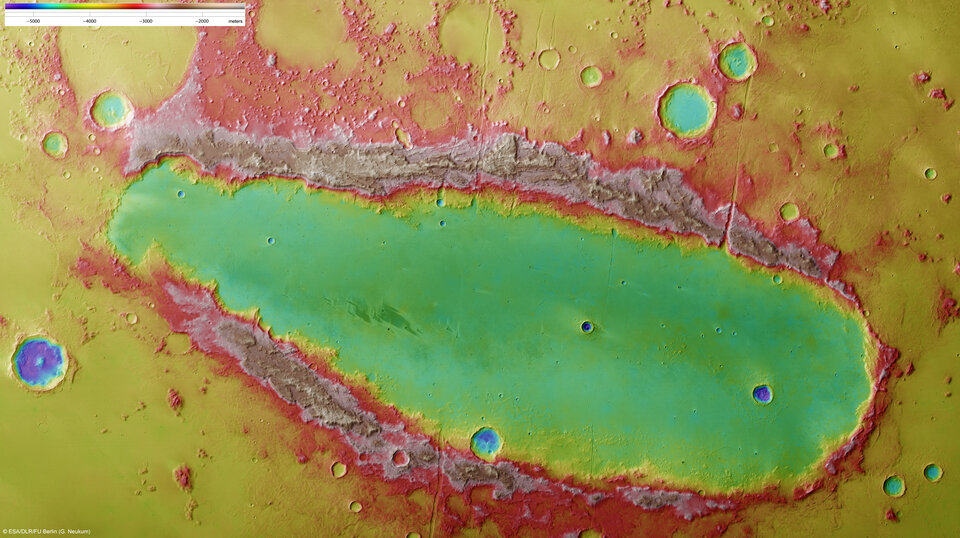
| | | |  | Orcus Patera is an enigmatic elliptical depression located between the volcanoes of Elysium Mons and Olympus Mons. This well-defined depression extends approximately 380 km by 140 km in a NNE–SSW direction. It has a rim that rises up to 1800 m above the surrounding plains, while the floor of the depression lies 400–600 m below the surroundings. This image was created using a Digital Terrain Model (DTM) obtained from the High Resolution Stereo Camera on ESA’s Mars Express spacecraft. Elevation data from the DTM are colour-coded: purple indicates the lowest-lying regions, and beige the higher elevations. The scale is in metres.
Credits: ESA/DLR/FU Berlin (G. Neukum) |  |  |  |  |
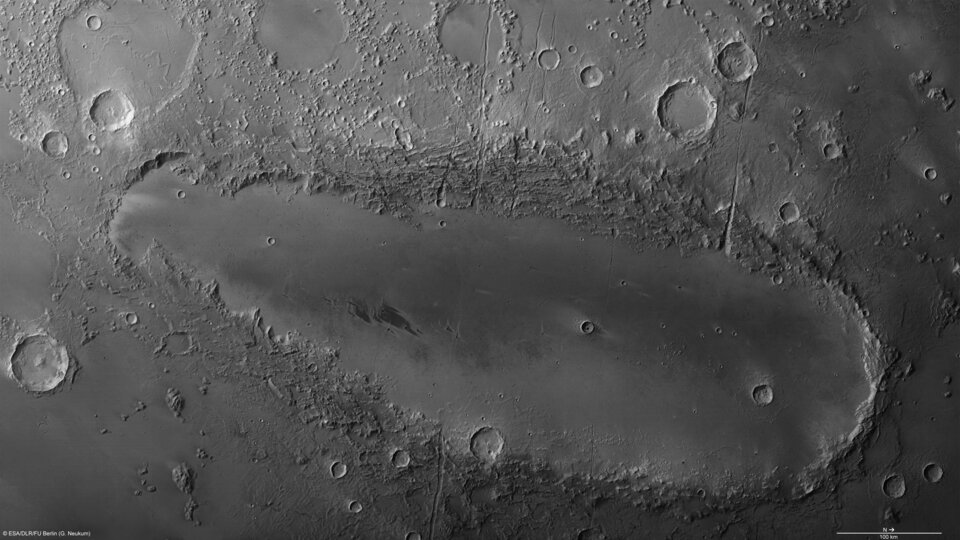
| | | |  | Orcus Patera is an enigmatic elliptical depression located between the volcanoes of Elysium Mons and Olympus Mons. This well-defined depression extends approximately 380 km by 140 km in a NNE–SSW direction. It has a rim that rises up to 1800 m above the surrounding plains, while the floor of the depression lies 400–600 m below the surroundings. The High-Resolution Stereo Camera (HRSC), on ESA’s Mars Express spacecraft obtained image data in the Orcus Patera region on 5 and 11 October 2005. The data were acquired during orbits 2216 and 2238 and this image was derived from the HRSC nadir channel, which provides the highest detail of all the channels.
Credits: ESA/DLR/FU Berlin (G. Neukum) |  |  |  |  |
| | | |  | Orcus Patera is an enigmatic elliptical depression located between the volcanoes of Elysium Mons and Olympus Mons. This well-defined depression extends approximately 380 km by 140 km in a NNE––SSW direction. It has a rim that rises up to 1800 m above the surrounding plains, while the floor of the depression lies 400–600 m below the surroundings. ESA’s Mars Express obtained image data of this region on 5 and 11 October 2005 using the High-Resolution Stereo Camera (HRSC). The data were acquired during orbits 2216 and 2238 and with a ground resolution of approximately 30 m per pixel. Combining data from the nadir channel and one stereo channel of HRSC produced this 3D image. Stereoscopic glasses are required to see the 3D effect.
Credits: ESA/DLR/FU Berlin (G. Neukum) |  |  |  |  |
| |
|  | Mars Express image browser Mars Express on YouTube Traces of Martian lifeRelated articles Mars Express close flybys of martian moon PhobosWind and water have shaped Schiaparelli on MarsLight and dark in the Phoenix LakeMars: how low can you go?Rocky mounds and a plateau on MarsWet era on early Mars was globalVolcanic ash in Meridiani PlanumCraters young and old in Sirenum FossaeCraters, lava flows and tectonic features near Ma'adim VallisCraters and channels in Hephaestus FossaeChaotic terrain in Ariadnes CollesIce-covered martian North PoleThe Euminedes Dorsum mountains on MarsLava deposits in Mangala FossaeRelated links High Resolution Stereo CameraBehind the lens...Frequently asked questionsFor specialists ESA Planetary Science archive (PSA)NASA Planetary Data SystemHRSC data viewer
|