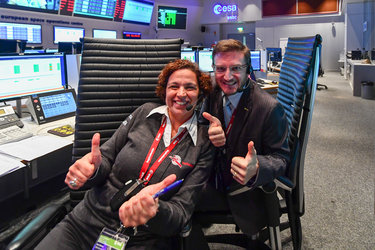
Hear from Philippe Grisard
With a strong foundation in embedded systems and hands-on experience working on Ariane 5 and Ariane 6 at ArianeGroup, Philippe Grisard brought his expertise into the European Space Agency through the Junior Professional (JP) Programme in 2022. In this interview, Philippe reflects on how the JP Programme allowed him to expand beyond his initial field, support teams in navigating evolving software and Agile practices and gain a deeper understanding of the diversity and scale of the European space sector. If you’re looking to kick-start your career in a similarly dynamic and impactful environment, the ESA Junior Professional Programme offers a unique gateway into Europe’s space activities.

What was your educational and professional background before joining the JP Programme?
I graduated in 2018 from an Engineering School in Paris with a Master's degree in Embedded Systems. During those years, I was also doing an apprenticeship at ArianeGroup Les Mureaux, for three years. That gave me the opportunity to work as a Mission Analysis Engineer on both Ariane 5 and Ariane 6. I then transitioned into a full-time role there as a Launcher Software Engineer on Ariane 6.
Can you describe your role as a Junior Professional at ESA and the main projects you worked on?
Since joining ESA in 2022 as a Junior Professional, I have been working as an Agile Software Product Assurance Engineer in TEC-QPS. The programme has given me the opportunity to contribute to more than 20 projects, including Galileo, ISS Payloads, the new Operations Centre in French Guiana, the VEGA-E launcher and multiple activities funded through ESA’s General Support Technology Programme (GSTP) and various small satellites.

What was the most exciting or rewarding part of your work during the programme?
One of the really rewarding parts has been helping people navigate domains they are confronted with but do not yet fully master. Software is increasingly present in the space industry, but many Product Assurance engineers have not had formal training in it. Similarly, Agile methodologies are becoming more common in ESA projects, but not everyone dealing with software activities is familiar with them. It has been deeply fulfilling to organise awareness sessions and trainings during workshops, plenaries and team meetings to help with those topics.
How did being part of the JP Programme help you grow professionally and personally?
Professionally, the programme gave a strong foundation through its structured learning opportunities. On a personal level, being part of a cohort of Junior Professionals was equally valuable. We all came from different fields and backgrounds but shared the same challenges and the same environment together. That sense of community naturally broadens your perspective. You start to see beyond your own domain and develop a bigger picture of how ESA works as a whole. And of course, sharing all those experiences turned this group into more than just colleagues, with genuine friendships forming through the programme.

What kind of mobility, training and development opportunities did you take advantage of during the programme?
The choice of mobility was pretty straightforward in my case. The Space Transportation Quality Office in ESA's HQ Daumesnil site in Paris was required to handle more and more software in its activities, so extra support on this topic was needed. During my six-month rotation there, I provided support to ongoing ground or flight software activities and prepared an action plan on how my section could provide support in the long term after my rotation. Since I had previously worked in industry on launchers, I did not feel the need to go back to industry for my rotation. Instead, I discovered more about other activities inside ESA and was able to immediately make the most out of those six months. This was a great experience, and I am happy to still maintain good relationships with the Space Transportation teams.
What was it like working with experts in your field and being part of an international team at ESA?
Before working at ESA, my experience and idea of space were defined by my experience in ArianeGroup Les Mureaux, which is a large industrial site focused on launchers, and has mainly French speakers. It already felt very grand, with so many opportunities. I did not realise that, upon arriving at ESA, all of this represented only a small fraction of what the space sector really is. Here, people come from everywhere in Europe, adding a huge variety of experience to share. Different industries, different projects, different processes and standards, different expectations. And all of these aspects come with different levels of expertise, which adds even more depth.
It makes you realise your uniqueness in this environment, but at the same time how much you still have to learn from your colleagues and how vast the space industry is.
What has been your most memorable experience at ESA so far?
Attending the VA264 Ariane 6 Launch Campaign in French Guiana in August 2025, without a doubt. The whole event was organised by Arianespace and I got the opportunity to be selected to attend the launch as a VIP. Since 2015, I have been working on Ariane 6 or had some links with related projects, so it was a real honour to see it flying with my own eyes. I will always be extremely grateful for this moment.

How do you feel the programme prepared you for the next steps in your career at ESA?
Being a Junior Professional puts you in a unique hybrid situation. You benefit from a more structured onboarding process with more training, the ability to shadow experienced colleagues and plenty of on-the-job learning. And you are also fully involved in your projects just like any other team member. You encounter a wide variety of contexts, challenges and ways of working than a standard position would rarely offer so early on.
What advice would you give to someone considering applying for the JP Programme?
This is a question that I often got from young people who were interested to join the second cohort of Junior professionals, and it was actually difficult to answer. It seemed like they felt they needed an extraordinary profile to feel comfortable applying or going to an interview. Of course, the programme is a great opportunity, and it needs to be taken seriously because there will be some competition. But first, you should not start by diminishing yourself, as if you do not belong at ESA. The space sector is a much more open domain than people think, and we are actively looking for people with a wide variety of skills and profiles.
So do not hesitate and realise that you can belong at ESA exactly as you are.
If you had to describe the ESA Junior Professional experience in three words, what would they be and why?
Breadth, brought by your projects, rotation and mixed environment.
Growth, through on-the-job learning and personal development.
Belonging, from the close relationships built within the community and your place at ESA.
The Junior Professional Programme
The ESA Junior Professional Programme offers a unique opportunity to launch your career at the heart of Europe’s space activities, working alongside leading experts, contributing to real missions and building a strong international network. Whether your passion lies in engineering, science or beyond, ESA provides a dynamic environment where you can grow, learn and make a tangible impact.