


Moonlight
Going to the Moon was the first step. Staying there is our ambition.
To support Europe’s lunar exploration goals and strengthen its strategic autonomy in space, the European Space Agency (ESA) is developing the Moonlight Lunar Communications and Navigation Services programme.
Moonlight will be Europe’s first commercial telecommunications and navigation service for lunar missions, delivered through a dedicated constellation of satellites around the Moon. By providing essential infrastructure for future lunar missions and operations, Moonlight will act as an enabler for Europe’s wider exploration ambitions, while also supporting the growing global interest in exploring and operating on the Moon.
Possibilities on the Moon
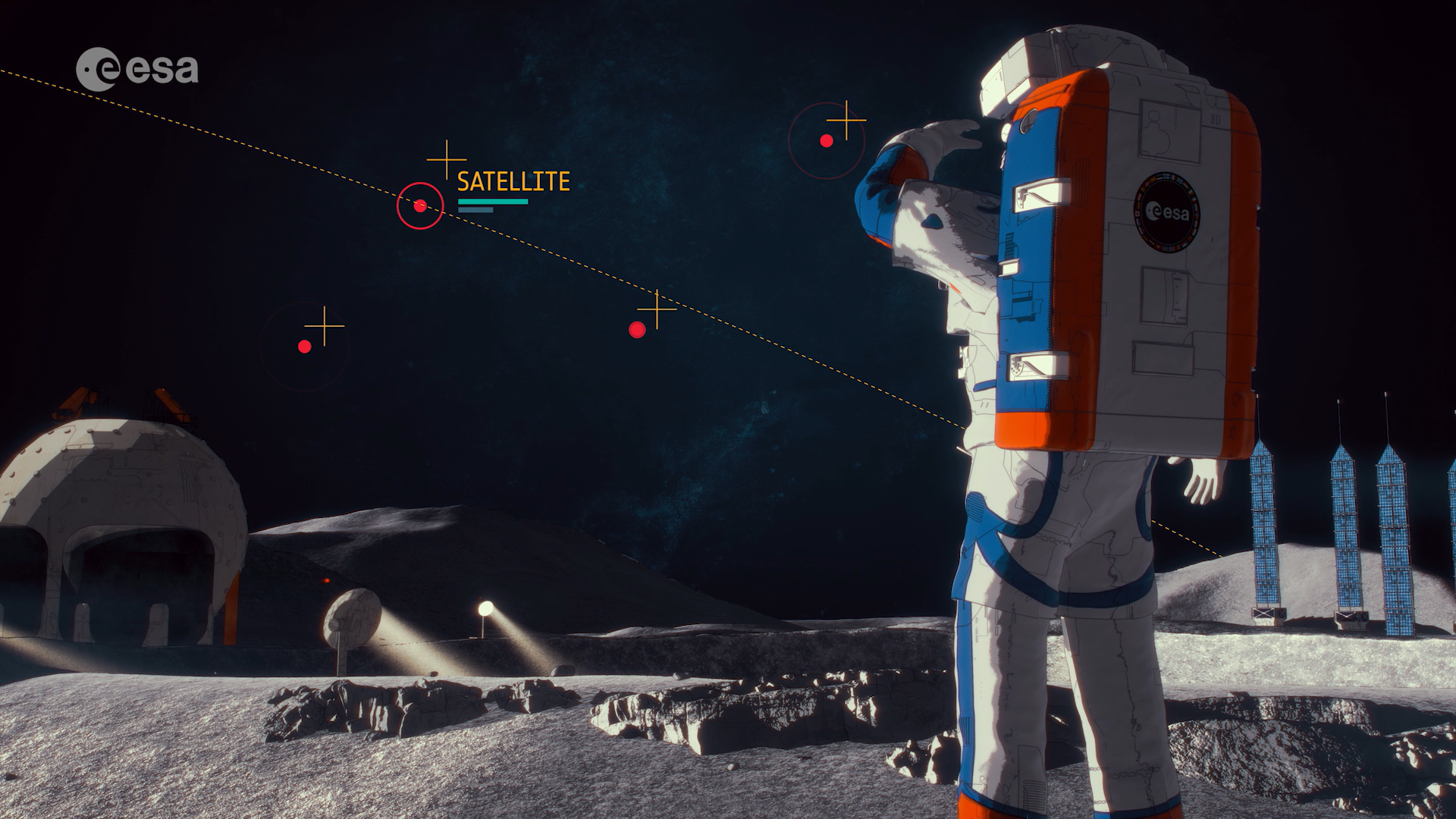
Comprising five satellites – one for telecommunications and four for navigation – the Moonlight constellation will enable high-bandwidth connectivity for services such as smooth Earth-Moon video calls, as well as positioning with precision of up to three metres on the lunar surface.
Navigation will be particularly important as lunar activity increases. Moving equipment and other assets across the Moon can be costly and, for human missions, potentially dangerous. Accurate landing and reliable positioning will therefore be essential, not only for crewed missions, but also for autonomous rovers, landers and other systems operating on the lunar surface.
The lunar south pole

The constellation will be positioned to prioritise coverage of the lunar south pole, a region of particular interest for future operations. Its elevated areas offer near-constant sunlight, a valuable source of power, while permanently shadowed craters may contain water ice that could one day be used to produce water, oxygen and rocket fuel.
While the lunar south pole is interesting, communications in this area can be particularly challenging. The terrain and the Moon’s curvature can prevent a direct line of sight between users on the surface and Earth. Satellites around the Moon can provide the relay needed to maintain reliable links between different points on the lunar surface and with Earth, helping connect missions even where direct communication is not possible.
According to market analysts at Analysys Mason, the lunar economy is projected to reach EUR 188 billion between 2024 and 2034. As more missions, infrastructure and commercial activities move towards the Moon, reliable communications and navigation will become an essential part of this emerging economy. By providing these services as shared infrastructure, Moonlight could help lower the cost and complexity of operating on the lunar surface, making it easier for a wider range of missions and businesses to take part.
European and international collaboration

Access the video
Moonlight is a partnership project between ESA and an industry consortium led by satellite solutions and services supplier Telespazio Italy, with significant financial support from the UK, Italian and Canadian Space Agencies. Additional participating states are Greece, Hungary, Luxembourg, Norway, Portugal, Spain and Switzerland.
Lunar exploration is increasingly a global effort. While Europe is developing its own independent connectivity and positioning infrastructure through Moonlight, ESA is also working closely with international partners to ensure that these capabilities can work alongside and support other lunar services. To this aim, ESA is working with the Japan Aerospace Exploration Agency (JAXA) and the National Aeronautics and Space Administration (NASA) on LunaNet, a framework for lunar connectivity and positioning services.
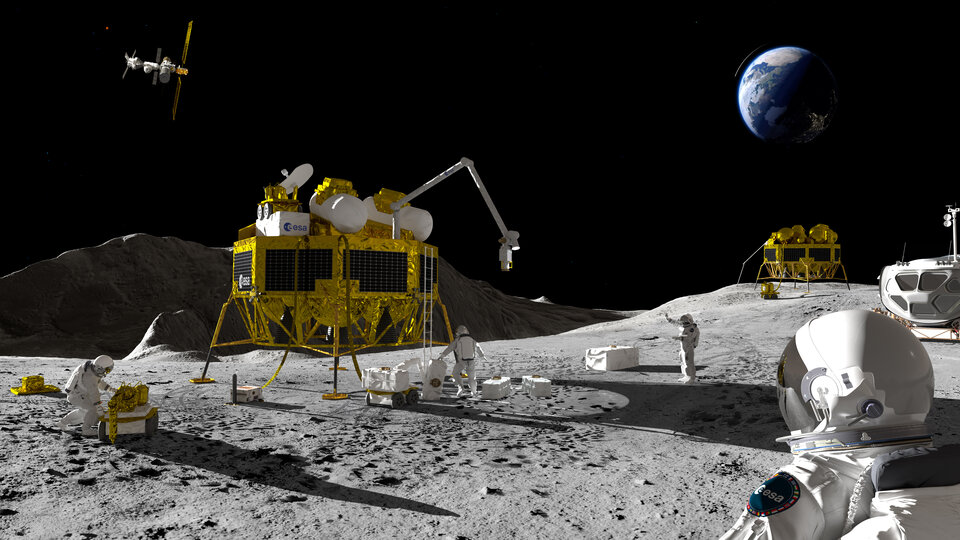
The cooperation will help ensure interoperability with other global lunar services and support the development of complementary advanced technologies and products. It will also make it possible for infrastructure developed through Moonlight to contribute to a broader international environment for lunar exploration.
Moonlight is Europe’s first step towards commercial communications and navigation networks that could one day support living and working beyond Earth. Starting with the Moon, the initiative aims to provide the reliable connectivity and navigation services needed by future missions, infrastructure and commercial activities, helping establish the foundations for increasingly ambitious operations beyond Earth and, ultimately, further into the Solar System.