Neosat: boosting Europe in the geostationary market
The Neosat programme has fostered competitiveness in the European space industry and become the most successful ESA communication satellite programmes so far, managed jointly by the European Space Agency (ESA) and the French space agency, CNES, in partnership with industry.
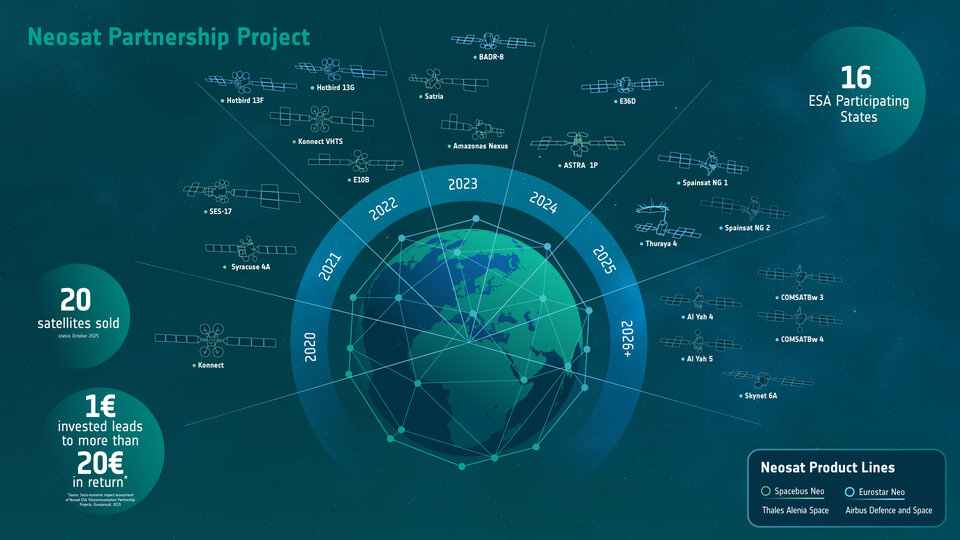
So far, 20 Neosat satellites have been sold – 12 for Eurostar Neo with satellite manufacturer Airbus Defence and Space and 8 for Spacebus Neo with satellite manufacturer Thales Alenia Space. This commercial success can be attributed to ESA’s programme of Advanced Research in Telecommunications Systems (ARTES) and to the French future investment programme ‘PIA’ with the involvement of CNES.
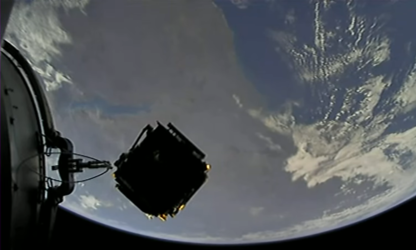
To date, 15 satellites are already in orbit, providing reliable communications services to commercial and institutional operators worldwide and bringing digital services to remote communities.
Though Neosat’s development has concluded, the product lines continue to further establish Europe as a leader in the geostationary satellite communications market and enable new telecommunication services.
Redefining geostationary satellites
The Spacebus Neo and Eurostar Neo platforms offer modular, cost-effective satellite solutions with a lifetime over 15 years. Designed to accommodate a wide range of advanced communication payloads, these satellites benefit from a fast production cycle and are easily customisable to suit the mission requirements of satellite operators.
Neosat's technologies are key to these satellite platforms, especially its electric propulsion and modular design. Electric propulsion reduces the amount of propellant needed, freeing up mass that can be used for more powerful telecommunications missions. This seemingly small improvement meant a complete reinvention of how satellites are built. Additionally, the modular design allows different sections to be manufactured simultaneously, considerably speeding up production times.
The new satellites also mark progress toward better connectivity for all European citizens. They offer very high-throughput satellite solutions which result in fast and reliable broadband speeds, reaching even the most remote areas.
Because they can track moving objects, the new-generation satellites with their state-of-the-art payloads particularly benefit aviation and maritime industries, ensuring that aircraft and ships maintain uninterrupted broadband access even when traveling long distances. This enhances safety and global awareness in the air and at sea through real-time data exchange.
Boosting European industry and economy
Managed jointly by ESA and CNES, and bringing together industrial partners across 16 Member States, Neosat showcases the strength and innovation of European industry. Neosat has generated more than €20 in economic returns for every €1 invested, creating thousands of jobs and fuelling economic growth across Europe.

“Neosat is a showcase for successful cooperation in Europe and demonstrates the power of ESA's Partnership Projects to federate industry around large space projects,” said Laurent Jaffart, ESA Director of Connectivity and Secure Communications. “It is crucial that Europe continues to invest in this high-tech sector to maintain its leadership in geostationary satellite manufacturing and expand its industrial capabilities into other satellite systems.”
“The Neosat product lines illustrate the competitiveness of Thales Alenia Space and Airbus Defence and Space satellites on the geostationary satellite communications market and the ability of the European supply chain to meet the technical challenges inherent in such powerful and versatile satellites,” said Jean-Philippe Taisant, CNES Telecommunication Programme Manager. “As part of its policy of supporting competitive innovation, CNES implemented this project from its conception to its large-scale commercial launch, in the framework of a successful partnership with ESA.”
“Our Spacebus Neo solution is a first-class product in the European telecommunications geostationary market for both civil and defence applications,” said Alcino de Sousa, Senior Vice President Telecommunications at Thales Alenia Space. “Using electric thrusters increases payload capacity, affording greater flexibility for operators. Spacebus Neo is the perfect fit for very-high-throughput satellites, helping to bridge the digital divide across the globe. I would like to sincerely thank ESA and CNES for their continuous support in the development of our various product lines, including our future Space Inspire software-defined solution, which will offer valuable flexibility to telecommunications operators as it will be reprogrammable in orbit.”
“The development of the Eurostar Neo telecommunications satellite family marks a milestone in state-of-the-art technology and in European partnership,” said Elodie Viau, Senior Vice President Telecommunications and Navigation Systems at Airbus Defence Space. “This achievement was made possible through close collaboration with our ESA and CNES partners, and by uniting diverse expertise across European states. The Eurostar Neo product offers best-in-class solutions in a world where connectivity is critical, delivering permanent coverage, worldwide reach and reliable high-throughputs ̶ strengthening Airbus Defence and Space’s position in a highly competitive market."