Development contract for Scout Tango awarded to ISISPACE
The New Space Scout missions were in the spotlight today at the Living Planet Symposium as ESA signed a contract with ISISPACE to develop the Tango mission.
Part of ESA’s FutureEO programme, the Scout missions complement the Earth Explorer missions. However, this new family of missions embraces the New Space era.
Defined by rapid development and low-cost, each Scout mission must be delivered within three years from kick-off to launch and within a budget of just €35 million.

These compact satellites are conceived to deliver cutting-edge science, either by miniaturising existing technologies or by pioneering new ways of observing Earth from space.
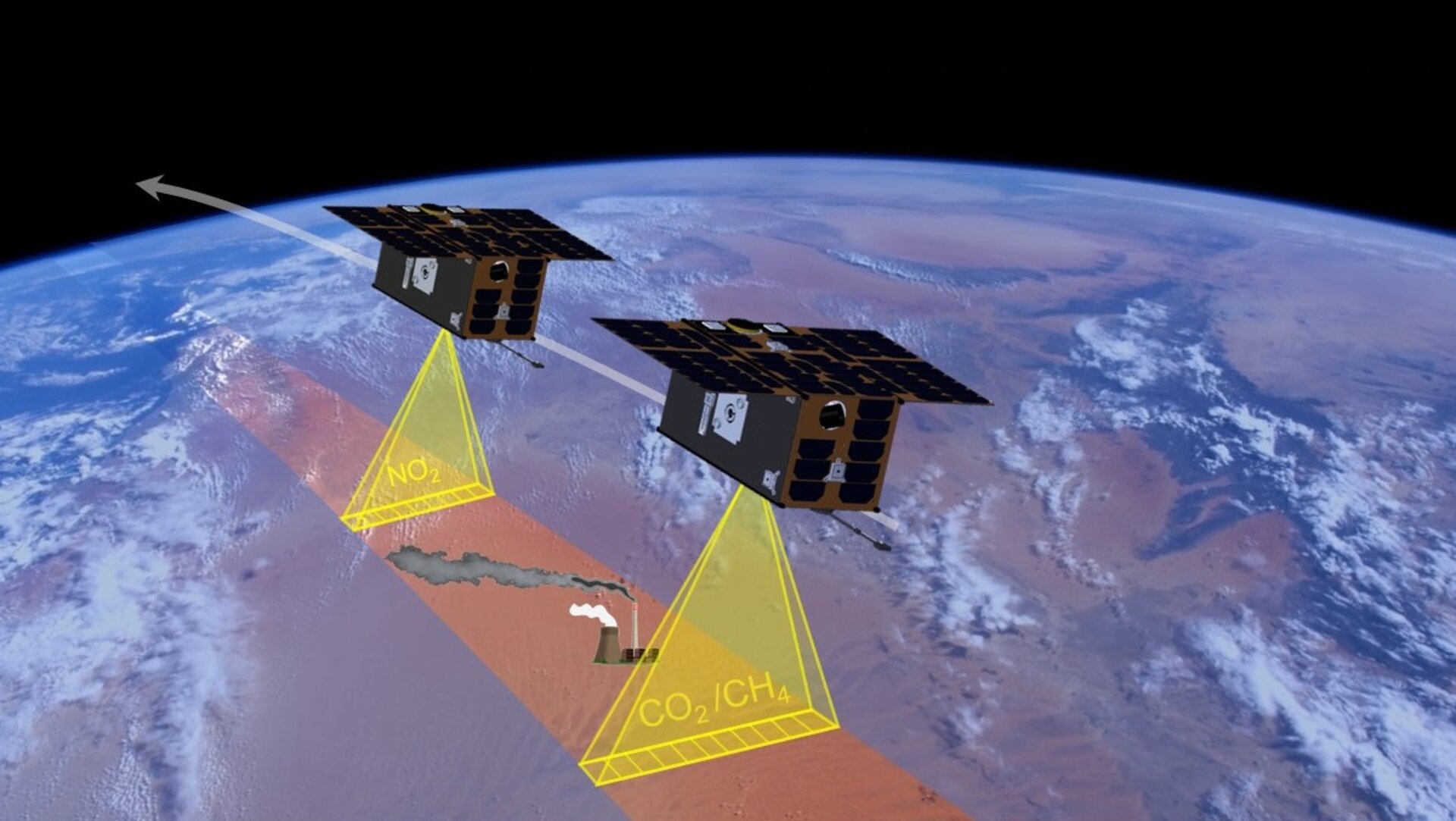
With the industrial contract signed today, ISISPACE kicks off the development and builds the Tango Scout mission, which comprises two 25-kg satellites orbiting in tandem. One of the satellites will measure methane and carbon dioxide, and one will measure nitrogen dioxide.
Tango is set to complement measurements of methane and nitrogen dioxide from the current Copernicus Sentinel-5P and the upcoming Sentinel-5 missions, as well as the Copernicus Carbon Dioxide Monitoring mission which will measure carbon dioxide.
Tango will monitor 150–300 known large industrial facilities and power plants every four days, delivering high-resolution images of emission plumes as well as the surrounding pollution.


Access the video
ESA’s Director of Earth Observation Programmes, Simonetta Cheli, said, “We are very happy to be here today at the Living Planet Symposium with our industrial partner ISISPACE to officially award the contract for the construction of the two Tango satellites.
“As the prime contractor, ISISPACE will lead the development of Tango, supported by fellow Dutch companies TNO and SRON, forming a strong national consortium.
“On the subject of Scout missions, we're also looking forward to the launch of our first Scout, HydroGNSS, later this year. This mission will use signals reflected off Earth’s surface from global navigation satellite systems to enhance our understanding of the water cycle – focusing on key variables such as soil moisture, wetlands and permafrost.
“Alongside HydroGNSS, development is also well underway for our second Scout mission, NanoMagSat.
“Altogether, it’s shaping up to be a very exciting year for the Scout missions – especially as we have also just selected a further four candidates for further study.”