


ESA joins agreement to strengthen global geodesy supply chain
In May, the European Space Agency (ESA) joined the Multilateral Memorandum of Understanding of the United Nations Global Geodetic Centre of Excellence (UN-GGCE). This initiative aims to strengthen the global geodesy supply chain and promote international cooperation to produce reliable geodetic products, which are essential for many satellite applications, including positioning, navigation, and timing (PNT) services.
From monitoring crop yields and tracking natural disasters to enabling navigation, communications and defence capabilities, satellites are critical for many aspects of modern life. Regardless of their size, design or purpose, all satellites depend on two indispensable pieces of information to carry out their task: knowing where they are in space and knowing where on Earth to point at, considering the planet’s shape, orientation and gravity field.
The reference data, known as ‘geodetic products’, is created through a global geodesy supply chain spanning from ground and space-based observatories that monitor Earth and satellite motion, to data centres that collect data, and analysis centres that process that data to make usable products available to the public.

Despite its importance, this supply chain remains fragile, under-resourced and decentralised. A 2024 United Nations report noted that approximately half of the geodetic ground observation stations are no longer fully operational due to ageing and insufficient funding, while the number of geodetic professionals continues to decline. Today, less than 0.05% of the revenue generated by global navigation satellite systems and Earth observation services are reinvested in the global geodesy supply chain.
ESA has actively contributed to the supply chain for more than two decades and has been key in raising the awareness of its current state. To help further address this imbalance, ESA has joined a growing network of national and international partners coordinated by the UN-GGCE. Created in 2020, the UN-GGCE assists Member States and geodetic organisations to coordinate and collaborate to sustain an accurate, accessible and sustainable geodetic reference frame.
Operational since March 2025, the Multilateral Memorandum of Understand was signed by Francisco-Javier Benedicto-Ruiz, ESA Director of Navigation, and Rolf Densing, ESA Director of Operations in May. The memorandum is structured in two main phases: first, it aims to avoid degradation of the supply chain, and second, to build long-term resilience.
The global geodesy supply chain is inherently cooperative. No single nation can generate it on its own, so collaboration is essential. By joining the Multilateral Memorandum of Understanding, ESA is committing to both strengthening the global geodesy supply chain and international cooperation.
“The geodesy supply chain is at the core of PNT but is also essential for Earth science, and societal applications. This includes sea-level and climate change monitoring, natural hazard and disaster management, and sustainable development. Establishing accurate and stable reference frames on Earth and in space is critical and increasingly in demand,” says Javier Benedicto, ESA Director of Navigation.
Through this collaboration, ESA will contribute to enhancing the reliability, sustainability, and global coordination of geodetic infrastructure, which will also support Europe’s satellite missions, from Earth observation to navigation.
ESA’s Navigation Support Office
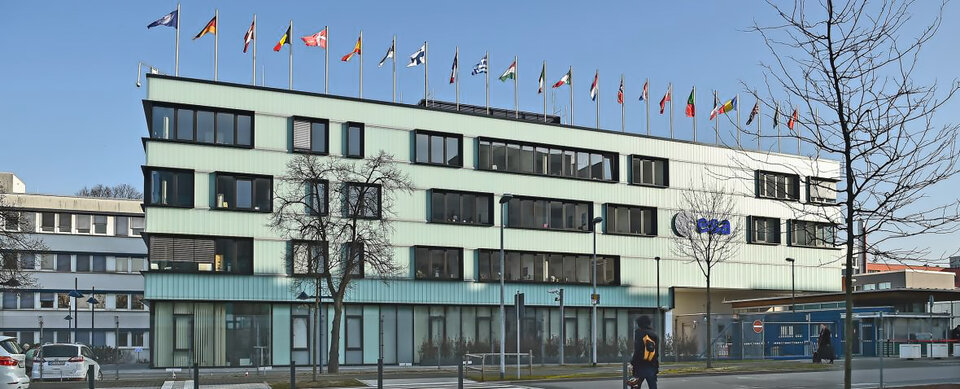
Based at the European Space Operations Centre (ESOC), the Navigation Support Office is ESA’s centre of excellence for precise navigation and geodesy.
As ESA’s geodetic service provider, the office provides the spatial reference for ESA missions. Given that this reference fundamentally relies on the global geodetic infrastructure, the Navigation Support Office is also a key contributor to the global geodesy supply chain, operating analysis centres for all four space-geodetic techniques. In this role, it acts as ESA’s interface with the geodetic community and coordinates ESA’s contributions.
The Navigation Support Office ensures ESA’s access to global spatial references, forming the foundation for PNT and thereby safeguarding ESA’s space operations.
ESA’s Genesis mission

Looking ahead, ESA’s Genesis mission will contribute significantly to advancing accuracy, interoperability and long-term resilience of the global geodesy supply chain, which is recognised by the United Nations for its essential role in global geospatial infrastructure.
By collocating and synchronising the main geodetic techniques on a single satellite, Genesis will help identify the biases of the different techniques, ultimately leading to more precise geodetic products, including a more accurate ITRF. Lessons learned and improvements from the Genesis mission will further advance ESA's contributions to the geodesy supply chain.
After passing preliminary design review in December 2025, Genesis models are being built and tested in preparation for the critical design review starting later this year. In parallel, ESA is regularly working with representatives from the scientific community and all the geodetic services to test and calibrate Genesis and to develop data tools to process and utilise Genesis’ data. This collaboration will maximise Genesis’ impact on the global geodesy supply chain.
About Genesis
Genesis is a mission of the FutureNAV programme, an optional ESA Navigation programme with support from Italy, Belgium, Germany, France, Switzerland, Hungary, Finland and the UK.
Genesis aims to significantly contribute to improving the accuracy and stability of the International Terrestrial Reference Frame (ITRF), which serves as a reference for all space- and ground-based observations for navigation and Earth sciences. Improving the ITRF will impact navigation applications such as aviation, autonomous vehicle driving and traffic management. In Earth sciences it will help refine models used for climate and environmental monitoring and much more.
Genesis's extreme accuracy is achieved by co-locating the four geodetic (Earth-measuring) techniques (satellite navigation, very-long-baseline interferometry, satellite laser ranging and DORIS) onboard one well calibrated satellite that acts as a flying observatory. The instruments will be synchronized by an ultra-stable oscillator (USO).
For more information, visit www.esa.int/Genesis