

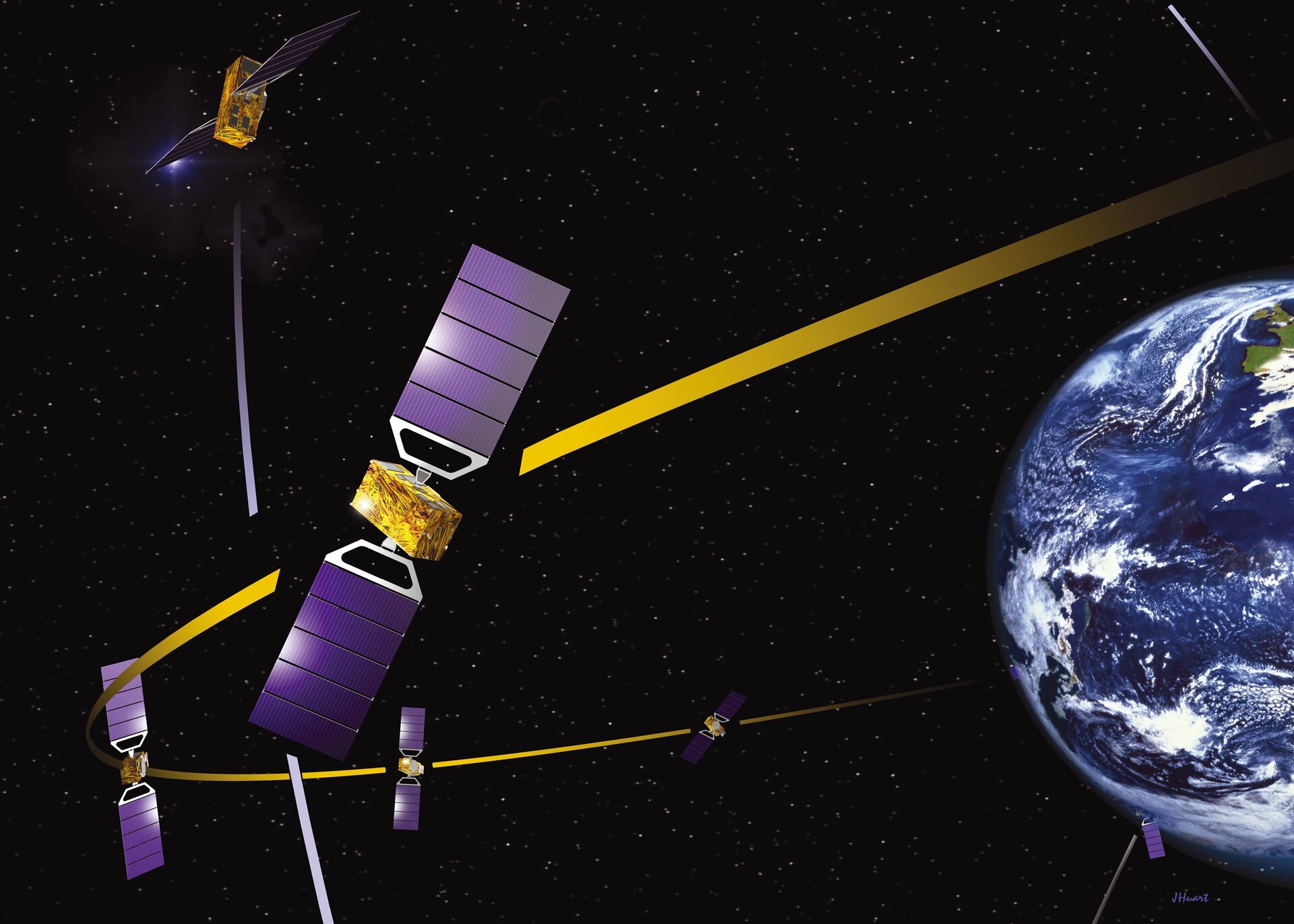
Galileo spacecraft
The Galileo System will be an independent, global, European-controlled, satellite-based navigation system and will provide a number of guaranteed services to users equipped with Galileo-compatible receivers.
System overview
The Galileo system will provide navigation and Search and Rescue services on a global base.
Ten navigation signals and one Search and Rescue signal are generated by the satellite constellation.
| Galileo navigation signal emission | |
|---|---|
| Signals transmitted | Frequency range |
| 4 | 1164-1215 MHz (E5a-E5b) |
| 3 | 1260-1300 MHz (E6) |
| 3 | 1559-1591 MHz (L1) |
The following Galileo Satellite-only services will be provided worldwide and independently from other systems by combining Galileo Signals in Space:
- The Open Service (OS) results from a combination of open signals, free of user charge, and provides position and timing performance competitive with other GNSS systems.
- The Safety of Life Service (SoL) improves the open service performance through the provision of timely warnings to the user when it fails to meet certain margins of accuracy (integrity). It is envisaged that a service guarantee will be provided for this service.
- The Commercial Service (CS) provides access to two additional signals, to allow for a higher data throughput rate and to enable users to improve accuracy. It is envisaged that a service guarantee will be provided for this service.
- The Public Regulated Service (PRS) provides position and timing to specific users requiring a high continuity of service, with controlled access. Two PRS navigation signals with encrypted ranging codes and data will be available.
- The Galileo support to the Search and Rescue service represents the contribution of Europe to the international COSPAS-SARSAT co-operative effort on humanitarian Search and Rescue activities.
Satellite Overview
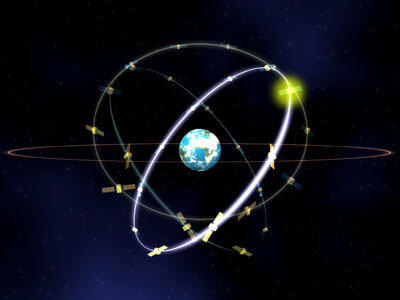
The Galileo Space Segment will comprise a constellation of a total of 30 MEO satellites, of which 3 are spares, in a so-called Walker 27/3/1 constellation. Each satellite will broadcast precise time signals, ephemeris and other data. The Galileo satellite constellation has been optimised to the following nominal constellation specifications:
- Circular orbits with a semi-major axis of 29 994 km (which corresponds to 23 616 km altitude)
- Orbital inclination of 56°
- Three equally spaced orbital planes
- Nine operational satellites, equally spaced in each plane
- One spare satellite (also transmitting) in each plane.
The Galileo satellite is a 700 Kg/1600 W class satellite.
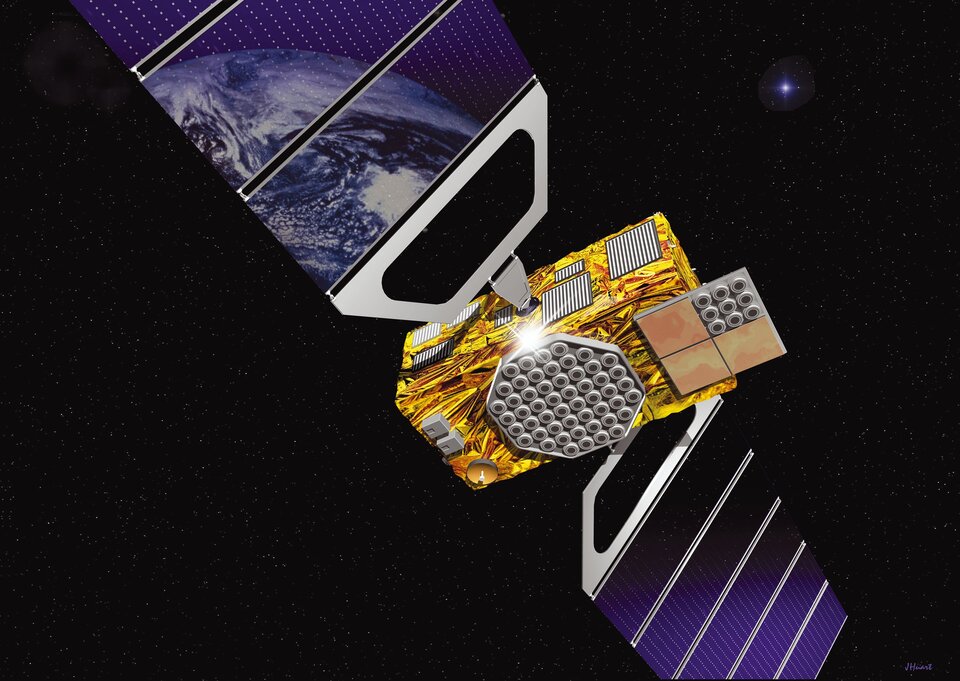
The image shows an artist's impression of a Galileo spacecraft in orbit with solar arrays deployed. The spacecraft rotates about its Earth-pointing axis so that the flat surface of the solar arrays always faces the Sun to collect maximum solar energy. The antennas, shown on the underside of the bus in the picture, always point towards the Earth. The spacecraft bus measures 2.7 x 1.1 x 1.2m and the deployed solar arrays span 13m.
Spacecraft components
The L-band antenna transmits the navigation signals in the 1200-1600 MHz frequency range.
The S&R (search and rescue) antenna picks up distress signals from a beacon on Earth and transmits it to a ground station for forwarding to local rescue services.
The C-band antenna receives signals from Galileo Uplink Stations containing mission data. This includes data to synchronise the on-board clocks with a ground-based reference clock and integrity data which contains information about how well each satellite is functioning. The integrity information is incorporated into the navigation signal for transmission to users.
Two S-band antennas are part of the telemetry, tracking and command subsystem. They transmit housekeeping data about the payload and spacecraft to ground control and, in turn, receive commands to control the spacecraft and operate the payload. The S-band antennas also receive, process and transmit ranging signals that measure the satellite's altitude to within a few metres.
The IR Earth sensors and the FSS Sun sensors both help to keep the spacecraft pointing at the Earth. The IR Earth sensors do this by detecting the contrast between the cold of deep space and the heat of the Earth's atmosphere. The FSS Sun sensors are visible light detectors which measure angles between their mounting base and incident sunlight.
The laser retro-reflector measures the satellite's altitude to within a few centimetres by reflecting a laser beam transmitted by a ground station. The laser retro-reflector is used only about once a year, as altitude measurements via S-band antenna ranging signals are otherwise accurate enough.
The space radiators are heat exchangers that radiate waste heat, produced by the units inside the spacecraft, to deep space and thus help to keep the units within their operational temperature range.
Interior: Payload
A passive maser clock is the master clock on board the spacecraft. It is an atomic clock which uses the ultra stable 1.4Ghz transition in a hydrogen atom to measure time to within 0.45ns over 12 hours.
A rubidium clock will be used should the maser clock fail. It is accurate to within 1.8ns over 12 hours.
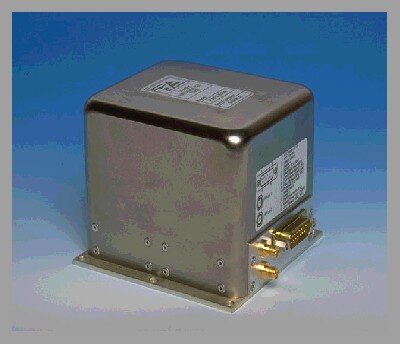
The spacecraft has four clocks, two of each type. At any time, only one of each type is operating. Under normal conditions, the operating maser clock produces the reference frequency from which the navigation signal is generated. Should the maser clock fail, however, the operating rubidium clock will take over instantaneously and the two reserve clocks will start up. If the problem with the failed maser clock is unique to that clock and not a basic design fault (the maser clocks are an innovative design especially for Galileo), the second maser clock will take over from the rubidium clock after a few days when it is fully operational. The rubidium clock will then go on stand-by or reserve again. In this way, by having four clocks, the Galileo spacecraft is guaranteed to generate a navigation signal at all times.
The clock monitoring and control unit provides the interface between the four clocks and the navigation signal generator unit (NSU). It passes the signal from the active master clock to the NSU and also ensures that the frequencies produced by the master clock and the active spare are in phase, so that the spare can take over instantly should the master clock fail.
The navigation signal generator, frequency generator and up-conversion units are in charge of generating the navigation signals using input from the clock monitoring unit and the up-linked navigation and integrity data from the C-band antenna. The navigation signals are converted to the L-band for broadcast to users.
The remote terminal unit is the interface between all the payload units and the on-board computer.
Interior: service module
SADM is the drive mechanism that connects the solar arrays to the spacecraft and rotates them slowly so that the surface of the arrays can remain perpendicular to the Sun's rays at all times.
The gyroscopes measure the angular velocity of the spacecraft.
The reaction wheels control the rotation of the spacecraft. When they rotate, so does the spacecraft. It rotates twice per orbit to allow the solar arrays to remain parallel to the Sun's rays.
The magneto bar modifies the speed of rotation of the reaction wheels by introducing a torque (turning force) in the opposite direction.
The power conditioning and distribution unit regulates and controls power from the solar arrays and batteries and distributes it to all the spacecraft's subsystems and payload.
The on-board computer controls all aspects of spacecraft and payload functioning.
| Spacecraft facts and figures | |
|---|---|
| Spacecraft bus dimensions | 2.7 x 1.1 x 1.2 m |
| Solar array span | 13m |
| Peak power | 1600 W |
| Navigation signals | 10 signals transmitted in 1200-1600 MHz range |
| Launch mass | 700kg |