ExoMars journey
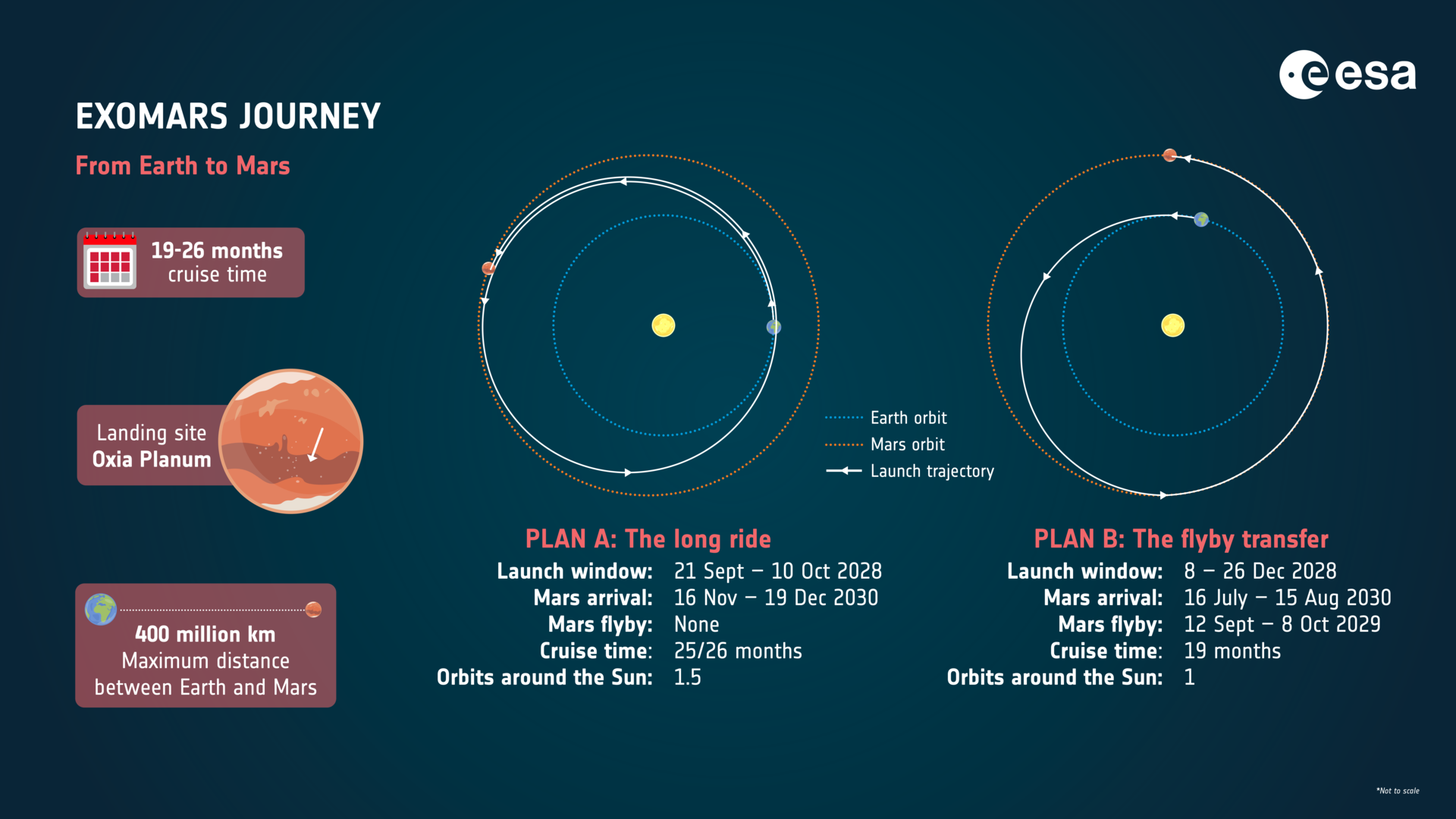
Infographic detailing the two approaching strategies from Earth to Mars for the ExoMars Rosalind Franklin mission.
ExoMars’s two possible launch windows will be in September and December 2028, followed by a two-year journey to Mars.
While the spacecraft won’t take the fastest route, the timing is crucial for the rover’s science mission and survival at the Red Planet. The Rosalind Franklin rover needs to complete its primary operations before Mars's global dust storms begin. Avoiding dark seasons during autumn and winter in Mars’s northern hemisphere will help the rover to produce more power, work more hours and perform more science.
The European Space Agency will embark on its most ambitious exploration venture to find signs of life on Mars – the ExoMars Rosalind Franklin mission. At its heart is an autonomous European rover designed to drill deeper than any previous mission, up to two metres beneath the surface.