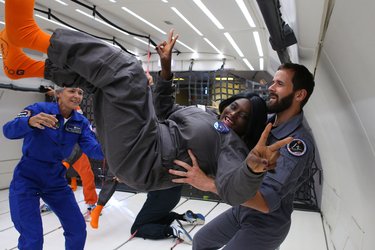
Exploring gravity's effects: parabolic flights
Space missions come with a unique set of challenges, including the effects of microgravity on astronaut activities. While these challenges are faced by all astronauts, the specific effects of microgravity on individuals with physical disabilities had not been examined – until now.
Fly! is an ESA’s initiative to improve our understanding of, and overcome, the barriers spaceflight presents for astronauts with a physical disability.
The Feasibility Study involved member of the ESA astronaut reserve John McFall in a parabolic flight campaign to evaluate how microgravity affects an astronaut with a physical disability and develop strategies to ensure their full integration in space missions.
Parabolic flights provide short periods of a low-gravity environment, or 'weightlessness'. Each parabola lasts approximately 22 seconds, allowing participants and experiments on the plane to experience conditions similar to those encountered by astronauts in orbit.
The Fly! Initiative includes two parabolic flight campaigns. The first one took place in April 2024 to assess essential capabilities for an astronaut with a physical disability, such as movement, stabilisation and performing Cardiopulmonary Resuscitation (CPR).
The second campaign, scheduled for May 2025, will focus on optimising prosthetic hardware to ensure it fits comfortably and functions effectively across all mission phases where prostheses are required.