Einstein ring explained
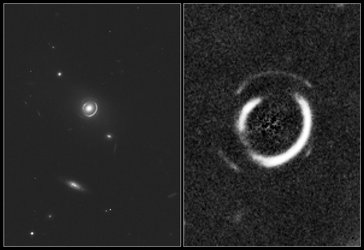
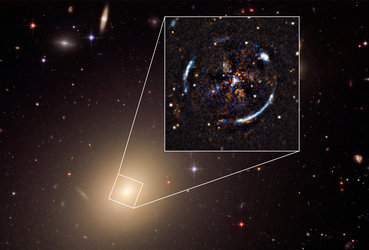
When we observe a distant galaxy with our telescope, its light may encounter another galaxy on its way to us. The foreground galaxy acts like a magnifying lens, bending the travelling light rays due to its gravity. This is called gravitational lensing. If the background galaxy, the lensing galaxy, and the telescope are perfectly aligned, the image appears as a ring – called an Einstein ring. Einstein rings were first theorised to exist by Einstein in his general theory of relativity.
[Image Description: Against a dark blue background, this infographic contains a paragraph of text in the top left corner, the logo of ESA in the top right corner and a succession of graphics in the bottom half of the image. The text paragraph explains the principle behind Einstein rings, and it can be read in the image caption. The graphics below it illustrate this astrophysical phenomenon, and by looking at them from left to right we can understand the process of how Einstein rings are formed.
The left-most element in the bottom half of the image is a graphic representation of a galaxy, labelled ‘distant galaxy’. To the right of it, another galaxy is shown, labelled ‘Foreground galaxy acting as a magnifying lens’. The third illustration, to the right of the previous one, shows ESA’s Euclid space telescope and is labelled ‘Telescope’. The ‘distant galaxy’ and the ‘Telescope’ are connected by two lines that form an elongated diamond-shape around the ‘Foreground galaxy’. This line is labelled ‘Gravity bends the light rays of the distant galaxy’. The fourth and last illustration in the line shows a ring of light around a central disk and is labelled ‘What the telescope sees’.]