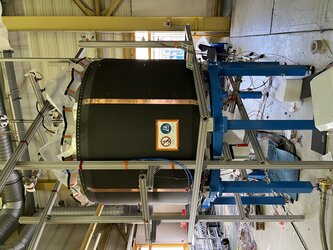
First full-scale Phoebus linerless oxygen tank
Phoebus full-scale linerless carbon-fibre reinforced-plastic oxygen tank finished production at MT Aerospace in Augsburg, Germany, 2025.
Phoebus is a European Space Agency (ESA) project together with ArianeGroup and MT Aerospace. It aims to assess the feasibility and benefits of replacing the metallic tanks on ESA’s Ariane 6 upper stage with carbon-fibre reinforced-plastic tanks. While this lightweight material offers the possibility of saving several tonnes of mass, such an approach has never been implemented before and presents significant technical challenges.
The central core of ESA’s Ariane 6 rocket runs on liquid oxygen and liquid hydrogen, two very different molecules, so the Phoebus project is developing and producing two versions of the same carbon fibre tank concept. Liquid oxygen is cooled and stored to –180 °C, a highly reactive and possibly corrosive propellant. Phoebus has already proved it is possible to use carbon fibre tanks for liquid oxygen storage: small demonstration ‘bottle’ tanks have shown that even without a protective liner, carbon fibre reinforced-plastic can hold oxygen in liquid form without leaking nor reacting.
After the 2019 demonstration of holding liquid oxygen in a 2-metre tank, further tests were a great success. The Phoebus team has found the right reinforcing plastic resin to resist both oxygen corrosion and the cold temperatures and figured out how to lay the carbon fibre so that they can bear the extreme conditions without cracking.
Phoebus is part of ESA’s Future Launchers Preparatory Programme (FLPP), that helps develop the technology for future for space transportation systems. By conceiving, designing and investing in technology that doesn’t exist yet, this programme is reducing the risk entailed in developing untried and unproven projects for space.