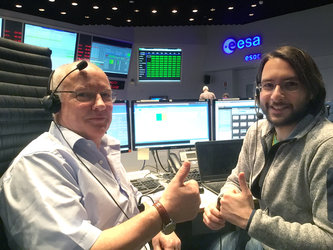
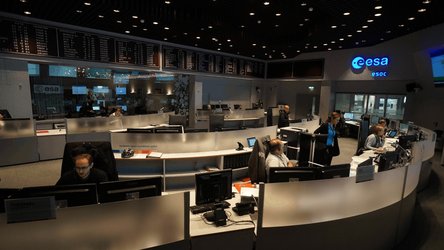
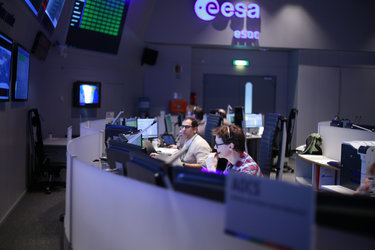
Space weather simulation exercice at ESOC
Before every ESA launch, mission teams undergo a rigorous simulation phase which rehearses the first moments of a satellite in space, while preparing mission control for any anomaly. Since mid-September, teams at ESA’s European Space Operations Centre (ESOC) have been immersed in simulations for Sentinel-1D, scheduled for launch on 4 November 2025.
To model one of the most extreme scenarios, simulation officers drew inspiration from the infamous Carrington event of 1859, the strongest geomagnetic storm ever recorded. The exercise replicated the effects of a catastrophic solar storm on satellite operations to test the team’s ability to respond without satellite navigation and under severe electronic disruption.
This campaign included a rare activation by ESA’s Space Weather Office of its Space Safety Centre, inaugurated in 2022 as part of ESA’s growing commitment to space safety. ESA’s Space Debris Office and the spacecraft operation managers of other ESA Earth-orbiting missions also joined the exercise to enhance realism, simulating cross-mission impacts and coordination.
ESA’s Space Safety Centre played a central role in the exercise and is a key asset in Europe’s preparedness for extreme solar storms. The simulation will provide critical insights for the constitution of European-wide space weather operational services, helping refine procedures and improve resilience.