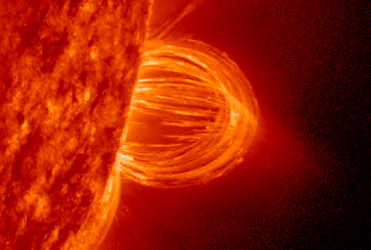
Solar flare observed on 11 November 2025
Activity on the surface of the Sun generates space weather that spreads outwards, across the Solar System. Earlier this week, two strong, X-type flares have been observed from the same solar active region (NOAA AR 14274) and have generated two coronal mass ejection (CME) that arrived at Earth this morning triggering moderate geomagnetic disturbance.
On 11 November, a more powerful, X5.1-class solar flare was observed, with a peak around 10:04 UTC. Following the flare, shock waves have been observed on the solar surface radiating away from the active region. Major solar flares of this type are known to impact radio communication and satellite navigation applications (GNSS) in the areas facing the Sun at the moment of the event.
The image shows an observation of the Sun in extreme ultraviolet, as seen by the Solar Dynamics Observatory’s AIA instrument on 11 November, provided by the Royal Observatory of Belgium / SIDC.
This was followed less than an hour later with the observation of a coronal mass ejection (CME) by SOHO’s LASCO and GOES-19’s CCOR-1 coronagraphs. Our initial observations see CME is traveling at speeds around 1500 km/s, with an arrival Earth on 12 November in the late evening, or on 13 November in the early morning. The impact of the resulting geomagnetic storm is estimated to be severe and might affect satellites, power grids, and navigation systems. The event does not pose a direct biological risk to people on Earth.
The European Space Agency (ESA) is closely monitoring this powerful space weather event and is collecting detailed information from all its expert service centres. The following description is based on the information currently available and might be subject to change.