Nearby star-forming FEAST galaxies
Astronomers using the NASA/ESA/CSA James Webb Space Telescope together with the NASA/ESA Hubble Space Telescope have looked deeply at thousands of young star clusters in four nearby galaxies, studying clusters at different stages of evolution. Their findings show that more massive star clusters emerge more quickly from the clouds they are born in, clearing away gas and filling the galaxy with ultraviolet light. The result gives us a more detailed understanding of star formation in galaxies, as well as how and where planets can form.
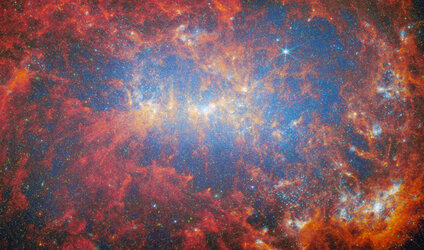
This image shows the four galaxies studied in this research, each of which has previously been the subject of a Picture of the Month: Messier 51 (top left), Messier 83 (top right), NGC 4449 (bottom left), and NGC 628 (bottom right).
[Image description: A collage featuring four images of spiral galaxies observed by Webb. Blue colours, especially in the centre of the galaxies, are near-infrared light that show the location of bright stars. Orange and yellow show ionised gas and red colours come from complex molecules and dust grains; these are longer mid-infrared wavelengths. They trace out the spiral arms of each galaxy as a network of filaments with cavities in between.]