Sentinel-1 interferometry highlights fractures of Petermann ice tongue
Europe’s Copernicus Sentinel-1 mission has captured a dramatic change at Petermann Glacier in northwest Greenland, where a 76 sq km section of the glacier’s floating ice tongue broke away on 4 August 2026. The event marks the glacier’s largest loss of floating ice since 2012 and the most significant calving event in the Arctic since 2020 – revealing once again how rapidly Earth’s polar landscapes can change.
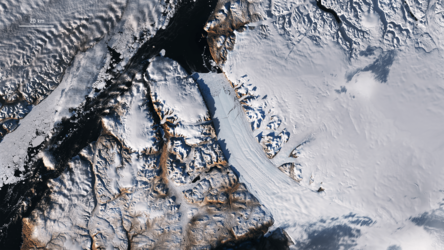
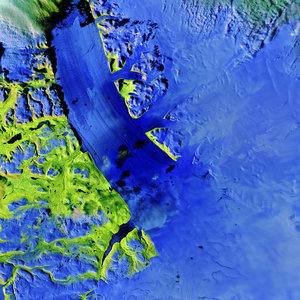
The image here shows an optical image of the Petermann glacier from Sentinel-2 (left) and an interferogram from Sentinel-1 (right), which reveals deformation and fractures within the ice tongue, providing a detailed picture of changes that had developed by April 2026, almost four months prior to the calving. The interferogram was made possible because of one-day repeat Sentinel-1 synthetic aperture radar images captured in the Sentinel-1C and Sentinel-1D tandem phase during the commissioning of the newly launched Sentinel-1D satellite. These data allowed very detailed measurements of fracture propagation across the ice shelf, and ice tongue surface motion with ocean tides, in the lead up to the iceberg calving event.
Read full story: Sentinel-1 captures major ice loss from Greenland glacier