Decagon on Saturn’s south pole (colour image)
Two views of Saturn from the NASA/ESA Hubble Space Telescope reveal a giant, evolving 10-sided atmospheric wave encircling the planet’s south pole. The feature, called a decagon, is the first large, regular-sided pattern observed at Saturn’s southern hemisphere.
By comparing observations taken over several years, researchers found that the pattern has become increasingly distinct since 2023, suggesting they may be witnessing a new atmospheric phenomenon develop on the gas giant. The observations were made as part of Hubble’s Outer Planet Atmosphere’s Legacy (OPAL) program, which has monitored Jupiter, Saturn, Uranus, and Neptune for more than a decade.
The “X” and dashed circle in the image on the right represent where data was not captured by Hubble.
[Image description: Side-by-side comparison of two views of the gas giant Saturn, labeled “August 29, 2025” at the top left corner. At left is a straight-on view of Saturn, a globe with pale yellow horizontal bands at the equator and orange and pink at the mid-latitudes. Some bands towards the north and south pole have a light blue hue. There are prominent horizontal rings circling at the equator. At right, labeled “Saturn’s south pole,” the south-polar view of Saturn shows concentric bands in its atmosphere, mostly tan and orange, surrounding a dark central region that has a 10-sided outline. A small, dashed circle at the very centre of the pole with an “X” inside denotes missing data.]

Decagon on Saturn’s south pole (single filter image)

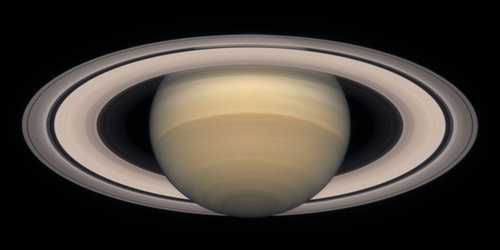
Saturn (2024 Webb and Hubble images)

Saturn and its northern auroras (composite image)
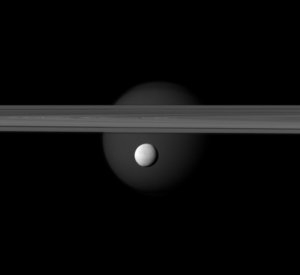
Saturn’s rings, Titan and Enceladus