Destination sighted: Hera's first glimpse of Didymos
Exactly two years after launch, ESA’s Hera planetary defence mission has caught its first glimpse of its destination: the Didymos binary asteroid system, seen from an approximate distance of 236 500 km away.
By combining multiple images and performing photometric analysis, the Hera mission team was able to identify Didymos against the background star field, seen in visible light, smaller than an individual pixel but sufficiently bright to be detected by the camera.
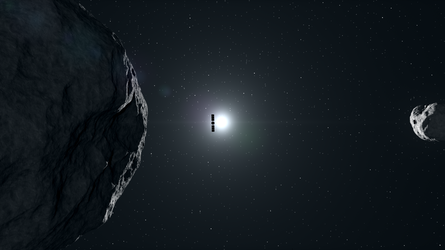
For now, Hera’s destination appears as little more than a single bright point. In reality, it is a binary asteroid system: the 780-m-diameter Didymos is orbited by the 150-m-diameter Dimorphos. In September 2022, NASA’s DART spacecraft deliberately impacted Dimorphos, changing its orbit around Didymos and demonstrating asteroid deflection for the first time.
Hera will have to travel much closer before its cameras can resolve the two asteroids separately. But from now on, its destination is no longer just a calculated point in space: Hera can see it.
When Hera reaches Didymos, it will perform a close-up investigation of the impact site and measure in detail how Dimorphos responded to DART’s collision.
These measurements will help turn the DART impact experiment into a well-understood and potentially repeatable planetary defence technique.
Have questions about Hera, its journey or what awaits it at Didymos? Ask the Hera Space Companion — an AI companion connected to the mission and designed to let everyone follow and explore ESA’s first planetary defence mission as it unfolds.