Shifting freshwater pool of the El Niño–Southern Oscillation

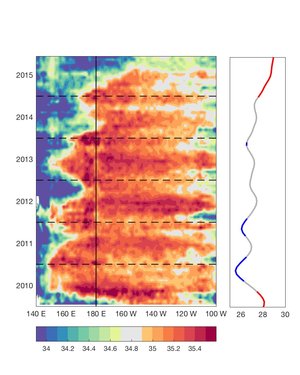
As the Pacific Ocean moves into an El Niño phase, scientists are monitoring changes in sea-surface temperature, but also sea-surface salinity – which is another key indicator of this phenomenon. Measurements from satellites such as the European Space Agency's SMOS mission are revealing how freshwater and salt patterns shift across the Pacific as this year’s El Niño develops – offering a potential new pathway for early detection.
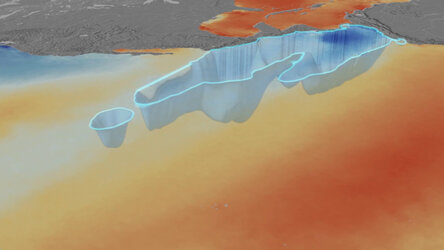
Drawing on data from ESA’s SMOS and NASA’s SMAP missions and other data sources, the animation illustrates the movement of the freshwater pool during the 2023 El Niño and La Niña events, and the current emerging El Niño.
Here, the eastern edge of the western Pacific freshwater pool shifts eastwards, together with the associated belt of deep atmospheric convection and heavy rainfall. One of the most striking features is the eastward displacement of the saltier waters immediately to the east of the freshwater pool, while salinity within much of the pool itself remains relatively low. This evolution reflects the combined influence of changing rainfall patterns and ocean surface currents as the trade winds weaken during El Niño.
Read full story: SMOS salinity could offer early indicator of El Niño