


AcubeSAT radiation test campaign at ESA ESTEC
AcubeSAT is a student-led space biology mission developed by SpaceDot, a multidisciplinary team formed mostly by students of the Aristotle University of Thessaloniki, Greece. As part of ESA's Fly You Satellite! programme, the team conducted a radiation test campaign at ESA ESTEC to help prepare their CubeSat for the harsh space environment. This milestone marks an important step forward in AcubeSAT's development.

The student satellite is a 3U CubeSat for advanced biological research in space. Combining engineering innovation with cutting-edge life sciences, AcubeSAT's mission aims to explore the yeast growth under the microgravity and radiation conditions of a low Earth orbit.
As part of the mission’s preparation, the student team visited ESA ESTEC in the Netherlands from 15 to 19 December 2025 to carry out a dedicated radiation test campaign. The activities were conducted with the support of ESA’s Radiation & Components Reliability Section, using the Cobalt-60 irradiation facility, as well as the Life Support and Physical Sciences Instrumentation section, providing access to the Life Sciences Infrastructure (LIS) laboratories for biological sample preparation.
Why testing radiation matters
Radiation is one of the dominant environmental stressors in low Earth orbit, affecting both spacecraft electronics and biological systems. The radiation test campaign at ESTEC was therefore a critical milestone in validating AcubeSAT’s hardware and scientific objectives.
Understanding yeast response to radiation
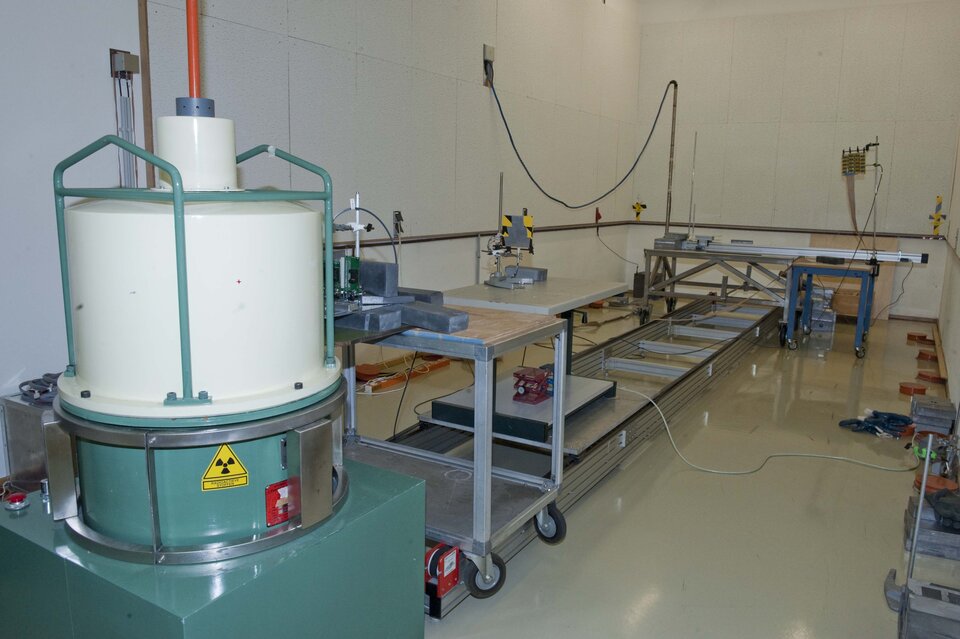
A primary objective was to conduct biological radiation testing to study the molecular response of yeast to space radiation conditions, simulating key components of the orbital radiation environment. To better understand the system’s behavior, the team also exposed it to higher radiation levels. Overall, these experiments are designed to support downstream high-throughput sequencing analyses aimed at better understanding cellular changes induced by radiation exposure.
Calibrating the on-board radiation dosimeter
Alongside the biological experiments, the team performed calibration of the on-board dosimeter, which is essential for accurately characterizing the radiation environment in orbit. This calibration ensures that the radiation data downlinked from space can be reliably correlated with the observed biological responses obtained during the in-orbit experiment.
First insights
Some preliminary results indicate that yeast cells exposed to radiation showed remarkably different growth compared to non-irradiated samples, clearly illustrating the effects of radiation on living organisms. In addition, the dosimeter remained functional and demonstrated a highly linear response across a range of tested radiation doses, indicating reliable performance.
What's next?

The radiation test campaign at ESTEC marks a significant step forward for the AcubeSAT mission and represents an important educational experience within ESA's Fly Your Satellite! programme. Through access to professional testing facilities and close collaboration with ESA experts, the team has advanced both the technical readiness and scientific depth of the mission, paving the way for future small satellite missions dedicated to space biology. The team is now proceeding with the full assembly of the complete satellite system, aiming to have a fully functional satellite ready by the end of 2026.