

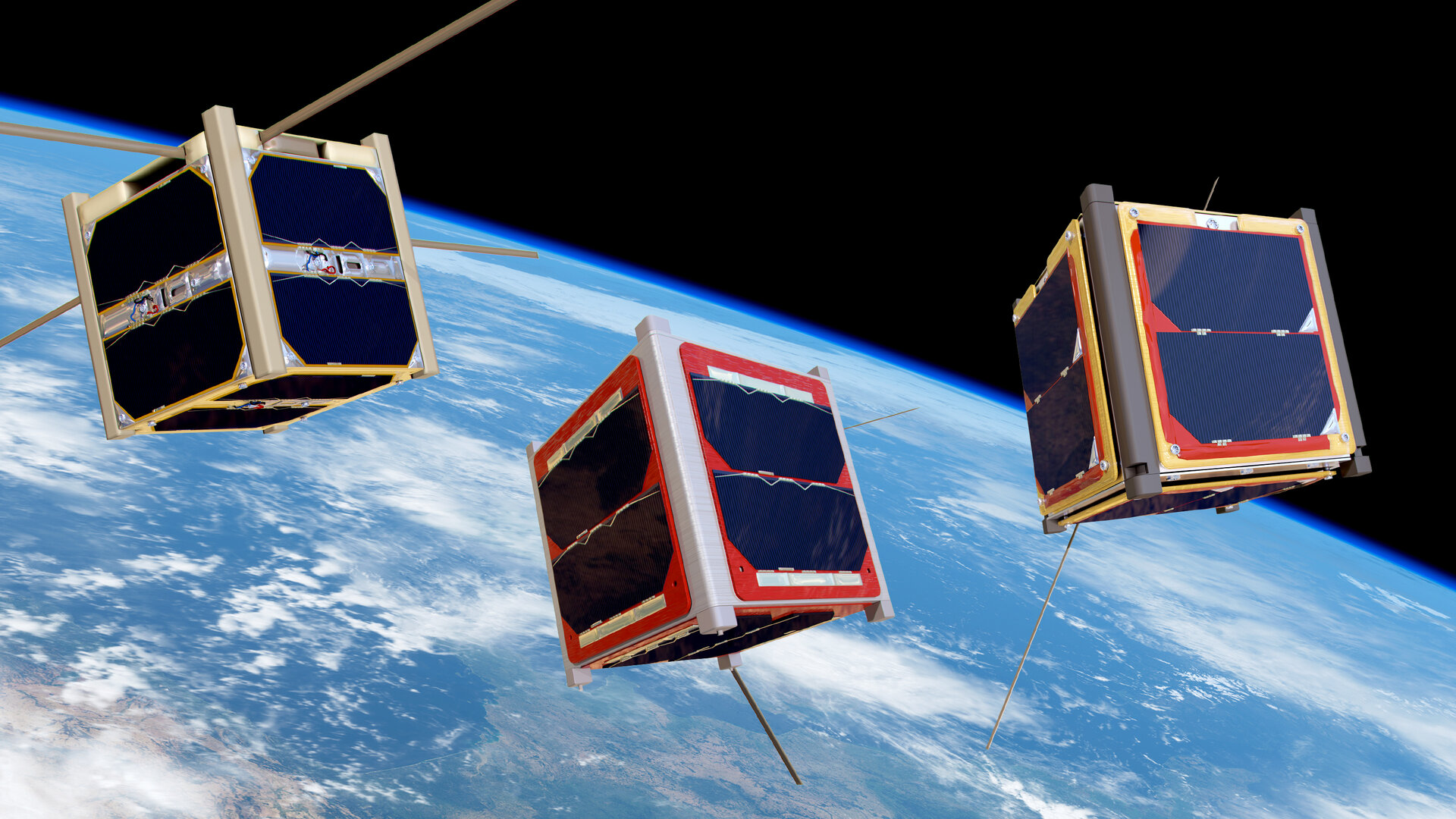
Request For Information (RFI): opportunity for launch service providers for upcoming educational nanosatellite projects
The European Space Agency (ESA) invites European Launch Service Providers, Brokers and Integrators to express their interest in providing launch and deployment opportunities for satellites participating in the educational Fly Your Satellite! programme. Interested parties are requested to respond to this Request For Information (RFI) before 27 February 2026, 18:00 CET.
Fly Your Satellite! is ESA’s educational satellite programme supporting university and other tertiary education student teams in the design, development, and launch of their own nanosatellites. Under guidance of ESA specialists, students progress through the various phases of spacecraft development, receiving technical and managerial support tailored to real-world space engineering challenges. To date, 50 nanosatellite projects from 20 countries have benefitted from the programme at different stages of their development. Of these, 15 satellites have successfully reached orbit, taking advantage of the launch opportunities provided by Fly Your Satellite!.
The purpose of this Request For Information (RFI) is to gather preliminary information from potential European Launch Service Providers, Brokers and Integrators regarding their interest in providing launch and deployment opportunities for nanosatellites participating in the third and fourth cycles of the Fly Your Satellite! programme. The nanosatellites include the following form factors: CubeSats ranging from 1U to 3U+, and PocketQubes ranging from 1P to 3P, with masses from <1kg to 5kg. The earliest expected readiness are in Q1 2027. Table 1 provides a summary of the nanosatellites, their required orbits and expected readiness.
Table 1: summary of the nanosatellites participating in third and fourth cycle of Fly Your Satellite!
| # | Form Factor | Expected readiness | Target Orbit | Inclination (see note 1) | LTAN | Other requirements | Max altitude for Zero Debris compliance (see note 2) | Applicable Design Specification |
| 1 |
3U+ (tuna can) CubeSat |
Q2-Q3 2027 |
LEO injection altitude compliant to ESA Zero Debris requirements |
Polar [SSO preferred] |
09-15h | More than 1 year lifetime.Maximum 2 years of desired orbital lifetime |
518 km (deployed) 484 km (stowed) |
See note 3 |
| 2 | 1U CubeSat | Q1-Q2 2027 | > 36° | -- | -- | 529 km | ||
| 3 |
3U+ (tuna can) CubeSat |
Q3 2027 |
> 40° [SSO preferred] |
06-11h | More than 1.5 years lifetime | 510 km | ||
| 4 | 2U CubeSat | Q3-Q4 2027 | > 52° | -- | -- | 520 km | ||
| 5 | 1U CubeSat | Q3 2028 | SSO | -- | -- | 514 km | ||
| 6 | 2 x 1P PocketQube | Q3 2027 |
> 41° [SSO preferred] |
-- | -- | 541 km | ||
| 7 | 2P PocketQube | Q3 2027 | > 45° | -- | -- | 549 km |
Note 1: The minimum inclination required is based on the geographical location of the ground station. Detailed visibility analyses have not been performed; therefore, a wider range of inclination may also be acceptable.
Note 2: The maximum altitude to comply with the 5 years lifetime requirement of the Zero Debris policy has been calculated using the DRAMA/OSCAR tool using the median method.
Note 3: Teams participating in Fly Your Satellite! must comply with the Fly Your Satellite Design Specifications, which are based on the corresponding CubeSat (CubeSat Design Specification rev. 13 and 14) or PocketQube standards (PocketQube Design Standard 1.7). Compliance with the Fly Your Satellite specifications ensures adherence to these standards.
Tendering process
The RFI is open to all European Launch Service Providers including ESA Developed launchers and European Launch Service Brokers or Integrators. Brokers and Integrators shall only propose launches making use of European Launch Vehicles operated by European Launch Service Providers.
Interested parties are requested to reply to the RFI, indicating which satellites they are interested in providing a launch opportunity for. Additionally, they are invited to indicate the launch vehicle and designation, injection orbit, deployer, any notes on vehicle and deployer heritage and Rough Order of Magnitude (ROM) Cost. Providers may provide multiple vehicle options for each satellite along with corresponding ROM cost estimates. Further information may be provided on the company’s experience, including any provision of educational opportunities. No rights are derived by ESA or the interested parties as a result of this RFI.
Following the RFI campaign, Restricted Competitions (RC) will be issued to all eligible European Launch Service Providers, Brokers and Integrators who expressed their interest in responding to the RFI for the award of Launch Service Contracts covering one or more satellite missions depending on proposals’ evaluation outcome. Offers may be submitted for individual or multiple satellites. The responses will be evaluated by a Board consisting of members from the Education Office and the Directorate for Space Transportation.
27/02/2026 Deadline for submission of RFI
Information delivery
Interested parties are requested to follow the instructions below to express their interest in this RFI.
Step 1: Register your entity in ESA STAR
Ensure that your entity is registered in ESA-STAR, if it has not been registered yet. ESA-STAR is ESA’s tool for registration and management of external entities: Home - esa-star Registration System
Step 2: Open the Interact
Open the interact announcement on esa-star Publication.
Step 3: Preparing the RFI submission:
3.1 Complete the Organisational Information form
3.2 Submit the RFI
Include the following information in your RFI submission, as applicable:
- Satellites of interest for offering Launch Services
- Brief description of the service approach
- Proposed timeline
- Intended launch vehicle(s) and its designation(s)
- Deployer
- Notes on vehicle and deployer qualification status
- Target injection orbit
- Rough Order of Magnitude (ROM) Cost
- Description of educational opportunities for students (if any)
- Any other comments or special considerations (optional)
Submission format:
- The RFI submission must not exceed 5 pages.
- The document must be submitted in PDF format.
- PDF File name: “FYS_RFI_Submission_ORGANISATIONNAME”