


Back to School 2025-2026: 5 projects to inspire your students
This year, take your students’ learning beyond the classroom and into space! Together with the ESERO network, ESA offers a range of interdisciplinary school-level projects designed to engage and inspire students with hands-on activities connecting space to STEM learning.
Astro Pi, Moon Camp, CanSat, Climate Detectives, and Mission X launch in September 2025 and will run throughout the 2025-2026 school year. Explore each project, check key dates and find the perfect activity to discover with your students.
Interdisciplinary school-level projects
The school-level projects, run by ESA and the European Space Education Resources Office (ESERO) network, immerse students in activities that mirror the collaborative, cross-disciplinary nature of real space missions. The projects not only deepen students’ understanding of science, technology, engineering, and mathematics (STEM) subjects, but also help them develop essential skills and competences in teamwork, problem-solving, and critical thinking.
With the projects, students can run their codes in space, design a space habitat, build and launch soda can-sized satellites, investigate Earth’s environment, and even train like an astronaut!
Get to know the 5 projects
Astro Pi

The European Astro Pi Challenge offers students the opportunity to write computer programs that run on Raspberry Pi computers, called Astro Pi, aboard the International Space Station (ISS). It consists of two different missions:
Mission Zero is the entry-level category, aimed at primary and lower-secondary students. Participants write a simple Python program that displays a pixel art image on the Astro Pi computers.
Mission Space Lab is the advanced-level category for students up to 19 years old. Participants are challenged to calculate the speed of the ISS using the sensors and camera of the Astro Pi computer aboard the ISS, by coding a program.
The European Astro Pi Challenge is an ESA Education project run in collaboration with the Raspberry Pi Foundation. It is implemented by the ESEROs across ESA Member States, Canada, Latvia, Lithuania, or Slovakia.
Registration for Astro Pi opened on 8 September 2025.
Find out more about Astro Pi at: https://astro-pi.org/
Moon Camp
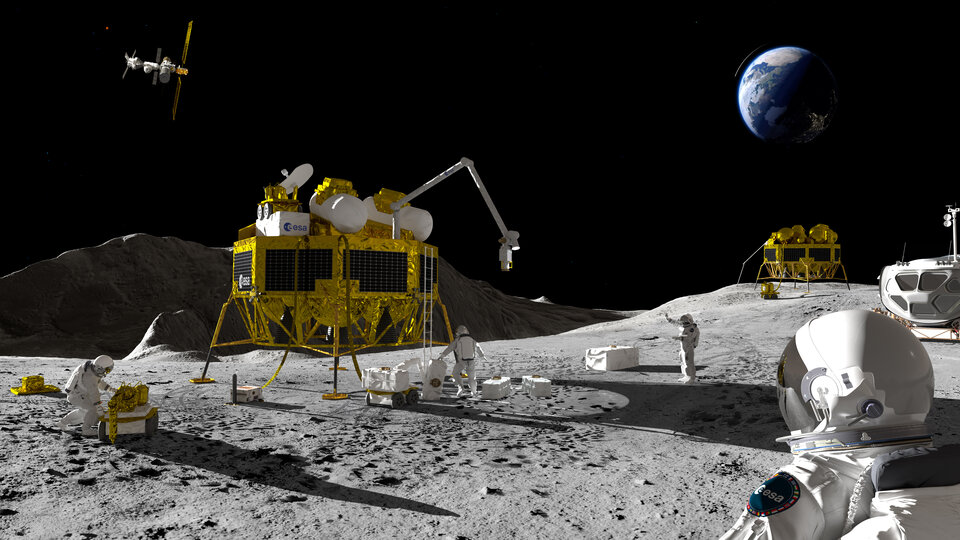
Moon Camp is a global project that challenges students up to 19 years old to design space habitats using creative tools such as 3D design software and game-based designs. Participants explore the wide range of challenges of living on the Moon or other bodies such as protection from radiation and meteorites, food production challenges.
Moon Camp is a collaboration between ESA, the ESEROs, and the Airbus Foundation.
Registration for Moon Camp opened on 11 September 2025.
Find out more about Moon Camp at: https://mooncampchallenge.org/
CanSat

In CanSat, students aged 14–19 years old work in teams to build and launch a satellite the size of a soda can. Students are challenged to integrate the key satellite subsystems into this small satellite, simulating a real mission from design to launch.
Student teams compete at national or regional CanSat competitions, organized through the ESEROs and other national organisers in most ESA Member States, Canada, Latvia, Lithuania and Slovakia. National winning teams are invited to ESA’s “Space Engineer for a Day” event at ESTEC in Noordwijk, the Netherlands.
CanSat is an initiative of ESA and the national ESEROs.
Registration for CanSat opened on 15 September 2025, but in some countries earlier or later: check your National Competition for specific dates.
Find out more about CanSat at https://cansat.esa.int/
Climate Detectives

Climate Detectives empowers students to investigate local environmental and climate issues using real Earth observation data from satellites orground-based measurements. The project features two categories:
Climate Detectives Kids is designed for students up to 12 years old and introduces them to Earth sciences through inquiry-based activities focused on the environment.
Climate Detectives is the advanced track, recommended for students from 12 to 19 years old. Student teams carry out their own research by investigating a climate problem and drawing conclusions on actions to be taken.
Climate Detectives is a collaboration between ESA and the ESEROs.
Registration for Climate Detectives opened on 17 September 2025.
Find out more about Climate Detectives at https://climatedetectives.esa.int/
Mission X

Mission X is a global project that encourages students up to 14 years old to engage in science through astronaut-style training. Student teams complete training tasks that are converted into 'steps' that help mascots Luna and Leo walk to the Moon.
Mission X is a collaboration between ESA and the ESEROs, and also run outside ESA Member States by local organisers.
Registration for Mission X opened on 19 September 2025.
Find out more about Mission X at https://trainlikeanastronaut.org/
Other STEM activities
In addition to the school-level projects, ESA and that ESERO network offer many more resources to help you enrich your teaching using space as an example of real-life STEM applications and to spark your students’ curiosity.
The Hack an Exoplanet set of activities gives students aged 14-19 the chance to step into the role of space scientists. In this inquiry-based astronomy experience, students analyse real satellite data from four intriguing exoplanets. The exoplanets were observed in 2023 by ESA’s CHEOPS satellite, and the data (processed by ESA experts) are ready for students to explore using mathematical techniques and model fitting.
The Teach with Space didactic resources are a set of ready-to-use curricular classroom resources for both primary and secondary school level. Each resource includes teaching guidelines and student activities that link space themes to STEM subjects.
On the ESA Education YouTube channel you can find a variety of videos to inspire and engage your students, from how-to guides and explainers, to experiments, interviews with space experts, and exclusive behind-the-scenes footage from ESA.