Proba payloads
Editor's note: This page was last updated on 18 May 2009
Proba carries onboard several Earth observation and space environment scientific instruments. In view of the project’s aim to demonstrate technology, several platform elements and systems have also been included as technology experiments.
The Proba development approach includes several innovative aspects. A design-to-cost approach was adopted according to European Cooperation for Space Standardisation category 3 project classification. This involved using COTS (commercial off-the-shelf) equipment and units; simulation-based development, verification and testing; automated software generation; extensive use of test and operations infrastructure commonalities; and a highly integrated ESA-industry design and development team.
Extensive use is made of automated functions onboard the spacecraft. Full onboard flight dynamics computation, in conjunction with automated ground segment functions such as pass automation and high-level user interfaces, satisfy the spacecraft autonomy requirements.
Automated functions onboard handle nominal spacecraft operations, plan and schedule activities, and manage payload resources. Onboard flight dynamics include orbital navigation as well as computation and control of instruments, camera pointing and scanning in order to meet user-defined targets (latitude, longitude and altitude).
Technology payloads and innovative features
Autonomous star tracker:
This is the first time that an autonomous star tracker has been used as the only source of attitude on an Earth observation, agile spacecraft.
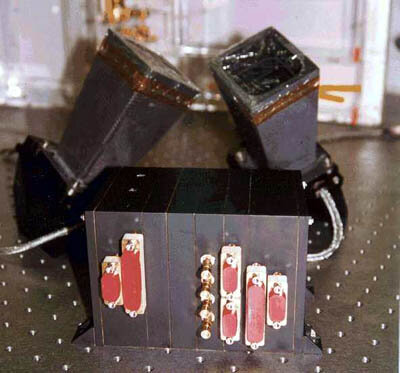
| Mass | 1.5 kg (electronics), 600 g (each camera head) |
|---|---|
| Power | 7.5 watt (including 2 heads) |
| Dimensions | 165x100x100 mm3 |
| Performance | 4-6 arcsec up to 1.2°/sec |
| Key characteristics | 2 camera heads |
| lost-in-space functionality | |
| reprogrammable software | |
| RS422 interface |
Avionics
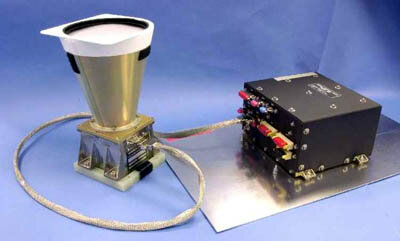
Platform avionics:
|
Payload avionics: PPU (Payload Processing Unit)
|
Software technology and development approach:
|
Structure: fully commercial process
Li-Ion battery:
|
ACNS approach:
|
Ground segment automatic functions:
|
Instruments
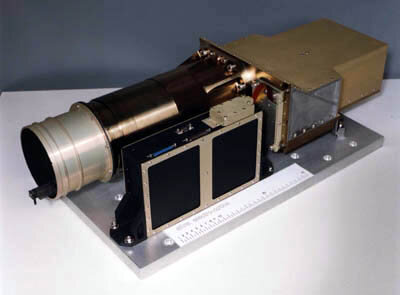
Compact High Resolution Imaging Spectrometer (CHRIS):
CHRIS is used to measure directional spectral reflectance of land areas, thus providing new biophysical and biochemical data, and information on land surfaces.
|
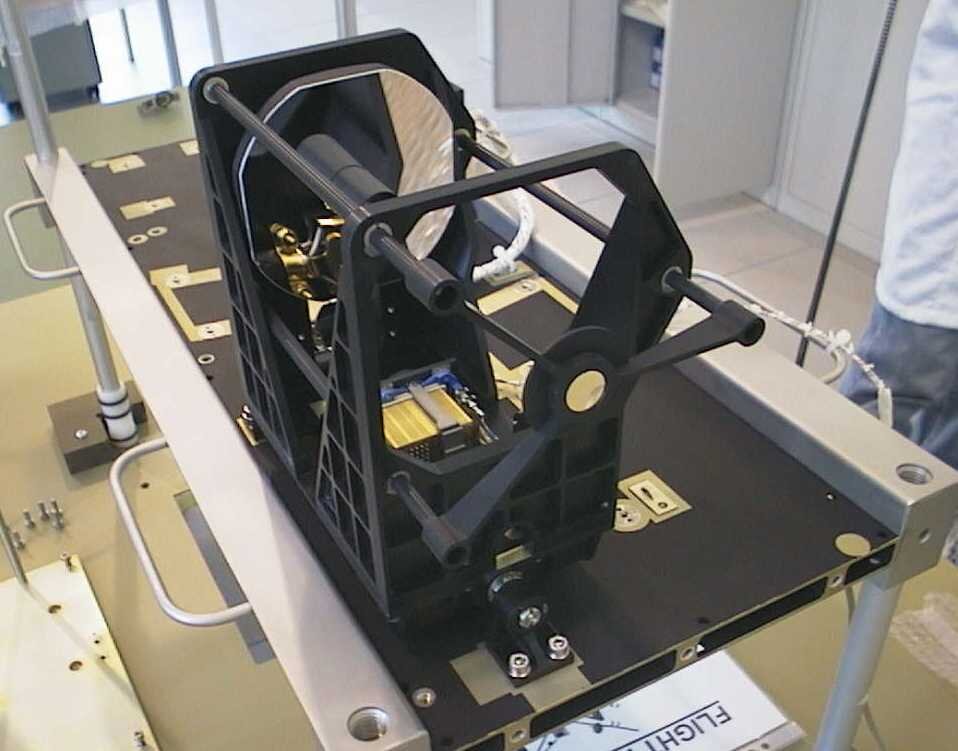
High Resolution Camera (HRC):
HRC is a black and white camera with a miniaturised Cassegrain telescope.
|
Wide Angle Camera (WAC):
This miniaturised black-and-white camera is used for Earth observation, as well as for public relations and educational purposes.
|

Space Radiation Environment Monitor (SREM):
SREM is used to provide data on space weather and space environment.
|

Debris In-orbit Evaluator (DEBIE):
DEBIE provides information on space debris in low-Earth, Sun-synchronous orbit.
|
Smart Instrument Points (SIPs)
These are smart sensors used to measure total radiation doses and temperature around the spacecraft.
|

Miniaturised Radiation Monitor (MRM)
The Miniaturised Radiation Monitor is an instrument that exploits a new method for measuring radiation based on quartz scintigraphy. This measurement method is evaluated on Proba by comparing MRM and SREM measurements.
Payload Autonomous Star Sensor (PASS):
The Proba Attitude Star Sensor is a new development of autonomous star sensor. Proba provides a flight demonstration for this unit and also the opportunity to test its novel star-pattern recognition algorithm.