


50 Years of Innovative Propulsion in TDE
SMART-1 was the first of ESA’s Small Missions for Advanced Research in
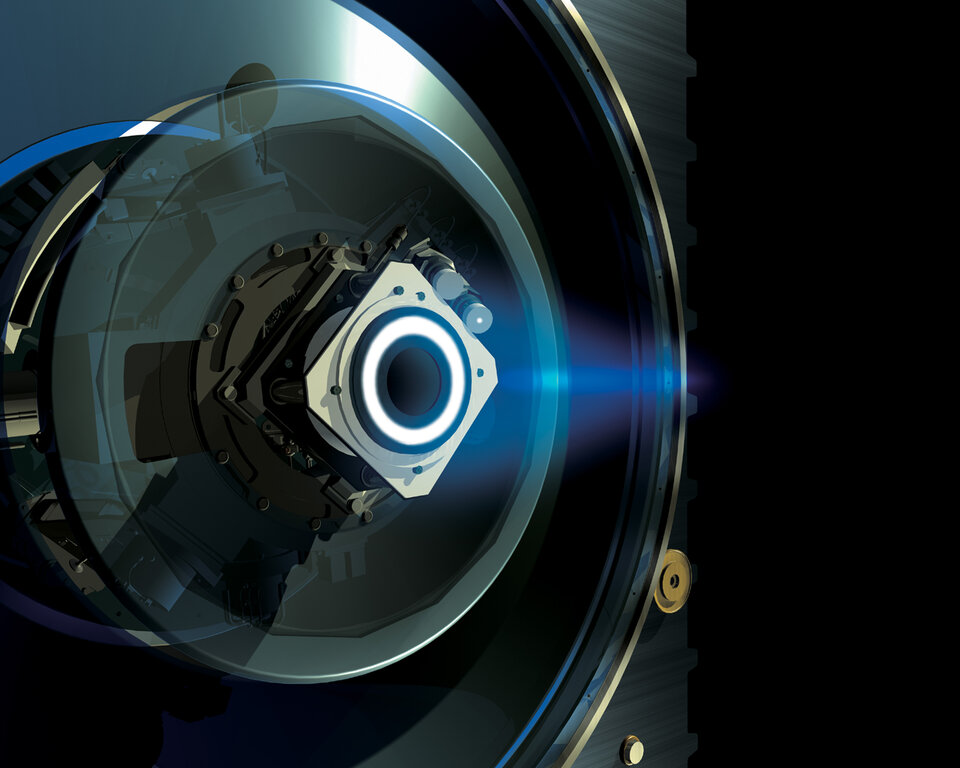
Technology. Originally, the objective for these activities was to test new enabling technologies for ESA’s Cornerstone science missions, such as BepiColumbo. Ultimately, the technology built, a hall effect thruster for the Smart-1 mission, broke several world records and created an impressive string of ‘firsts’ for ESA.
From a technology point of view, it was the first time that: • a Hall-effect plasma thruster was used for primary propulsion; • a Hall-effect propulsion system was used under variable power conditions; • a plasma thruster had operated continuously for more than 240 hours in space; • a plasma thruster had accumulated nearly 5000 hours of operations in space. As a technology demonstration mission these achievements have been keys that have unlocked several missions since and continue to provide the basis for propulsion systems on current missions. HENON, ESA’s first standalone deep space CubeSat, which is due to launch in 2026, will run on a miniature version of the BepiColumbo thruster which was itself based on the Smart-1 electric propulsion system.
Early Beginnings and Small Starts
TDE has also given funding through the Innovative Propulsion for CubeSats study, supporting the development, testing and validation of a range of innovative propulsion technologies and helping them to reach at least TRL 3. The studies bridge the gap between research and commercialisation, fostering the development of cost effective, high-performance propulsion systems that could enhance CubeSat manoeuvrability and mission capabilities. The activities are part of ESA’s ongoing efforts to improve efficiency and performance in next-generation CubeSat propulsion systems, whilst recognising that different satellites will have different propulsion requirements and that no single propulsion unit will be suitable for all CubeSats.
Innovative Propulsion Today

For all of the technology programmes, from Discovery to GSTP, innovative propulsion systems remain a focus of ESA’s R&D strategy and are vital for the Technology Vision 2040. Propulsion is a strategic space technology and continuous advancement in this domain remains fundamental to maintain Europe’s leadership in the global space economy. Looking further ahead, innovative propulsion involves novel green technologies with much higher performance, environmental friendliness and lower cost, able to expand space logistics capabilities and enable ambitious new missions and applications not only in Earth orbit but also far beyond. We are now working on greener systems such as water or atmospheric-breathing propulsion systems, as well as very high power, nuclear and cryogenic propulsion to enable long-term and large cargo missions. In 2024 TDE closed an activity investigating iodine as a potential electric propulsion system propellant, ultimately developing an iodine-compatible cathode that is currently being prepared for integration into a full system. It is also advancing technologies to develop solar arrays that have greater power capacity to enable solar electric propulsion.
Industry Collaboration and Spin-offs
TDE has consistently empowered European industry by providing funding and technical support for the development of cutting-edge space technologies. Over 50 years, ESA has facilitated the creation of more than 100 technology companies and spin-offs, many of which have successfully transitioned to commercial markets. Electric propulsion technologies developed for ESA’s missions like SMART-1 are a clear example of how technologies developed within the TDE have been commercialised by European companies and are now widely adopted for satellites and deep space. A recent example shows TDE supporting the development of active thrust control for an already commercially-available propulsion system to make it suitable for CubeSat and MicroSat applications.