


How did an Ariane 5 launch work?
It is a launcher's job to carry satellites into space, far enough away from the Earth to ensure that they are not pulled back into the Earth’s atmosphere, where they would burn up on reentry.
Weight is all important. The heavier the payload the more fuel the launcher must carry to ensure liftoff; but more fuel means bigger tanks and yet more weight. A delicate balance has to be sought between weight and fuel to ensure that the launcher has enough fuel to create the power needed to reach the orbit required by its payload before the launcher falls to the ground.
For this reason most launchers have a number of stages and each stage falls away once it has fulfilled its purpose. This makes the launcher progressively lighter so that it requires less fuel.
Launching into geostationary transfer orbit
Huge 30-m tall boosters were attached to either side of the first stage of the Ariane 5 launcher to increase the thrust at liftoff. Each booster contained approximately 230 tonnes of propellant. Tremendously powerful engines are needed to ensure liftoff and even though they work for only 2 to 3 minutes, they need a great deal of fuel.
First the main Vulcain engine under the main stage was ignited and some seven seconds later the boosters ignite to enable liftoff. These seven seconds allowed a last verification of the Vulcain engine before the boosters were ignited, an irreversible process, which marked the point of no return.
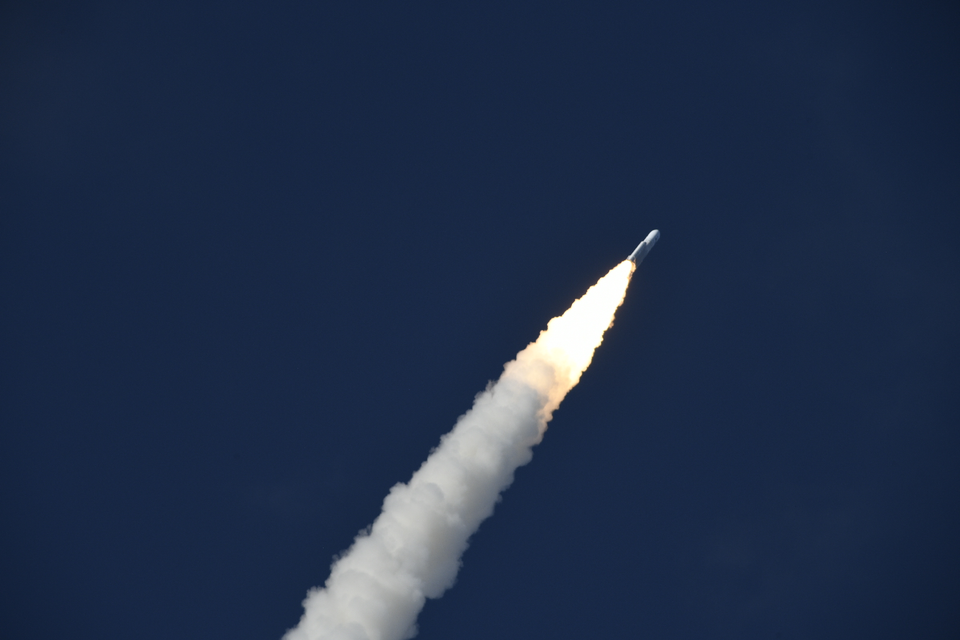
The launcher lifted off vertically and after approximately five seconds banked progressively towards the east to put it into geostationary transfer orbit. It took about 2 minutes to reach a height of around 60 km, at which point the two boosters separated and fell into the sea.
The main stage burned for about 12 minutes. During this time the launcher continued its ascent in preparation for the horizontal trajectory which was handled by the upper stage. As the launcher was then above Earth’s atmosphere the fairing, which protected the satellites, was no longer needed and was jettisoned.
During upper stage burnout, which lasted approximately 13 minutes, the launcher reached its highest velocity of around 8 km per second. At this point the launcher’s upper stage engine was cut and the computer on board the launcher commanded the satellites(s) to spin on their axis. This put them into the correct position to continue their journey into space alone.
The launcher was steered from the ‘brain’ in the Vehicle Equipment Bay, placed above the cryogenic main stage. It was here that data is stored on position, velocity and acceleration so that the onboard computers could estimate in real-time the best trajectory and make any necessary corrections.
Once the satellite or satellites were on their way, the upper stage was sent into what was called a ‘cemetery orbit’ where it can do no damage to other orbiting satellites and vehicles.

