

Multifunctional integrated structures based on hollow spheres
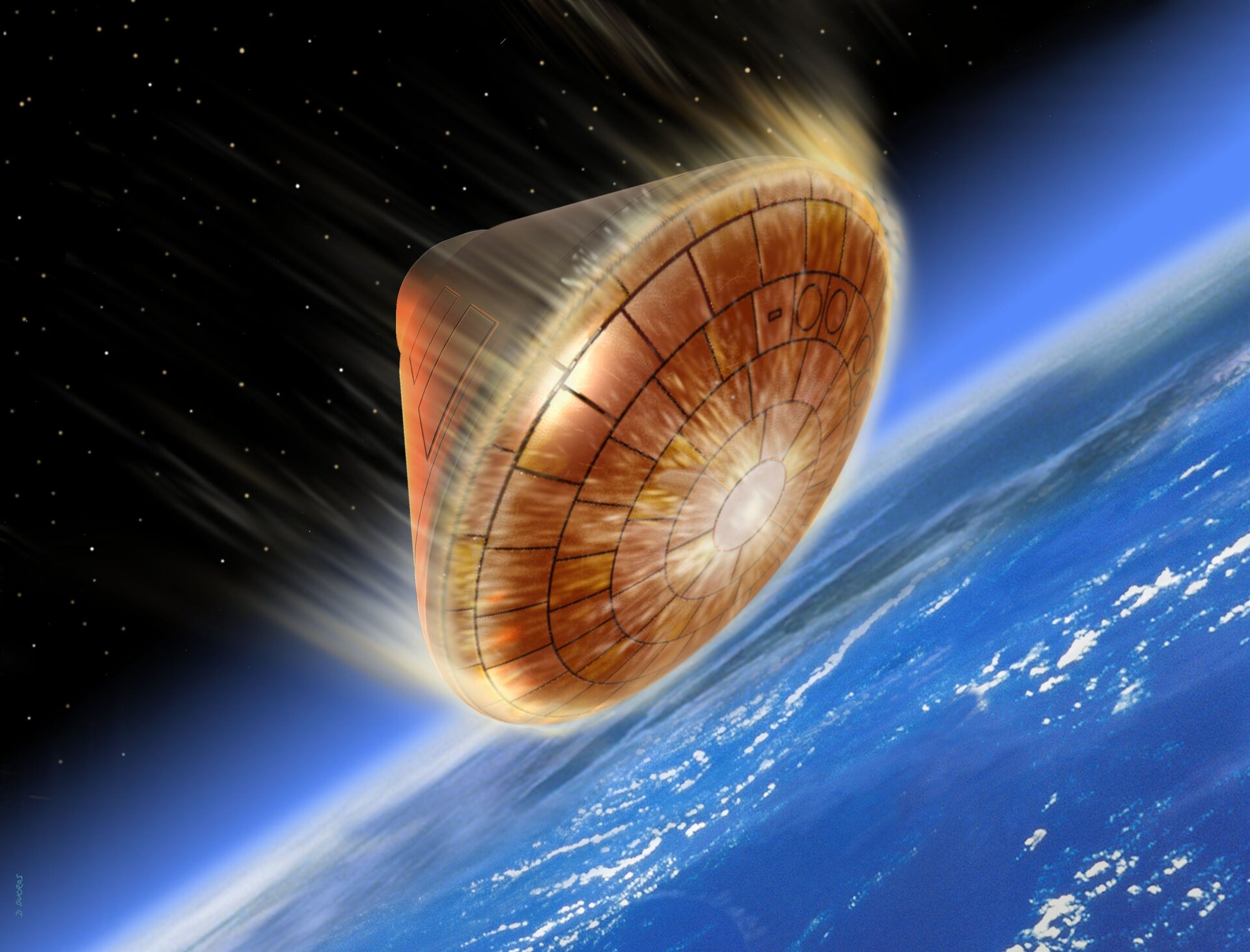
Within the Mars Sample Return (MSR) mission, it is foreseen to bring back to Earth samples of Martian soil. Those samples will have to be shipped onboard a dedicated probe that will go through the Earth’s atmosphere following a hyperbolic interplanetary trajectory.
The entry conditions are of such a challenging nature that existing materials for heat shields will not withstand the generated heat fluxes (in the order of 8 to 10 MW/m2). Besides, the probe configuration has to meet the requirements needed for a hard landing, which means touch-down speed of over 30m/s.
In this context, there is a call for robust, lightweight, thermally insulating multifunctional structures. Indeed, these structures have shown highly attractive values of thermal conductivity. Their insulation properties are very well suited for an Earth re-entry application. In addition to that, they have a high absorption capacity due to their cellular structure.
This makes them a very good candidate for both a shock absorbing layer surrounding a sample container during a hard landing on Earth and meteorite and space debris protection panel material. Another interesting feature of such materials is their isotropic mechanical behaviour. Thus, they can be used as load-carrying materials.
In previous studies, it was stated that both from a thermo-physical and a mechanical point of view, metallic hollow sphere structures are a promising candidate for the application considered. Based upon the achieved results, hollow-sphere technology will be traded at material level and a design study will be implemented to optimise the configuration. This will lead to selection and development of a first component. The optimised and selected material is tested at engineering sample level, and the performances compared across different concepts.
The phase involving the Earth re-entry vehicle is of the utmost criticality in the MSR mission as very stringent planetary protection requirements have to be met. Any probe bringing surface planetary samples back to Earth must be qualified for hard-landing to avoid any backward contamination.
| Start |
Expected or actual duration | Status | Prime contractor |
|---|---|---|---|
| Oct '03 | CCN | Ongoing CCN | PLANSEE |