


MPAc: measuring the Moon with lasers
More than 50 years after Apollo astronauts placed the first retroreflectors on the Moon, a new European instrument is set to improve that scientific legacy.
MPAc (MoonLIGHT Pointing Actuator) is a next-generation lunar laser ranging payload that will allow scientists to measure the distance between Earth and the Moon with millimetre-level precision. Scheduled to fly aboard Intuitive Machines’ IM-3 mission to the Reiner Gamma region of the Moon early next year, MPAc will help reveal new details about the Moon’s interior and support even more sensitive tests of our understanding of gravity.
Firing a laser
MPAc uses a technique called lunar laser ranging. Laser pulses are fired from observatories on Earth towards the Moon, where a retroreflector returns the light directly to its source. As the speed of light is known very accurately, measuring the laser’s round-trip travel time allows scientists to calculate the Earth-Moon distance with remarkable precision.
This isn’t a new technique – lunar laser ranging has been around since reflector arrays were placed on the Moon during the Apollo and Soviet Luna programmes. Over the past five decades, these measurements have helped scientists study the Moon’s orbit and rotation, investigate its interior and carry out stringent tests of Einstein’s theory of gravity.
Today, however, the Apollo-era reflectors have become the weak link in the measurement chain. Laser ranging stations on Earth have improved dramatically, and the uncertainty introduced by the original reflector arrays is now greater than that of the ground systems. MPAc is designed to overcome this limitation.
Less is more

MPAc combines two elements: MoonLIGHT, a next-generation corner cube retroreflector, and MPAc, a precision actuator that points the reflector towards Earth*.
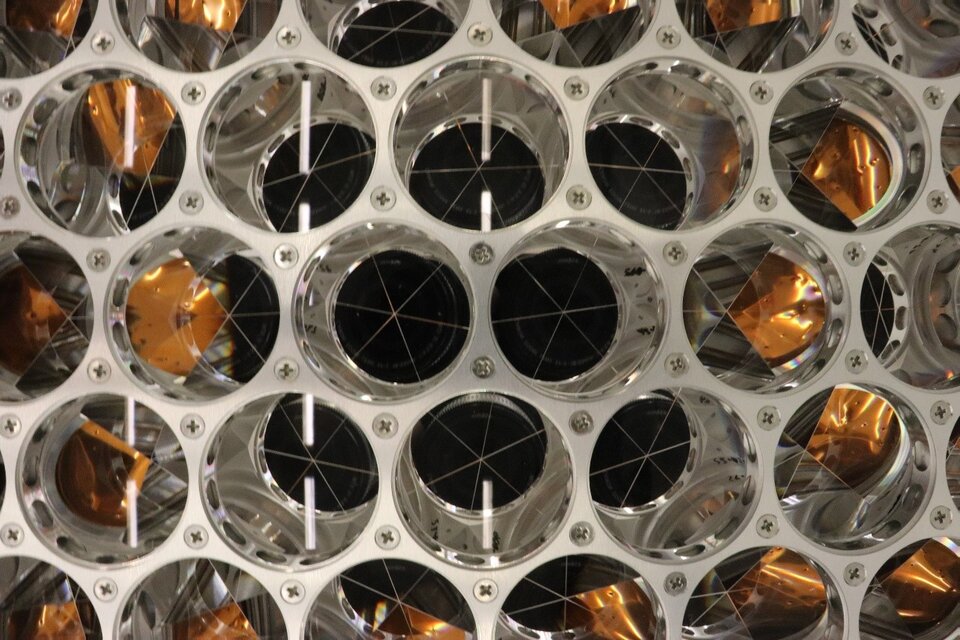
The Apollo reflectors consisted of arrays containing many small retroreflectors. While effective and robust for their time, these arrays are affected by lunar libration, the slight apparent wobble of the Moon as it orbits Earth. As the Moon wobbles, different parts of an array sit at slightly different distances from Earth. This causes photons from the same laser pulse to return at slightly different times, spreading out the returned signal and limiting measurement precision.
Instead of an array, MoonLIGHT uses a single large retroreflector. This greatly reduces the signal spreading, producing a sharper return signal and enabling much more precise distance measurements. However, the reflector has a narrow field of view and needs to be pointed very accurately towards Earth – this is the role of MPAc, which aligns the reflector after landing and enables it to achieve its full scientific performance.
Together, MoonLIGHT and MPAc aim to improve ranging precision from the current centimetre scale towards the millimetre scale.
European lunar science

MoonLIGHT was developed by Italy’s National Institute for Nuclear Physics (INFN) in collaboration with the University of Maryland. ESA funded the development of the MPAc actuator and secured a flight opportunity through NASA’s Commercial Lunar Payload Services programme on Intuitive Machines’ IM-3 mission to the lunar surface. The Italian Space Agency will support MPAc through its Matera Laser Ranging Observatory, alongside three more ground stations at: Grasse in France, Wettzell in Germany, and APOLLO in the United States.
MPAc has completed qualification and testing and awaits integration onto Intuitive Machines’ Nova-C lander ahead of launch in 2027.
Once on the Moon, MPAc will build on more than half a century of lunar laser ranging heritage, helping scientists probe the Moon’s interior and test fundamental theories of gravity with unprecedented precision.
*Editor’s note: This payload as a whole was originally known as MoonLIGHT and referred to by that name in earlier ESA publications; it is now generally referred to as MPAc to avoid confusion with ESA’s Moonlight programme developing communications and navigation services for the Moon.