

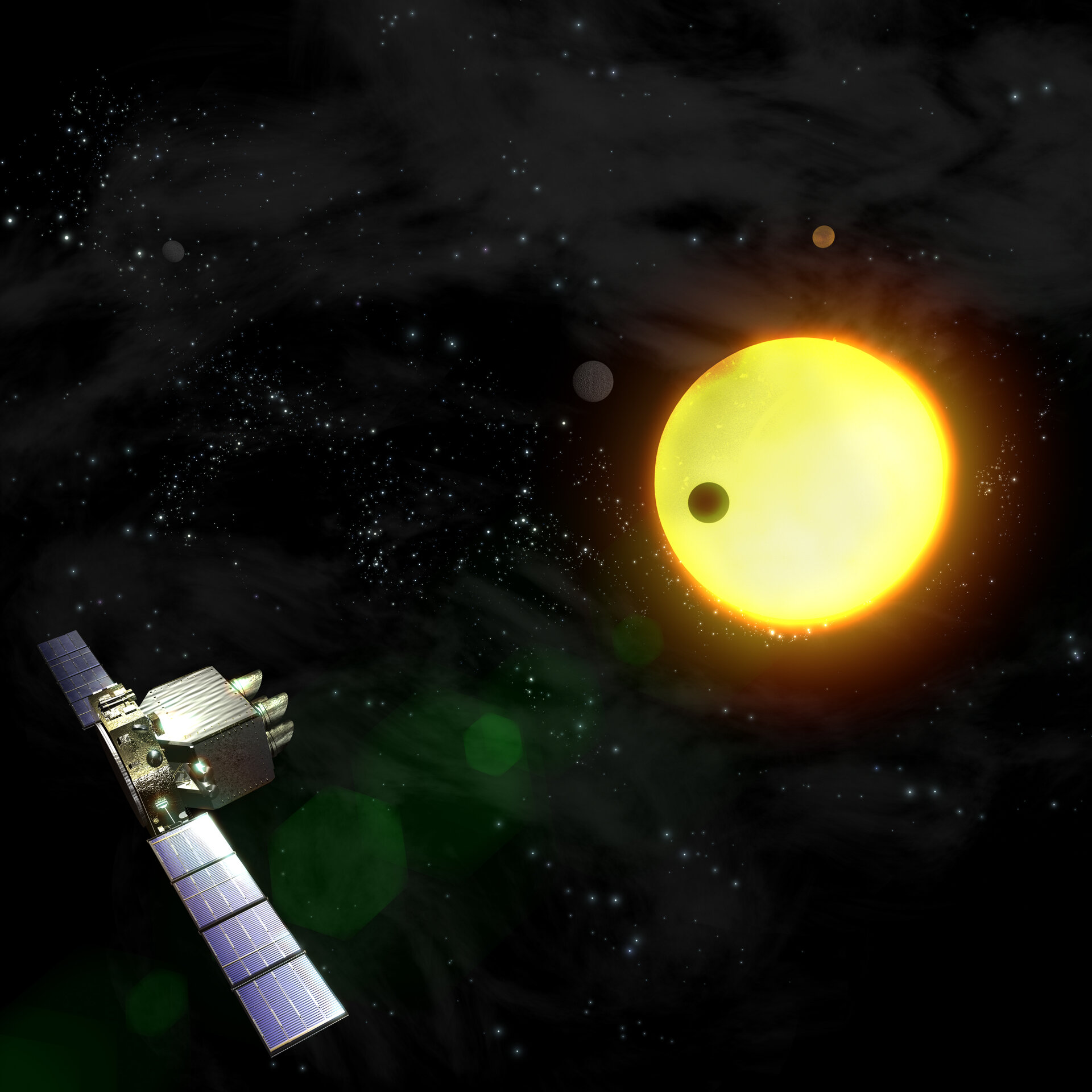
Eddington factsheet
Searching for habitable planets and mapping stellar interiors
Name Many of the ideas behind Eddington originated before the coming of the Space Age with the physicist Arthur Stanley Eddington.
Description Eddington was designed to detect subtle changes in the light from stars. It would have spotted oscillations that show the star’s interior condition. It would also have found planets half the size of Earth and upwards, within the star’s habitable zone, as they cross the face of the star.
Launch Planned for 2008
Status Cancelled due to funding constraints
Journey After leaving Earth, Eddington would have travelled beyond the Moon to a special orbit called the second Lagrangian point (known as L2).
Notes Eddington would have carried a precision photometer, that is, a device to measure small changes in the brightness of a celestial object. These changes in brightness may well be due to the passing of planets in front of a star.
Eddington would have been so sensitive that if, for example, it observed a swarm of 10 000 fireflies, it would have noticed if just one of them 'turned off'.
Asteroseismology is the study of stellar oscillations in stars like our Sun (that is, the study of starquakes). Eddington would have been the culmination of an international attempt to perform asteroseismology from space. A small precursor mission, Corot, led the way.
By looking at stars of similar mass to the Sun but of different ages, Eddington would have allowed astronomers to check their theories about how the Sun has changed since its birth and how it will evolve in the future.
Eddington would have helped solve a problem called the Faint Sun Paradox. Astronomers expect that the Sun was about 30% fainter when it was born. However, geological records show that Earth's climate has remained more or less stable throughout its history. Either the solar models are wrong or our climate is remarkably resistant to change.