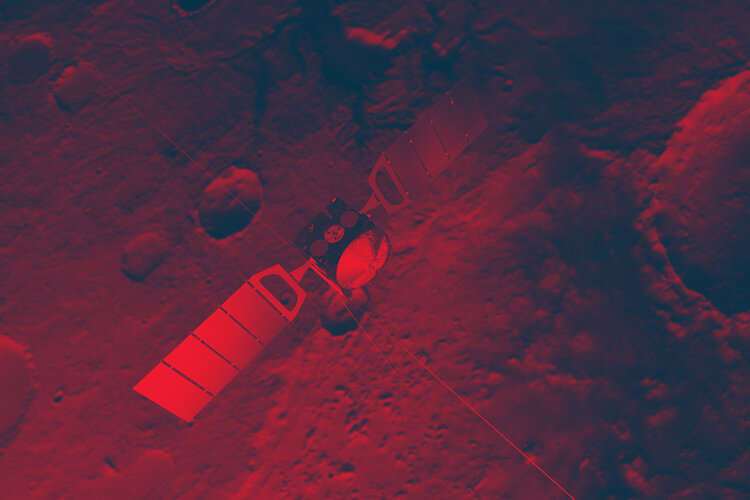
Mars moon lander set to launch on 19 October
The Martian Moons eXploration (MMX) mission is set to launch into space on a H3 rocket from the Tanegashima Space Center at 04:41 JST on 20 October 2026 (20:41 BST / 21:41 CEST on 19 October 2026). MMX will be the first mission to collect a sample from Mars’s moon Phobos and bring it back to Earth.
MMX is led by the Japan Aerospace Exploration Agency (JAXA), in collaboration with the National Aeronautics and Space Administration (NASA), the French space agency (CNES), the German Aerospace Center (DLR) and the European Space Agency (ESA).
Why the martian moons?

Mars has two moons: Phobos (fear) and Deimos (terror). Despite the large fleet of missions sent to the Red Planet, the moons remain particularly mysterious, with huge open questions about how they formed and what they are made of. No spacecraft have dwelled near them for long, so we only really know what a few flybys have revealed.
We don’t even know their origin story. They may be asteroids that were captured into Mars orbit, or they may be the remnants of debris thrown into orbit after a giant collision on the surface of Mars. To find out, we need to collect samples.
“The data and samples returned by MMX are a window to study the evolution of Mars and the Solar System,” says Elliot Sefton-Nash, ESA MMX Project Scientist.
Just like Earth, Mars has changed a lot since it formed 4.5 billion years ago. Conditions there may once have been suitable for life. Digging up this history will also tell us more about how Earth and the rest of the Solar System formed and evolved, and perhaps even rocky planets around other stars.
What’s new?
MMX will be the first spacecraft to orbit Phobos (in a 'quasi-satellite orbit'), and the first to collect samples from a moon's surface other than our own. Special technology has been created to help land, manoeuvre and collect samples robotically in the extremely low gravity at Phobos.
After achieving all that, MMX will be the first mission that returns to Earth after visiting the Mars system. The ability to make such round trips could be interesting for future robotic missions that bring back samples from Mars itself, and potentially even visiting Mars with humans in the future.
The main MMX spacecraft will study Phobos from a distance, then deploy a rover called Idefix to the moon's surface, before finally landing on Phobos to collect samples to return to Earth. On the way home, it will fly past and further investigate Deimos and Mars itself.
The mission carries a total of 11 science instruments: seven on the main spacecraft, and four on the rover. The main spacecraft also carries a radiation monitor, two high-resolution cameras, and two different sampling devices.
The 25-kg Idefix rover has two main tasks: providing information to prepare for the landing of the main spacecraft to collect samples, and analysing the composition and texture of Phobos’s surface. The gravity on Phobos is so low that Idefix will only weigh the equivalent of 15 grams on its surface!

What does the mission timeline look like?
MMX will take around a year to arrive at Mars. It is expected to enter orbit around the Red Planet in August 2027, and orbit Phobos from September 2027. After studying Phobos (and Deimos) from a distance, MMX will release Idefix in early 2029.
With ESA’s Mars Express spacecraft confirmed to operate at Mars until at least 2029, the long-running orbiter may be able to support MMX’s observations. ESA's upcoming ExoMars Rosalind Franklin rover will nicely complement MMX by collecting samples from Mars's subsurface and analysing them with an onboard laboratory.
In 2030, the main spacecraft will land on Phobos to collect samples and pack them into a return module for the journey back to Earth. This module will arrive back at Earth in 2031 and send down at least ten grams of Phobos material in a sample return capsule.
The capsule will land in Australia before being transferred to Japan, where the sample will be extracted, catalogued, and shared with mission partners. Samples are planned to be made available to European scientists, and ESA is working with CNES, DLR, and JAXA to provide announcements of opportunity to work with the samples. Tiny amounts of sample may contain a lot of information that can be revealed with precise measurements.
“Bringing samples to our most sophisticated labs here on Earth is a multiplier for discoveries, because our most precise instruments are too large, complex or sensitive to send to space,” says Elliot. “Even after the mission has been completed, future generations of scientists will study the Phobos samples with even more advanced instruments – samples brought to Earth are the gift that keeps on giving.”
Follow the launch live
Watch the launch live in Japanese/English via JAXA’s YouTube channel. Follow @JAXA_en for updates and join the conversation with #MMX. An ESA image release confirming successful launch will be issued on 20 October.