Roman factsheet
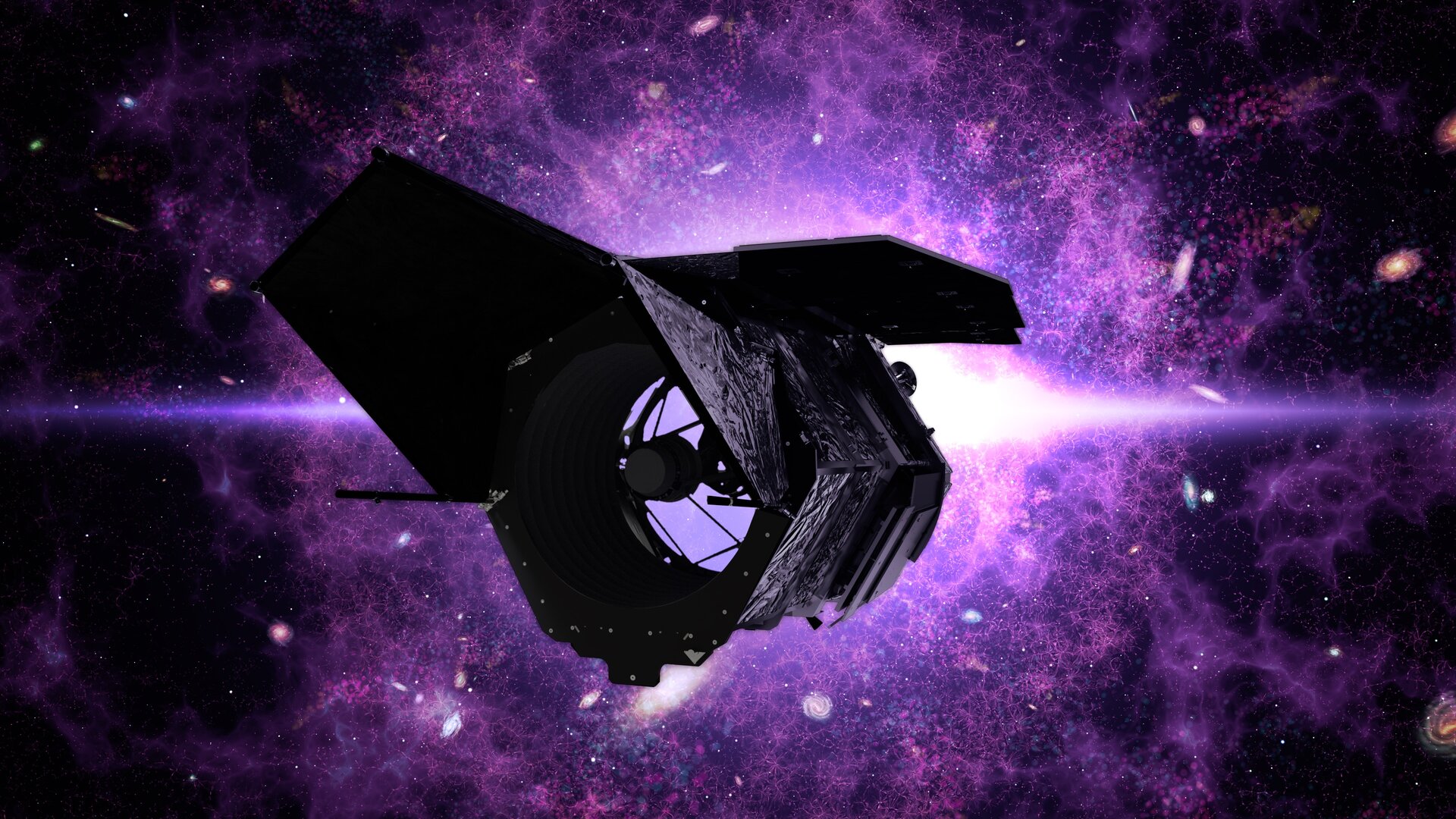
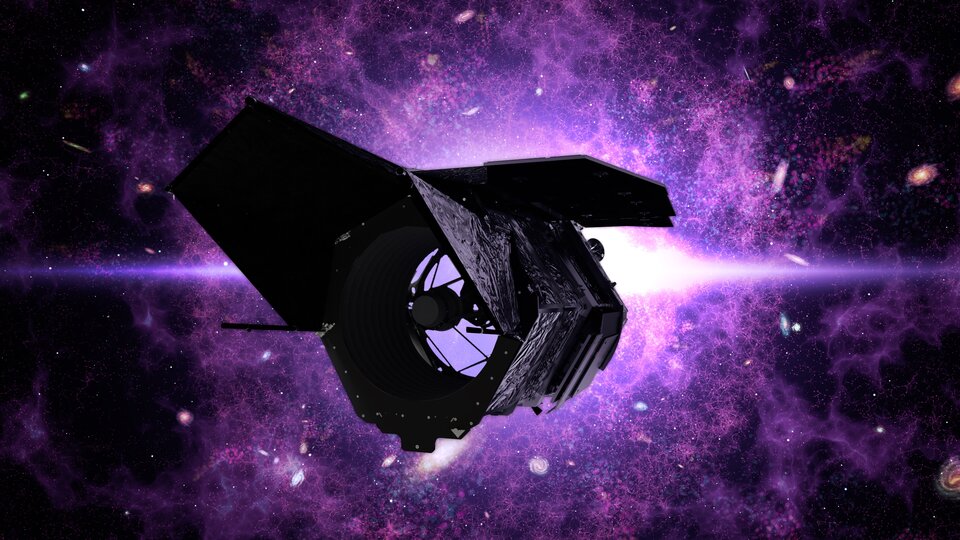
Overview of the Nancy Grace Roman Space Telescope.
Name: Nancy Grace Roman was NASA’s first chief of astronomy throughout the 1960s and 1970s and is known as the ‘Mother of the Hubble Space Telescope’. The Roman mission was previously named WFIRST (Wide-Field InfraRed Survey Telescope) and was renamed in 2020 to the Nancy Grace Roman Space Telescope to honour Nancy Grace Roman.
Mission theme: Conduct a survey of the sky in near-infrared light. This will enable scientists to understand the nature of dark matter and dark energy and find new exoplanets.
Partnership: The Nancy Grace Roman Space Telescope is a NASA-led mission to which ESA contributes as a Mission of Opportunity. Participating in these kinds of missions enables ESA and the European space community to take advantage of the opportunities that arise through partner agencies, providing an element of flexibility to the ESA Science programme.
European contributions: Europe’s contributions to the mission consist of detectors (EMCCDs) for the Coronagraph Instrument, star trackers and batteries. Furthermore, ESA will provide time for downlinking data from the spacecraft to a ground station; to this end, ESA has built a new 35-metre antenna in New Norcia in Australia, next to an existing antenna that is also used by other ESA missions.
Mission objectives:
The Roman telescope is a cutting-edge space observatory for in-depth studies of the Universe in infrared light. The telescope’s large field of view, fast survey speed, high sensitivity and advanced coronagraphic capabilities will allow astronomers to detect and study galaxies in the very early Universe, search for potentially habitable exoplanets and provide answers to some of the most pressing questions in astrophysics, such as the nature of dark matter and dark energy.
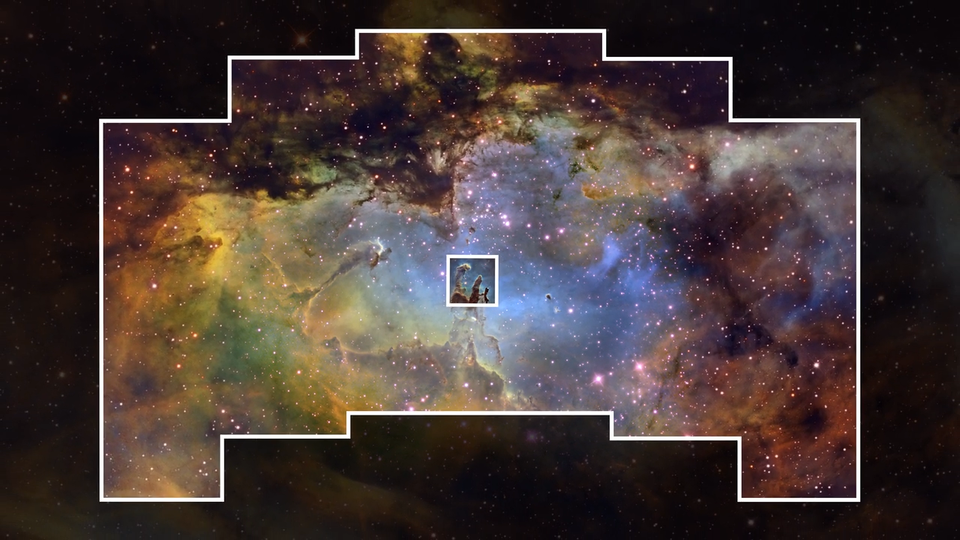
The wide-field view of the Roman Telescope and the quick way in which the telescope can be re-oriented will enable astronomers to perform surveys very efficiently. A wide-field survey prioritises looking at a large part of the sky instead of looking ‘deeper’ into a smaller patch, as is currently achieved with the Hubble and Webb Space Telescopes.
With one of Roman’s surveys, scientists will look outside of the plane of our galaxy’s disc in search of supernovas. Supernovas shine brightly and are visible from enormous distances. They are like signposts in the Universe. Astronomers use them to measure cosmic distances. These measurements reveal how fast the Universe is expanding and allow astronomers to determine a value known as the Hubble constant.
In another Roman survey, scientists will look towards the centre of our galaxy and monitor the intensity of light coming from millions of stars over time. They could discover over 1200 exoplanets through their microlensing signature and more than 100 000 exoplanets through the more standard transit method. The transit method looks for the periodical dimming of starlight as a planet repeatedly crosses in front of its host star.
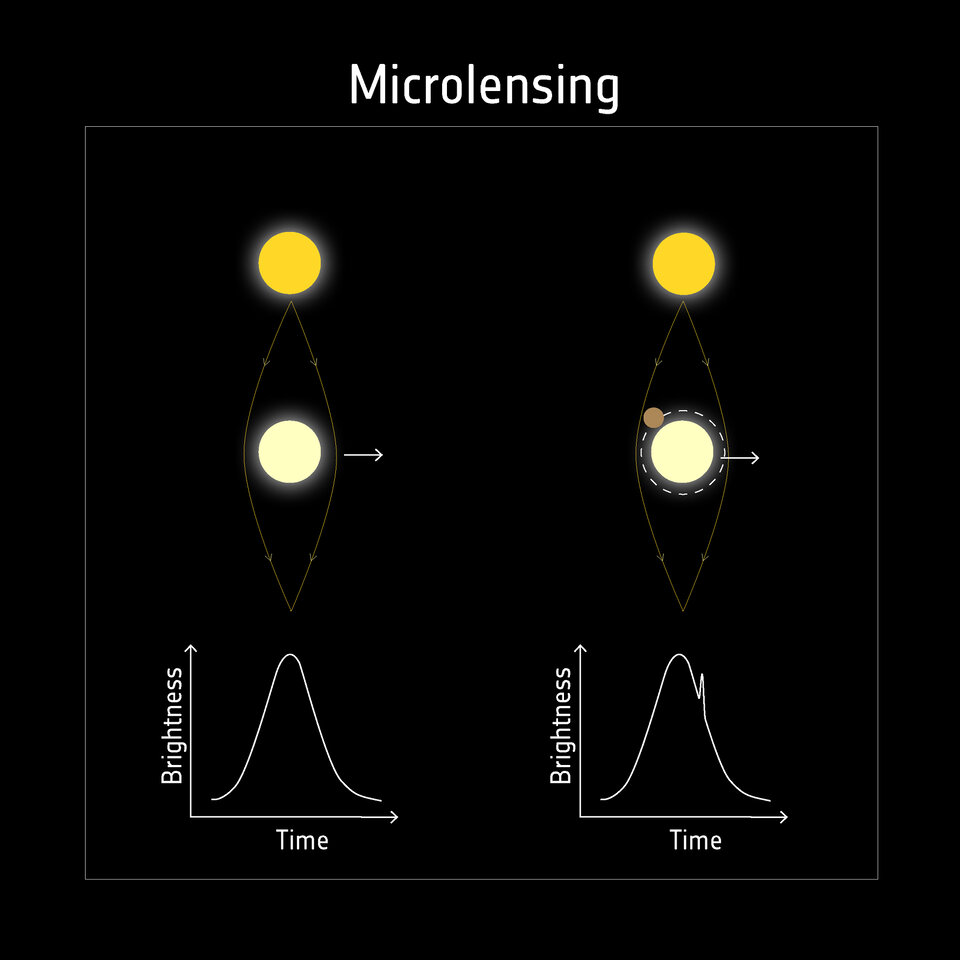
Microlensing events occur when the light from distant stars is altered due to the mass of closer stars. All massive objects passing in front of a distant star bend the star’s light due to their gravitational field, creating a temporary increase in the brightness of the star. With Roman, astronomers will monitor the brightness of millions of stars over time. When two stars align closely along the telescope’s line of sight, the nearer start acts like a cosmic lens, magnifying the light from the background star. As the stars drift along their orbits around the galaxy, the alignment shifts over days to weeks, changing the apparent brightness of the more distant star. If the lensing star has an exoplanet, the brightness of the background star will show an additional peak due to the gravitational influence of the exoplanet.
Apart from exoplanets, Roman will also study dark matter by looking at another type of lensing that happens to distant galaxies. Their apparent shape gets warped by small clumps of dark matter spread out through the Universe. This effect is called weak gravitational lensing. By studying the tiny changes in the shapes of millions of galaxies, Roman will help astronomers accurately map the distribution of both normal and dark matter across the history of the Universe.
Finally, Roman will use multiple methods to shine a light on the nature and evolution of dark energy, which seems to be speeding up the expansion of the Universe. Roman will map clustering of galaxies over time and space. Depending on the evolution of clusters through time, it is possible to test the effect of dark energy on them. Roman’s infrared vision will study the light coming from thousands of distant type Ia supernovas which will help astronomers trace the expansion of the Universe over time.
What’s special?: Roman will survey the Universe with a much larger field of view than the NASA/ESA Hubble Space Telescope or the NASA/ESA/CSA James Webb Space Telescope. This is useful for selecting targets for missions that cannot look as ‘wide’ but are able to probe ‘deeper’ such as Webb.
Roman complements ESA's Euclid mission by combining a larger telescope with deeper infrared observations over a smaller survey area. Together, the two missions will provide a more complete view of the Universe, with Euclid mapping vast regions of the cosmos and Roman revealing fainter objects and finer detail.
Euclid has the larger field of view in a single pointing (0.53 square degrees, compared with Roman's 0.28 square degrees), while Roman combines its still exceptionally wide field with a larger 2.4-m telescope. This enables deeper observations, more sensitive infrared spectroscopy, and finer image quality over a somewhat smaller survey area.
Roman is also equipped with a high-performance technology demonstration coronagraph capable of seeing planets a billion times fainter than their stars. The mission will use the coronograph to directly detect and characterise exoplanets. A coronagraph works by blocking out incoming stellar light so that fainter objects around the stars can be observed. Roman’s coronograph blocks this light by creating an ‘opposite’ wave. This opposite wave has peaks where the stellar light has valleys, and valleys where the stellar light has peaks. When the ‘opposite’ wave interacts with the light wave, they cancel each other out and only the light from possible planets and rings around the star remains.
Roman will advance and demonstrate the technology that will allow future missions to observe and characterise rocky planets in their star's habitable zone – the range of orbital distances where liquid water may exist on a planet's surface.
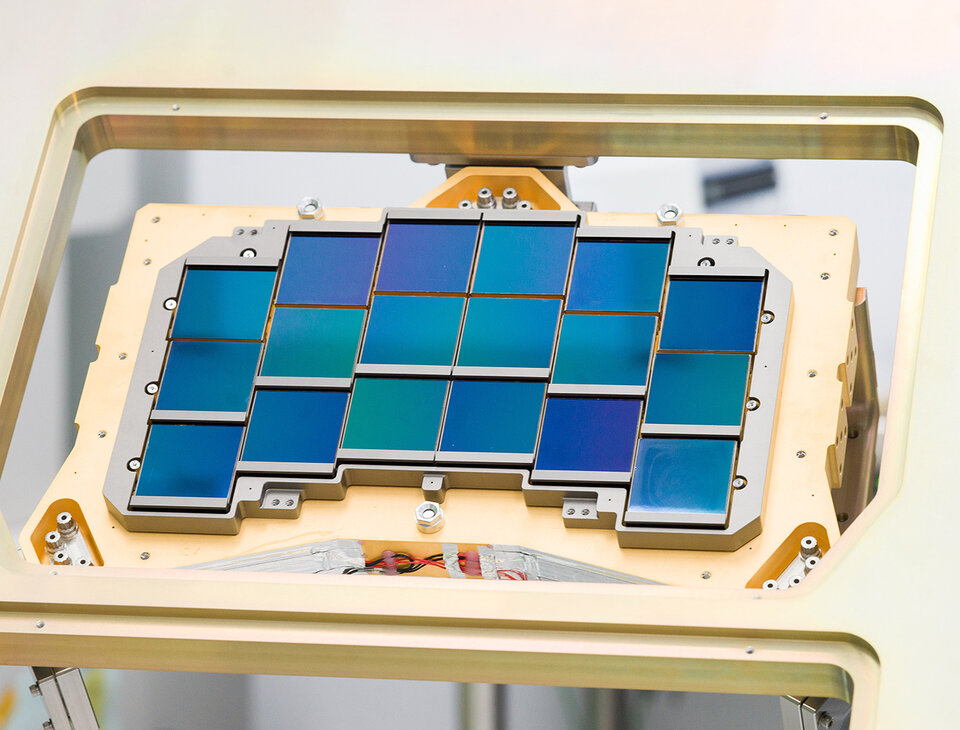
Spacecraft and instruments: The Roman telescope has a primary mirror of 2.4 m and two instruments: the Wide Field Instrument (WFI) and a Coronagraph Instrument technology demonstration. The WFI is a 300-megapixel multi-band visible and near-infrared camera. The Coronagraph Instrument uses destructive interference to block out starlight in order to look for faint planets around them.
Journey and orbit: Roman launched on a SpaceX Falcon Heavy rocket from NASA’s Kennedy Space Center in Florida, USA. The space telescope will operate on an orbit around the second Lagrange point of the Sun-Earth system (L2).
Lifetime: The mission has a nominal lifetime of five years with a potential five-year extension.
Mission facts:
- In 2010, the Roman space telescope was put forward as the top priority for the next decade in astronomy by the United States National Academy of Sciences Decadal Survey Committee. The mission was proposed as WFIRST (Wide-Field InfraRed Survey Telescope) at the time.
- Roman’s primary mirror is 2.4 metres in diameter, as large as the primary mirror of the Hubble Space Telescope.
- The Wide Field Instrument will provide images of the same quality as Hubble, but its field of view is 200 times (0.28 square degrees) greater than Hubble’s infrared field of view.
- Roman will gather up to 20 petabytes of data over the course of its five-year primary mission. This is the same amount of data as that of 10 000 000 HD movies all together.
- The Coronagraph Instrument could be capable of imaging Jupiter-sized exoplanets in Jupiter-like orbits around their host stars.