The mission
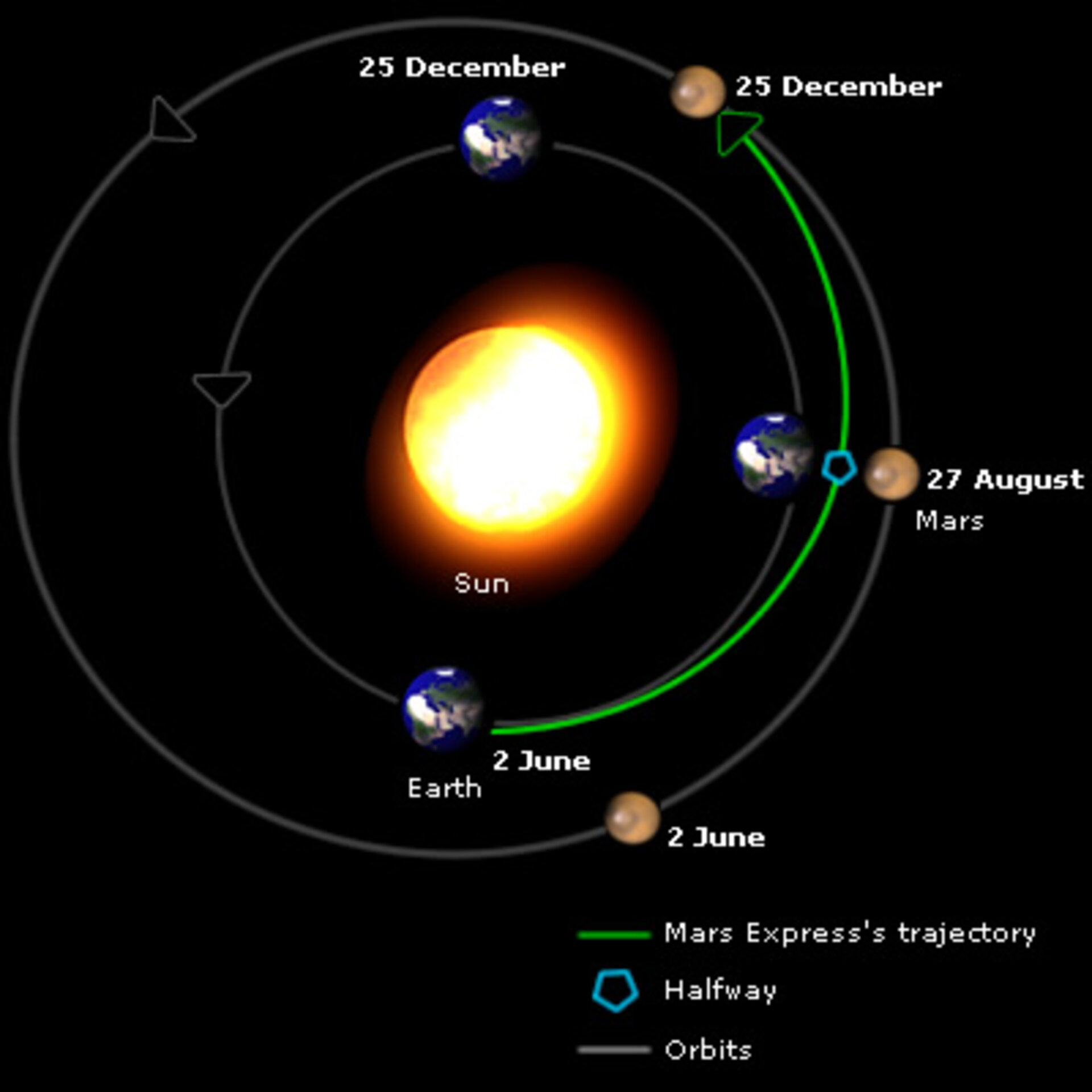
Mars Express set off on 2 June 2003
At this time of year the positions of the two planets made for the shortest possible route, a condition that occurs once every 26 months.
The intrepid spacecraft began its six-month journey from the Baikonur launch site in Kazakhstan on board a Russian Soyuz/Fregat launcher.
Having escaped the Earth's pull, Mars Express was sent on course for the Red Planet, cruising at a velocity of 10 800 kilometres and hour, relative to Earth. Six days before arrival on 25 December 2003, Mars Express ejected the Beagle 2 lander which was to have made its own way to the correct landing site on the surface.
The orbiter successfully entered Martian orbit on 25 December. First it manoeuvred into a highly elliptical capture orbit from which it moved into its operational near polar orbit later in January 2004.
| During first 440 days | After 440 days | |
| Orbit inclination | 86° | 86° |
|
Apocentre: (furthest point from Mars) |
11 560 km | 10 107 km |
|
Pericentre: (closest point to Mars) |
259 km | 298 km |
| Period | 7.5 h | 6.7 h |
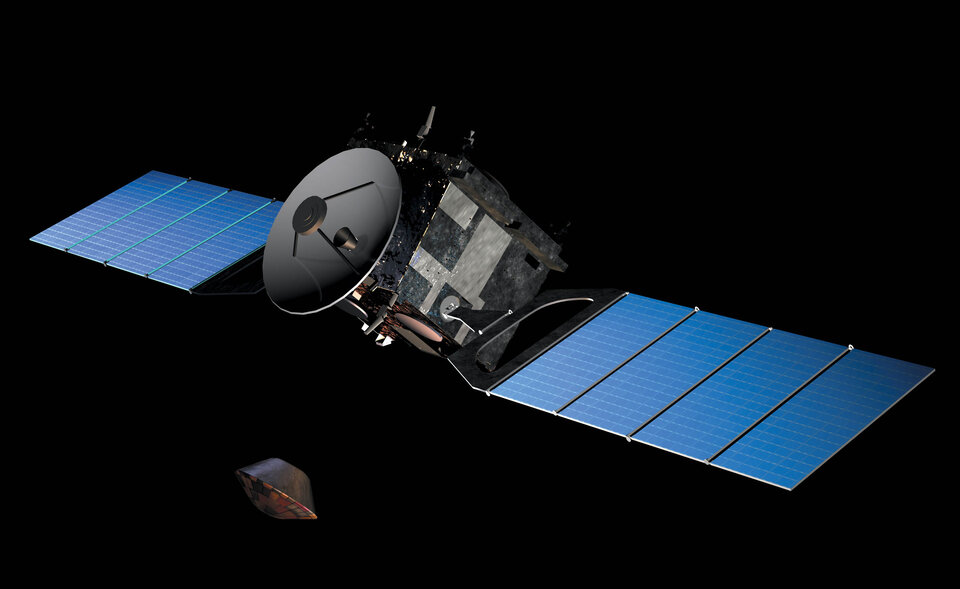
Mars Express will remain in orbit around the Red Planet for at least one Martian year, 687 Earth days, which is the nominal mission lifetime.
During this time, the point of the orbit closest to Mars (pericentre) will move around to give the scientific instruments coverage of the entire Martian surface at all kinds of viewing angles.

Beagle 2 entry, descent and landing
Beagle 2 was planned to descend to the surface, entering the atmosphere at more than 20 000 kilometres per hour. A heat-resistant shield would have protected it as friction with the upper atmosphere slowed it down.
When its speed had fallen to about 1600 kilometres per hour, a parachute would have deployed to slow it further. Finally, large gas-filled bags inflate to protect it as it bounced to a halt on the chosen landing site.
As soon as the lander came to a halt, the gas bags would have been jettisoned, its clam-like outer casing sprung open, its solar panels unfurled, the robotic arm deployed and its cameras started to take in the view.
Unfortunately, the Beagle 2 lander was declared lost after it failed to make contact with orbiting spacecraft and Earth-based radio telescopes.
The landing site
Beagle 2 was planned to land on Isidis Planitia, a large, flat sedimentary basin straddling the relatively young northern plains and ancient southern highlands, where traces of life could have been preserved.
The intended landing site (10.6°N, 270°W) was at low latitude to minimise the amount of insulation (and hence mass) needed to protect the lander from the cold Martian night.
The site was not too rocky to have threatened a safe landing (but rocky enough to be interesting for the experiments), had few steep slopes down which the probe may have bounced as it landed, and was not too dusty.
Isidis Planitia is at a low enough elevation to have provided sufficient depth of atmosphere to allow the parachutes to have braked the lander's descent.

Communications and spacecraft operations
During each orbit, Mars Express spends some time turned towards the planet for instrument observations and some time turned towards Earth for communications with ground stations.
Data collected by the orbiter instruments is transmitted to an ESA ground station at New Norcia near Perth, Australia, at a rate of up to 230 kbps. Between 0.5 and 5 Gbits of scientific data is downlinked from the spacecraft to Earth every day.
From Perth they are sent on to the European Space Operations Centre (ESOC) in Darmstadt, Germany, which adds spacecraft attitude and orbital data, and then retransmits the data to the instrument Principal Investigators (PI) for further processing and analysis.
After about six months, the processed data will be sent to the European Space Research and Technology Centre (ESTEC) in the Netherlands for placing in a publicly available Mars Express science data archive.
Information on the health and position of the spacecraft is included in a separate data stream. The Mars Express operations team at ESOC use this information, together with the forthcoming operational needs of the instruments, to work out new commands to instruct the spacecraft how to behave over the coming months. The new commands are sent to the spacecraft via the Perth ground station.