


Flaring black hole whips up ultra-fast winds
Leading X-ray space telescopes XMM-Newton and XRISM have spotted an extraordinary blast from a supermassive black hole. In a matter of hours, the gravitational monster whipped up powerful winds, flinging material out into space at eye-watering speeds of 60 000 km per second.

The gigantic black hole lurks within NGC 3783, a beautiful spiral galaxy imaged recently by the NASA/ESA Hubble Space Telescope. Astronomers spotted a bright X-ray flare erupt from the black hole before swiftly fading away. As it faded, fast winds emerged, raging at one-fifth of the speed of light.
“We’ve not watched a black hole create winds this speedily before,” says lead researcher Liyi Gu at Space Research Organisation Netherlands (SRON). “For the first time, we’ve seen how a rapid burst of X-ray light from a black hole immediately triggers ultra-fast winds, with these winds forming in just a single day.”
Devouring material
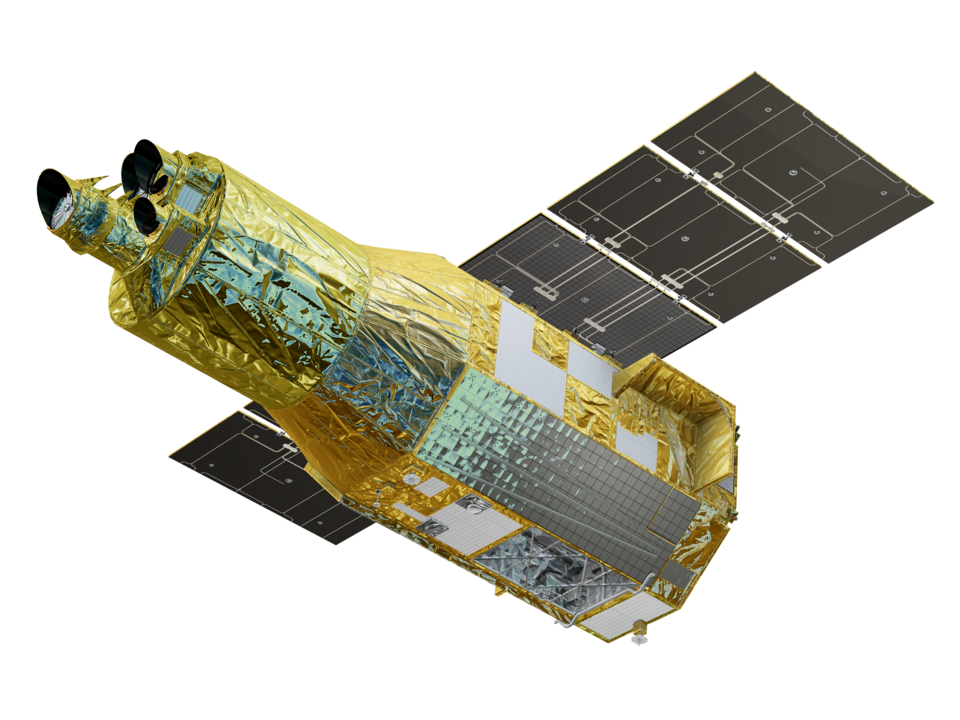
To study NGC 3783 and its black hole, Gu and colleagues simultaneously used the European Space Agency’s XMM-Newton and the X-Ray Imaging and Spectroscopy Mission (XRISM), a JAXA-led mission with ESA and NASA participation.
The black hole in question is as massive as 30 million Suns. As it feasts on nearby material, it powers an extremely bright and active region at the heart of the spiral galaxy. This region, known as an Active Galactic Nucleus (AGN), blazes in all kinds of light, and throws powerful jets and winds out into the cosmos.
“AGNs are really fascinating and intense regions, and key targets for both XMM-Newton and XRISM,” adds Matteo Guainazzi, ESA XRISM Project Scientist and co-author of the discovery.
“The winds around this black hole seem to have been created as the AGN’s tangled magnetic field suddenly ‘untwisted’ – similar to the flares that erupt from the Sun, but on a scale almost too big to imagine.”
A little less alien
The winds from the black hole resemble large solar eruptions of material known as coronal mass ejections, which form as the Sun hurls streams of superheated material into space. In this way, the study shows that supermassive black holes sometimes act like our own star, making these mysterious objects seem a little less alien.
In fact, a coronal mass ejection following an intense flare was spotted at the Sun as recently as 11 November, with the winds associated with this event thrown out at initial speeds of 1500 km per second.
“Windy AGNs also play a big role in how their host galaxies evolve over time, and how they form new stars,” adds Camille Diez, a team member and ESA Research Fellow.
“Because they’re so influential, knowing more about the magnetism of AGNs, and how they whip up winds such as these, is key to understanding the history of galaxies throughout the Universe.”
A joint discovery
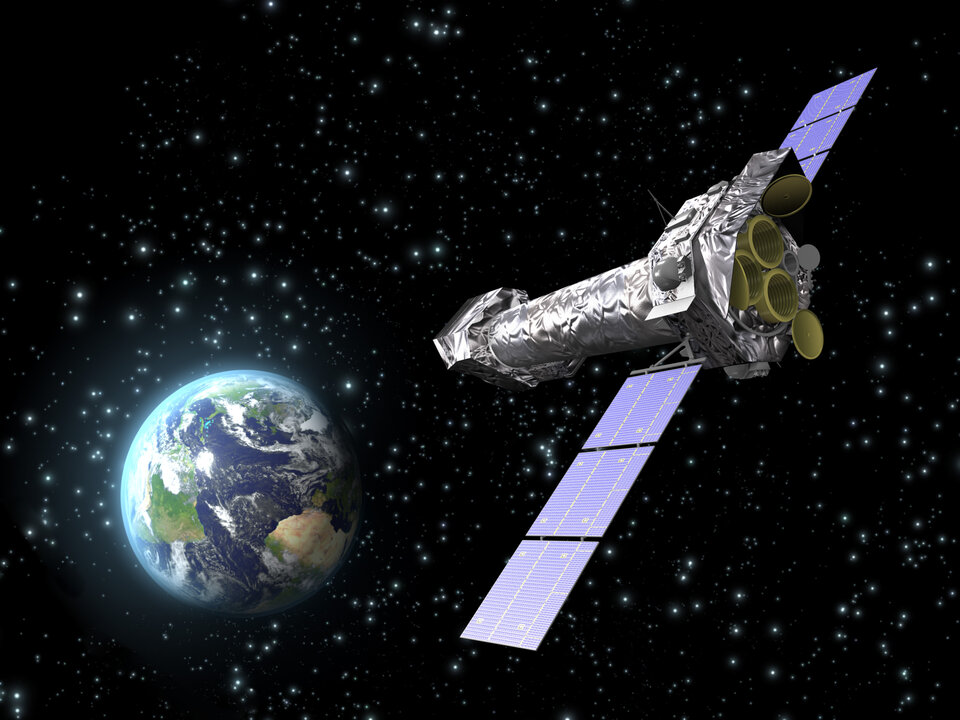
XMM-Newton has been a pioneering explorer of the hot and extreme Universe for over 25 years, while XRISM has been working to answer key open questions about how matter and energy move through the cosmos since it launched in September 2023.
The two X-ray space telescopes worked together to uncover this unique event and understand the black hole’s flare and winds. XMM-Newton tracked the evolution of the initial flare with its Optical Monitor, and assessed the extent of the winds using its European Photon Imaging Camera (EPIC). XRISM spotted the flare and winds using its Resolve instrument, also studying the winds’ speed, structure, and figuring out how they were launched into space.
“Their discovery stems from successful collaboration, something that’s a core part of all ESA missions,” says ESA XMM-Newton Project Scientist Erik Kuulkers.
“By zeroing in on an active supermassive black hole, the two telescopes have found something we’ve not seen before: rapid, ultra-fast, flare-triggered winds reminiscent of those that form at the Sun. Excitingly, this suggests that solar and high-energy physics may work in surprisingly familiar ways throughout the Universe.”
Notes for editors
‘Delving into the depths of NGC 3783 with XRISM: III. Birth of an ultrafast outflow during a soft flare’ by Liyi Gu et al. is published today in Astronomy & Astrophysics.
For more information, please contact:
ESA Media Relations
media@esa.int