


Lightning watch satellites spotted mystery Atlantic fireball
A meteor that exploded high above the South Atlantic off the coast of Argentina in April was detected by lightning imagers aboard European and US weather satellites. Their observations are helping to pin down its likely origin.

On the morning of 1 April at 02:13 UTC (04:13 CEST), US government sensors detected a high-velocity fireball whose brightness peaked at an altitude of 90.5 km over the South Atlantic, which was duly catalogued in NASA’s Jet Propulsion Laboratory Center for Near-Earth Object Studies (CNEOS) fireball database.
The primary source from such detections are space-based military surveillance satellites, which have proved adept at identifying meteors entering the atmosphere.

“The data passed to CNEOS about such events includes a measurement of total radiated energy and of the estimated entry speed,” explains Juan Luis Cano of ESA’s Planetary Defence team, co-author of a new paper on the event.
“In the case of this 1 April fireball, the reported velocity components implied such a high entry speed that independent verification of such value was required in order to later assess its possible origin.”

Supplementing the initial US government sensor data, this new paper published in the Research Notes of the American Astronomical Society harnesses observations gathered from a pair of civilian lightning imagers aboard geostationary weather satellites which also observed the fireball between them: the Geostationary Lightning Mapper on the US GEOS-East satellite and the Lightning Imager on Europe’s Meteosat Third Generation (MTG) Imager-1 satellite.
“The Lightning Imager on MTG-I1 and its US counterpart detect millions of lightning flashes from their approximately 36 000 km altitude on the equator on a daily basis,” notes Juan Luis. “But not all the flashes they see come from lightning."
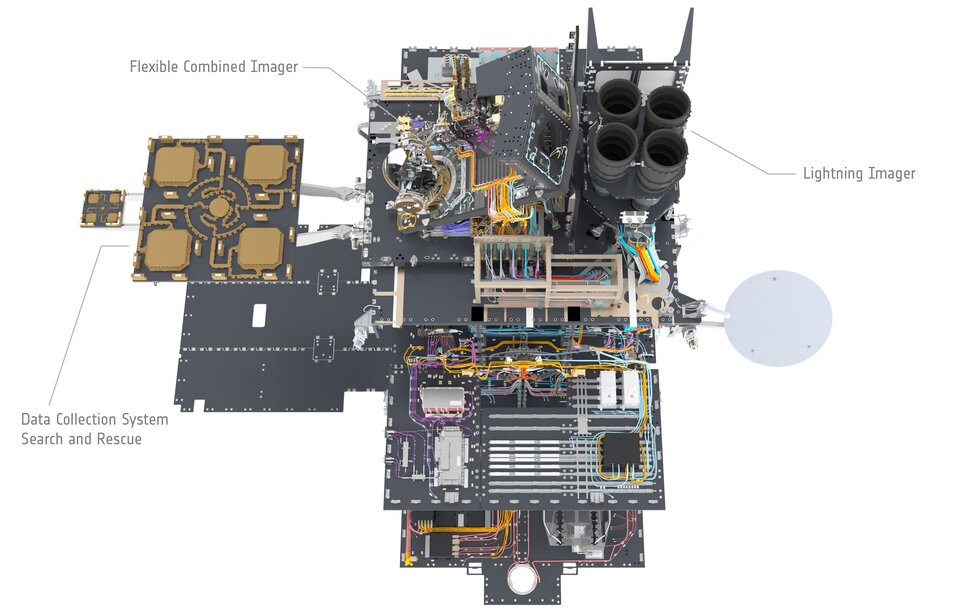
“Working with MTG-I satellite operator Eumetsat as well as with our American colleagues, our research has shown that fireball detonations have their own distinct signatures, possessing clear linear paths and a gradual increase in intensity before fading away, unlike the fixed points of lightning flashes.
“So we have been investigating methods to routinely separate out fireballs from lightning, to build a global inventory of these events in support of our knowledge of the very small-object population in near-Earth space for planetary defence.”

ESA graduate trainee Niels Rubbrecht, working on this process, adds: “Our experience has shown that detecting fireballs with the MTG-I Lightning Imager is not simply a matter of identifying a new signal – it requires rethinking the entire processing chain, which was originally designed and optimised to recognise lightning and reject non-lightning events.”
The new study also notes the availability of relevant acoustic signatures. The international Comprehensive Nuclear-Test-Ban Treaty Organization operates a worldwide network of acoustic stations to detect low-frequency ‘infrasound’ signals inaudible to human ears, associated with nuclear detonations – and also fireballs.

“Having documented the multi-sensor record, our next step will be to carry out the detailed analysis required,” explains Juan Luis. “So far, by applying two independent velocity models to the combined satellite observations, we find a peak-brightness location and direction consistent with the US government findings, but with a velocity magnitude around 18% lower, helping constrain its likely origin from the outskirts of our Solar System.”
”As part of our coming activities we will include a follow-on energy estimate derived from the low-frequency acoustic records, and its intercomparison with space-based estimates.”
EU-ESA Workshop in Meteor Observations for Planetary Defence
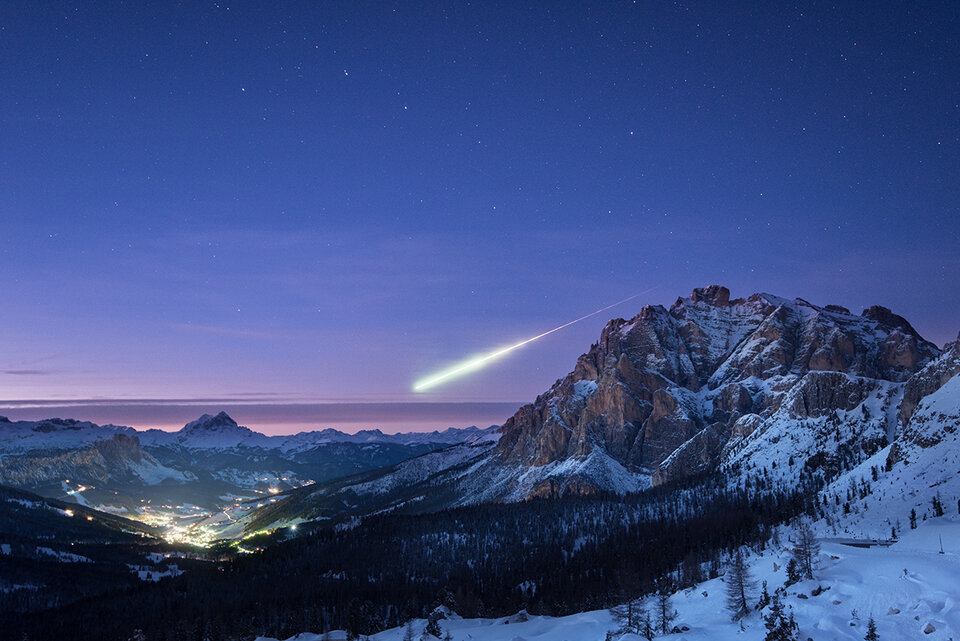
Small ‘imminent impactors’ are today routinely detected before entering Earth’s atmosphere, creating new opportunities for collaboration across the planetary defence and meteor communities.
For metre-scale objects, pre-impact telescopic observations can be combined with atmospheric measurements from dedicated fireball camera networks, radar, infrasound and seismic stations (to detect impacts) as well as space-based sensors.
Europe has strong capabilities across these different observational techniques, with the potential to connect an object’s orbit and physical properties before atmospheric entry with its subsequent trajectory, fragmentation, impact effects and possible meteorite recovery.

In practice however coordination and communication across these communities remain fragmented.
Accordingly the European Commission and ESA’s Planetary Defence Office are jointly organising the EU-ESA Workshop on Meteor Observations for Planetary Defence, taking place on 3-5 November in Petralia Sottana, Sicily, Italy – the same island where ESA’s inaugural asteroid-detecting Flyeye telescope is being erected, and from where the very first asteroid was discovered, back in 1801.
People interested in participating in person are invited to register by 23 October 2026, and a limited number of presentation slots remain available. A link to the website and registration portal can be found here.