Recording its own demise: Draco’s design challenge
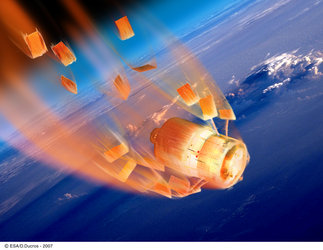
The European Space Agency’s Draco mission will measure and film its own fiery demise as it reenters the atmosphere. This raises the question: how can we still collect its data after such violent destruction? The answer involves a heat shield made of cork, a meticulously shaped capsule, zapping plasma through wind tunnels and parachute drop tests.
“Draco’s unique data will improve reentry modelling and design-for-demise technologies that will let new satellites burn up more completely, reducing casualty risks on the ground. It will also give us some much needed data on the effect of reentries on our atmosphere. But to get that data is nowhere near easy,” says Stijn Lemmens, Draco project manager at ESA.

“Our biggest design challenge lies in meeting two contrasting requirements: having Draco disintegrate normally during reentry just like any average satellite, yet also recording the event and storing its data in a capsule that stays intact throughout, until the data can be transmitted safely.”
The development of Draco is led by prime contractor Indra, coordinating the design of the mission, developing the platform and capsule, and overseeing the physical demonstration of all critical technologies.
Testing, or, throwing everything at it
Researchers at the von Karman Institute for Fluid Dynamics (VKI) conduct fundamental studies on how materials behave and burn under extreme conditions. Now, that knowledge is applied to Draco and in particular the capsule that must survive reentry.
“The design goal is simple but demanding: to ensure that the materials, systems and electronics can withstand the intense heat and forces of reentry and emerge intact, carrying their valuable data safely back down,” says Bernd Helber, Draco technical lead at VKI.
“We developed and tested the capsule heat shield, made from Portuguese cork, together with the insulation system for the internal instrumentation, combining specially designed insulation and ablative fibre felts. We then tested if all the relevant systems can survive. We simulate conditions that replicate atmospheric reentry as closely as possible with hot and cold tests in our wind tunnels, including hitting the capsule with streams of plasma that are as beautiful as they are destructive.”

“For us at VKI, one of the most exciting aspects of this project is that this is not just a laboratory exercise, it is hardware that will actually fly in space,” says Amandine Denis, Draco project manager at VKI.
“Our instrumentation engineers usually spend weeks building something just so that we can burn it in a matter of seconds. But this time, our final product will go into space – and come back down.”
A long string of critical steps

Although the mission will last only about twelve hours, there is no shortage of critical moments. The data collected by the 200 sensors and four cameras will immediately be processed onboard Draco while it is burning, in order to send only the most relevant data to be stored in the capsule.
In the chain of critical events needed to then secure this data, three stand out:
1) The satellite and capsule must separate successfully and on time.
The capsule needs to let go late enough to get as much data as possible, but early enough to not get dragged into destruction itself. The team spent a lot of time developing and refining the active separation system to function reliably just when the conditions are at their most volatile and the satellite potentially tumbling at rates that could reach over five full turns per second. Separation will be triggered either by a timer or if it reaches a tumble rate beyond what the system can tolerate.
2) The capsule must stabilise itself without any active control systems.
The capsule must rely entirely on its own shape to stabilise, with a smart design by VKI that combines elements of three previously proven capsule geometries. The great challenge here is to ensure that the capsule naturally reaches the correct orientation, with its top indeed being at the top, and managing this quickly enough.


Access the video
3) The capsule deploys its parachute and transmits its data.
Once the stabilised and upright capsule reaches denser layers of the atmosphere (around an altitude of 10 km) the back shell is jettisoned, and the parachute deploys. This will let the capsule descend much slower, allowing it to connect to a satellite and upload its data. It will share anywhere from 20 MB to 1 GB, depending on the time available, before ultimately crash landing.
A plane as an external ‘backup’

To enrich the data Draco will collect, ESA is also preparing a plane campaign to witness the reentry from below, adding a unique calibration point. Following previous plane observation campaigns of ESA’s Cluster reentries, a plane with scientists and instruments onboard will help de-risk the mission.
Draco will have specially developed marker materials onboard by Astros Solutions that will give off unique green sparks when they heat up and dissolve because of the reentry forces. This is a novel experiment will help more precisely calibrate the data from the spacecraft with the observations, hopefully inspiring similar experiments in the future.
Linking Draco’s in situ data and the footage from the aircraft will further validate and improve space debris and reentry models, supporting future observation campaigns as well as the interpretation of past reentries.
As reentry observations from the inside so far have been very few and far between, Draco’s measurements will provide unprecedented data and significantly enhance our understanding of spacecraft breakup and fragment survival.
Draco’s next steps
With the design determined, the project is entering the next phase, with the full-scale capsule to be built and subjected to another round of testing throughout the rest of 2026. Its development will close with another dramatic test: a parachute drop test from a balloon at 25 km altitude performed by Indra, to test the capsule’s stabilisation, the parachute’s deployment and the data connection.
“On the ground, or even at 25 km altitude, you test parts and systems separately, but in space they will all need to work at the same time. The two very different engineering worlds of building satellites and building capsules are coming together in Draco, with both elements needing to fall into place seamlessly,” says Stijn Lemmens, Draco project manager at ESA.

Access the video
“In the end, the Draco mission is a technological experiment on a budget. In an ideal world, you continue designing and testing until all uncertainties and potential points of failure are removed or backup systems added. We do not have the luxury to go quite that far, some risk will remain. But for me, that’s also what makes this mission so exciting and rewarding: it’s technological space exploration at is finest, operating on a technological knife edge.”