


11 NOV. 2026
publication date
714
Views
Polish company Orbital Matter achieved a world first when their 3D printer onboard the Replicator 2 satellite printed a 30-cm boom – the first ever object manufactured in the harsh conditions of open space.
In just 30 minutes, one of the four printers flying on Orbital Matter’s Replicator 2 printed a boom that extends from the miniature satellite. The printer was intentionally nestled right under a stowed solar array, so that the gradually extending boom could push the array outward and unfold it, confirming that the printing test was successful.
So far, all reported achievements in additive manufacturing in space took place under controlled conditions, like stable pressure and temperature. These include NASA’s world-first 3D printing of polymers on the ISS in 2014, DLR’s first 3D printing of metals in suborbital space in 2021 and ESA’s recent world-first 3D printing of metals on orbit in 2024.
Media modal
“Orbital Matter’s achievement is unprecedented – it is the first time in history that a part has been printed in open space, and therefore in an uncontrolled environment,” comments Advenit Makaya, ESA’s advanced manufacturing engineer.
Media modal
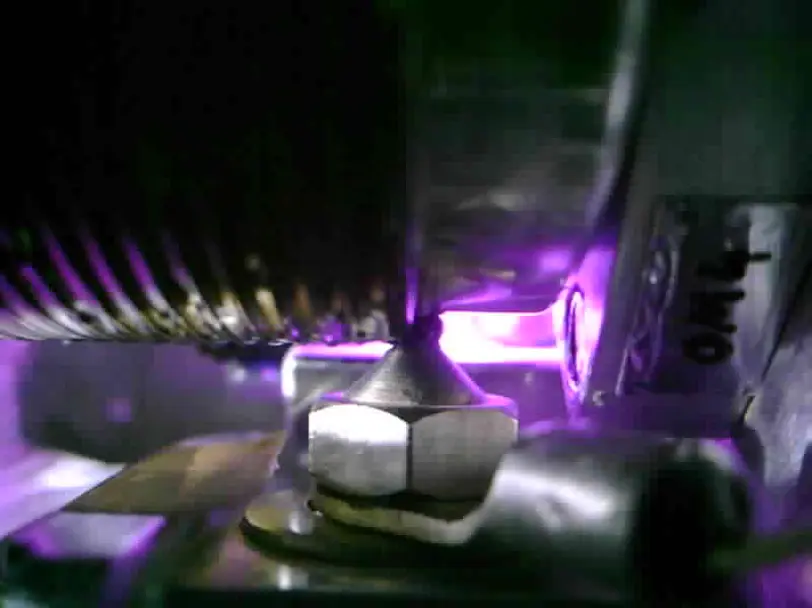
The boom is printed in a spiral onto a rotating platform
The company’s 3D printer technology uses a liquid photopolymer – a resin that forms solid plastic when exposed to light. Compared to metal printing or standard polymer printing methods, both of which require heat, their technology uses a relatively low amount of energy, making for an important advantage in space where energy sources are limited.
The printer – only slightly larger than a Rubik’s cube – built the boom in a continuous spiral, resulting in a light and hollow structure measuring 32.5 cm in length and 3.8 cm in diameter.
Space poses serious challenges to any technology that braves its extreme environment. 3D printing, or ‘additive manufacturing’, is no exception. Vacuum causes air bubbles trapped in the printing material to escape in a process called outgassing; temperatures ranging from far below freezing to boiling hot can disturb the printing process, and so can microgravity.
But manufacturing directly in space means large structures could be built using fewer materials, as they wouldn’t need to withstand the rigours of launch. This could open a door for larger communication antennas or telescopes for science missions, and even space stations built directly in orbit.
Media modal

Replicator 2 before flying to space
Orbital Matter’s latest demonstration goes a step further: the same process that printed a structural element also deployed the spacecraft’s solar array, a job that normally requires a dedicated mechanism or motor.
“We achieved several things with this test: our print was stable, resulting in a boom that looks very consistent and smooth, showing very little outgassing during printing,” says Jakub Stojek, CEO of Orbital Matter. “This is remarkable, considering the resin was stored onboard the satellite in orbit for three months before printing.”
The printer worked in both daylight and nighttime conditions, meaning the process had to withstand drastic temperature changes following varying exposure to sunlight.
Media modal

3D printers during testing
“The breakthrough is not simply producing material in a vacuum. We printed a rigid structure directly in space that helped deploy a stowed solar array,” adds Robert Ihnatisin, Chief Technology Officer at Orbital Matter. “Our next challenge is to understand how these structures perform over time in orbit and to scale the technology from centimetres to metres and beyond for future missions.”
“Orbital Matter’s achievement is an important step towards in-space manufacturing capability with resulting benefits for sustainable and self-sufficient space activities. It is also another demonstration of Europe’s current leadership in this field,” concludes João Gandra, ESA’s coordinator for manufacturing research and development.
“At ESA, we are supporting a range of in-space manufacturing demonstrations,” adds Thomas Rohr, Head of the Materials, Manufacturing and Assembly team at ESA. “We encourage further activities that test these processes under representative space conditions, both in ground facilities and in orbit through flight experiments, some of them fully exposed to the space environment. This is in line with the recommendations from the ESA Out of Earth Manufacturing white paper which was recently issued.”
Orbital Matter is a successful graduate of ESA’s Business Incubation Centre (BIC) programme in Poland, and the launch of their first technology demonstration satellite, Replicator, on Ariane 6’s first flight in 2024 was enabled through the ESA PUSH programme.
Share this page


stay updated
Subscribe to our newsletter to receive the latest news, mission updates, and exclusive insights directly in your inbox. Be the first to know about our upcoming projects and breakthroughs.