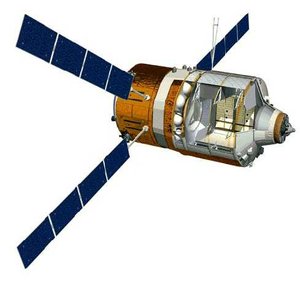
Jules Verne payload (May 2005)
| Mass budget in launch configuration | ||
|---|---|---|
| Dry cargo mass (includes bags & packing material) | ~ 1 610 kg | |
| Refueling propellant transfered to ISS (UDMH + NTO): | + 860 kg | |
| Water: | + 280 kg | |
| Gas (Nitrogen, Oxygen or air): | + 100 kg | |
| Propellant (MMH + MON) available for ISS re-boost & attitude control: | + ~2 010 kg | |
| Total net cargo | = 4 860 kg | |
| Total cargo support hardware (1) | + ~ 2 260 kg | |
| Total gross cargo(net cargo + its support hardware) | = 7 120 kg | 7 120 kg |
| Jules Verne mission propellant (2): | + 3 690 kg | |
| Jules Verne empty (without propellant, without cargo & its support hardware (1) | + 8 790 kg | |
| Jules Verne mass at launch: | = 19 600 kg | |
| Ariane 5 ES-ATV launch capability | 20 750 kg | |
| Waste download capacity: | 6 340 kg (5 500 kg dry material + 840 kg liquid) | |
| Jules Verne dimensions | |
|---|---|
| Dry cargo volume to be transferred to the ISS (3): | ~ 8 m³ |
| Pressurized cabin volume: | 48 m³ |
| Overall ATV length: | 10.3 m |
| Max ATV diameter: | 4.5 m |
| ATV-A5 interface diameter: | 3.9 m |
(1) Cargo support hardware : containers, racks, shelves, lateral guides, bags; pipes and tanks for water, gas, refueling and reboost propellants; Kurs antenna and anti-meteorite protection.
(2) About one third of the 3 690 kg mission propellant figure corresponds to the propellant needed for the demonstration phases unique to the Jules Verne flight (such as testing the rendezvous abort modes: stopping the approach, going back to a parking orbit and delaying the rendezvous until the following day like the touch-and-go of an aircraft).
(3) Dry cargo volume (with 6 racks which are a kind of support shelf) available is about 13.8 m³ (9.3 m³ inside the racks + 4.5 m³ outside the racks), but the payload priority for the Jules Verne mission is given to re-boost propellants.