Spin Your Thesis! programme phases
The yearly Spin Your Thesis! Programme is outlined in detail below. A brief summary of the milestones and the associated dates of the edition Spin Your Thesis! 2022 can be found on the 2022 Schedule page. The guidelines and templates to the deliverables can be found in the List of Documents.
A.1 Project definition and proposal writing
During this first phase, the applicants form their team, find a professor or supervisor willing to endorse the project, and start thinking seriously about their project. Student teams should work towards defining the objective and operations of the experiment, and assess if the experiment is feasible.
Once the student team has defined the project, the team can begin conceptualizing the experimental design. At the end of this process, teams are expected to have accurate knowledge of the scientific theory behind their project, and a preliminary design of the experiment itself, in both a qualitative and quantitative way.
The experiment proposal should focus on the scientific and technological objectives of the project, and on the technical details needed to implement the experiment. Generally, teams are invited to explain what they intend to investigate, and how they are going to investigate it. Teams should show that they have extensive knowledge of their project topic using references to scientific literature in a bibliography. Teams should also include any hypotheses or expected results of the experiment.
Documents expected: Experiment proposal, formal endorsing letter(s), and ‘privacy notice and consent form’ ratified by each team member
Deadline: November 21, 2021, 23:59 CET
A.2 Review of the proposal and shortlisting of teams
The ESA Education Office produces a shortlist of teams who have met the eligibility criteria, have demonstrated appropriate background knowledge of the science, and whose experiments are suitable for the Spin Your Thesis! programme.
The selected teams will be offered support from an ELGRA mentor.
Deadline: November 28, 2021, 23:59 CET
B.1 Selection Workshop
The selection workshop takes place over the course of one day on a video teleconference platform. Shortlisted teams are provided an opportunity to present their project to the ESA Education Office and a review board made up of ESA Experts. The review board will select the final list of teams to participate in the Spin Your Thesis project, and make the announcement approximately one week after the workshop takes place.
Deadline: December 14, 2021
B.2 Training Workshop and Experiment Development
The gravity-related experiments training week has teams from Spin, Drop, and Fly Your Thesis programs meeting to help participating teams organize their projects, and achieve the best quality science for their research topics. Participating students learn important topics such as project management, risk mitigation, verification and validation of their system, and other skills required to carry out a successful project.
Teams have the opportunity to meet with and discuss preliminary designs with engineers from the facilities where their experiment will take place. Workshop sessions are hosted by former participants in the programme to share their experiences, knowledge, and lessons learned with students. Previous workshops have had an experienced ESA astronaut to discuss their adventures in space and how their experience has shaped their view of the Earth.
Ideally the training workshop will happen in person at ESEC in Belgium, however extraneous circumstances may require this event to take place online via teleconference.
Deadline: January 25-28, 2022
C. Experiment preparation
Selected teams start to implement and build their experiment with the assistance of qualified professionals and their ELGRA mentor. When designing the experiment, teams must take the 'LDC Experimenter User Manual' into account. Furthermore, teams will have access to experts from ESA’s Education Office, and the Life and Physical Sciences Instrumentation and Life Support Laboratory (LIS) to answer any questions they may have about any portion of their project.
During the preparatory phase, teams are required to expand the experiment report template. Teams share this document with the ESA Education Office for feedback and guidance on their project and process. The experiment report serves as both a reference document throughout the preparation and execution of the experiment, and as a final report once the programme ends.
The development cost of the experiment is partly supported by ESA's Education Office.
Documents expected: Experiment report, and ERASMUS experiment record
Deadline: Two to three versions of the experiment report are delivered to ESA’s Education Office and LIS before the campaign. The ERASMUS experiment record is delivered with the second version of the experiment report.
D. Hypergravity campaign
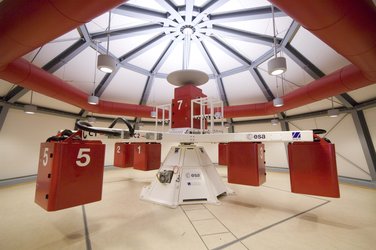
Selected teams perform their experiments during, or after, September 2022. ESA’s Spin Your Thesis! campaign takes place on the Large Diameter Centrifuge, at ESTEC, Noordwijk, the Netherlands. The campaign lasts one to two weeks depending on the number of teams selected, and each team has 2.5 days to perform their experiments in the LCD.
After the campaign teams must deliver a report to ESA Education Office with: lessons learned, feedback on the programme itself, and their opinion about the programme and campaign could be made better.
Documents expected: Feedback report
Deadline: 2 weeks after campaign
E. Analysis of results and Final Report submission
After the campaign teams have the opportunity to analyse the results from their experiment. These results are documented in the Spin Your Thesis Final Report that is to be submitted to ESA's Education Office within 4 months of the experiment. Teams may write a scientific paper based on their experimental findings, if this is applicable to the team and the experiment. Students may be sponsored to attend international conferences (such as the ELGRA Biennial Symposium) to present their results to the scientific community.
Documents expected: Final versions of the experiment report and of the ERASMUS experiment record
Deadline: Four months after experiment campaign
Please note that the schedule detailed above is subject to change.