Drop your Thesis! Programme phases
The annual Drop Your Thesis! Programme phases is described detail here. It is intended to give insight into what each phase the programme entails, and the expectations and milestones of each phase. The brief overview of the 2022 Schedule can be used as a quick reference for teams. Further information can be found in the List of documents.
A.1 Project definition and writing of the proposal by applicant
During this phase, the students assemble the members of their team, and identify an endorsing professor. It is preferable if the endorsing professor is an academic supervisor of one of the team members. The team, and potentially the endorsing professor, discuss project ideas and feasibility to piece together an experiment for Drop Your Thesis.
With a defined project and experiment, the student team should perform a scientific literature review of similar experiments performed in the past. The literature review ensures that the project is not duplicating previous research, and acts as a guide to assist teams in the experimental design. The team uses the knowledge from their literature review to develop the preliminary design of their proposed experiment. This process should result in an accurate plan of the intended scientific method, and experimental plan for their project.
The teams should think carefully about which drop tower mode to choose. Although the catapult mode may appear more attractive, the implementation of the experiment is more complicated and may not even be feasible. Therefore, reading the ZARM Drop Tower User Manual document is mandatory. Furthermore, if teams wish to use the Gravitower, the team must consider that because of the early development stages of the facility, it may not be accessible for the 2022 campaign. All currently available documentation can be found in the list of documents.
The experiment proposal should focus on the scientific and technological objectives of the project, and on the technical details for the implementation of the experiment. Generally, teams are invited to explain what they intend to investigate, and how they are going to implement their experiment. Teams should show that they have in-depth knowledge of their project topic using references to scientific literature in a bibliography. Teams should also include any assumptions or hypotheses used in the experiment, and any expected results of the experiment.
Documents expected: Experiment proposal, formal endorsing letter(s), and ‘privacy notice’ ratified by each team member.
Deadline: November 14, 2021, 23:59 CET
A.2 Review of the experiment proposal and selection of the winning team
The ESA Education Office produces a shortlist of teams who have met the eligibility criteria. Then ZARM, the European Low gravity Research Association (ELGRA) and ESA Academy select the teams that have demonstrated appropriate background knowledge of the science, and whose experiments are suitable for the Drop Your Thesis programme. The selection process may involve the student team to deliver via teleconferencing, a presentation of the project proposal to the Selection Board.
Deadline: December 2, 2021
B. Training Workshop and Experiment Development
The gravity-related experiments training week has teams from Spin, Drop, and Fly Your Thesis programmes meeting to help participating teams organize their projects, and achieve the best quality science for their research topics. Participating students learn important topics such as project management, risk mitigation, verification and validation of their system, and other skills required to carry out a successful project.
Teams have the opportunity to meet with and discuss preliminary designs with their appointed facility engineers. Workshop sessions are hosted by former participants in the programme to share their experiences, knowledge, and lessons learned with new teams. Previous workshops have had an experienced ESA astronaut to discuss their adventures in space and how their experience has shaped their view of the Earth.
Ideally the training workshop will happen in person at ESEC in Belgium, however extraneous circumstances may require this event to take place online via teleconference.
Deadline: January 25-28, 2022
C. Experiment preparation
Selected teams start to finalize the design of their experiment and begin to implement and build their experiment with the assistance of qualified professionals and their ELGRA mentor (if applicable). The students should prepare the experiment with reference to the ZARM Drop Tower User Manual and in close consultation with ZARM engineers and ESA’s Education Office. The cost of building the experiment is partially supported by ESA's Education Office.
During the preparation phase, teams are required to develop and expand the Experiment Report document. Teams share this document with the ESA Education Office for feedback and guidance on their project and process. The Experiment Report serves both as a reference document through the preparation and execution of the experiment and as a final report once the programme ends.
In certain circumstances it may be possible for the team to use special equipment (e.g. CCD cameras, heating/cooling devices) available from the drop tower operator. These requests are assessed on a case-by-case basis and may carry associated costs for the team.
ZARM and the University of Bremen have technical laboratories and other facilities available for hire upon request. For more information on this, please contact the ESA Education Office.
Documents expected: Experiment report and ERASMUS experiment record.
Deadline: Two to three versions will be delivered to ESA’s Education Office and ZARM engineers before the campaign. The ERASMUS experiment record should be delivered with the second version of the Experiment report.
D. Drop Tower campaign
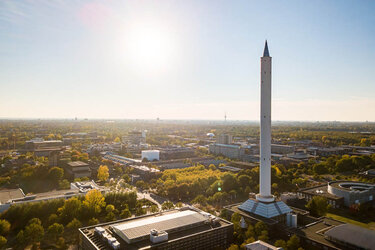
Selected teams perform their experiments during, or after, October 2022. The two-week-long campaign takes place at the ZARM Drop Tower in Bremen, Germany. The first week is dedicated to integration and ground testing of the experiment to reduce the probability of experiment failure. In the second week, teams are allocated five flight opportunities for its experiment (drop or catapult). One flight can be substituted for four hours of time in the Gravitower, should it be available to the team.
After the campaign teams must deliver a report to ESA Education Office with: lessons learned, feedback on the programme itself, and their opinion about the programme and campaign could be made better.
Documents expected: Feedback report
Deadline: 2 weeks after campaign
E. Analysis of results
Students of the selected teams analyse the results obtained during the campaign and provide ESA's Education Office with the final version of their report within 4 months of performing their experiment. If successful, teams are expected to write a scientific paper, thesis, or conference paper of their experiment. Some students may be sponsored by ESA to attend international conferences (such as the ELGRA Biennial Symposium) in order to present their results to the scientific community.
Documents expected: Final versions of the Experiment report and of the ERASMUS experiment record
Deadline: Four months after experiment campaign
Please note that the schedule detailed above is subject to change.