Meet the teams: PW-Sat
Seven teams of university students were selected to fly their CubeSats on the maiden flight of ESA’s Vega launch vehicle. Here is an introduction to the PW-Sat team, which has built the first Polish satellite.
| University | Warsaw University of Technology, in cooperation with the Space Research Centre of the Polish Academy of Sciences |
| Endorsing professor | Piotr Wolański |
| Team | Maciej Urbanowicz, Tomasz Szewczyk, PhD Piotr Orleański, PhD Jerzy Grygorczuk, PhD Marcin Stolarski, Kamil Bobrowski, Andrzej Cichocki, Marcin Dobrowolski, Rafał Graczyk, Marcin Iwiński, Bartosz Kędziora, Adam Kostrzewa, Jan Kostrzewa, PhD Andrzej Kotarba, Andrzej Kotarski, Michał Kurowski, Jakub Lisowski, Marta Mordalska, Marta Tokarz, Łukasz Wiśniewski, Grzegorz Woźniak |

The project was begun by members of the Students’ Space Association, with the intention of becoming the first team to design and develop a Polish spacecraft. They were later joined by members of the Student Space Engineering Scientific Group. Since then, 70-80 people have worked on the project. In 2011, the team was rearranged and the number of people involved was reduced to 22, with a core of 9 members.
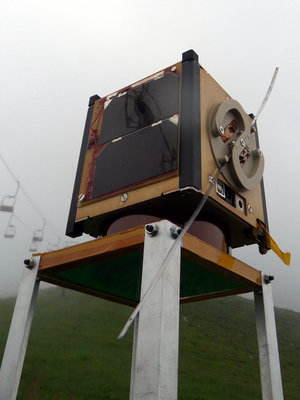
Before they started building the satellite, the team decided to design it as simply as possible, in order to minimise the chance of failure. Their preliminary work included a wooden model of the CubeSat, which was used to demonstrate the antenna deployment system.
The most important criterion for measuring the success of the project is to prove the ability of the satellite to work in space. However, the team was also motivated to seek a way of mitigating the space debris problem, which is one of the most important problems facing present and future space exploration.
Early ideas about using a balloon and a sail for the deorbit system were eventually dropped, partly because of low reliability. After some organisational problems, the team started to collaborate with the Space Research Centre of the Polish Academy of Sciences. This led to the creation of a new payload, which consists of a deployable drag augmentation device (the tail) covered by a new type of solar cell.
The main objective of this experiment is to test the concept of using atmospheric drag to deorbit the satellite. It is hoped to be able to remove the satellite from orbit at a predicted time, about one year after launch. The secondary objective is to test the solar cells, which have never before been used in space.
During its flight, the satellite will send telemetry with information about the status of each subsystem and the parameters of the deployed tail. Radio amateurs will also be able to receive the telemetry.
The CubeSat experience

How did the team members deal with the experience of CubeSat selection, design, construction, testing and integration?
"There were many difficulties. How to organise the team? How to split work into subgroups? How to manage money, people and time? Other difficulties involved changes in the student population and motivation. This resulted in the need to rearrange the team in 2011, and to speed up the design and development process, whilst paying attention to the required quality and fulfilling all of the requirements given by ESA. The new arrangements enabled us to successfully assemble and deliver the PW-Sat."