Meet the teams: XaTcobeo
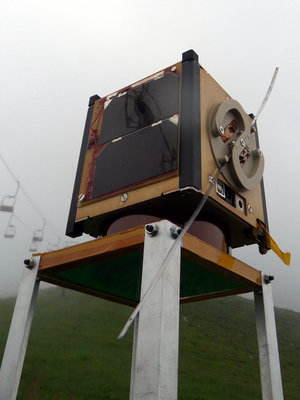
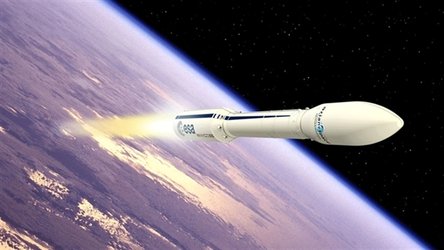
Seven teams of university students were selected to fly their CubeSats on the maiden flight of ESA's Vega launch vehicle. Here is an introduction to the Spanish XaTcobeo team.
| University | University of Vigo and INTA, Spain |
| Endorsing professor | Fernando Aguado-Agelet |
| Team |
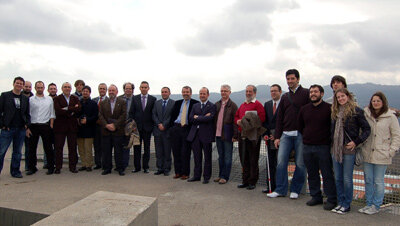
10 professors and 80 students full list here |

The team is composed of more than 80 students, assisted and supervised by teachers from the University of Vigo and by experts in different disciplines from the Instituto Nacional De Tecnica Aeroespacial (INTA).
The project was overseen by a project manager from the University of Vigo, while INTA provided support for all of the management and engineering activities. From an organisational point of view, the group was divided into separate teams responsible for management, engineering, design and science.
Xatcobeo’s primary goal is educational, providing students with the opportunity to participate in a space project, following a methodology of work according to ESA standards.
A secondary objective is the development and operation of three challenging experiments on board the satellite:
The Software Defined Radio (SRAD) is a brand new reconfigurable radio which uses a field-programmable gate array (FPGA). Team members expect to be able to establish a communications link with it, to change in-built modulations and to re-establish the communications link with the new modulation. This technology could have a very important role in future space missions, since it provides the capability to completely redefine a communication system after launch.
The Radiation Displacement Damage Sensor (RDS) is a non-ionising radiation dosimeter, based on long base silicon diodes developed for measurement of the kinetic energies of heavy particles, particularly fast neutrons. Since Xatcobeo will be released into a non-typical low Earth orbit, RDS will have a unique opportunity to map the radiation in this region of space.
- The Panel Deployment Mechanism (PDM) will test and validate a new deployment mechanism If the PDM is deployed properly, it will provide additional electric power, extending Xatcobeo’s lifetime and improving the performance of the spacecraft. This will enable more sophisticated and higher powered payloads to be flown on future missions.
The CubeSat experience
How did the team members deal with the experience of CubeSat selection, design, construction, testing and integration?
"In the beginning, most students found some difficulties in adapting their working methodology to that required by the recommendations of the ECSS standards. However, in the end they were highly satisfied and they felt that they learned a lot of things.
"The students also found very interesting the possibility of learning concepts related to project management and organisation, as well as the technical concepts for developing one of the parts of the spacecraft.
"Furthermore, the structured teamwork helped a lot in the establishment of good personal relationships. In fact, most of the students who worked on this project are still friends, and some have decided to keep working together on different projects, demonstrating that not only the academic work, but also the human experience within the XaTcobeo project, was very satisfactory."