• → European Space Agency

      • Space for Europe
      • Space News
      • Space in Images
      • Space in Videos
    • About Us

      • Welcome to ESA
      • DG's News and Views
      • For Member State Delegations
      • Business with ESA
      • ESA Exhibitions
      • ESA Publications
      • Careers at ESA
    • Our Activities

      • Space News
      • Observing the Earth
      • Human Spaceflight
      • Launchers
      • Navigation
      • Space Science
      • Space Engineering
      • Operations
      • Technology
      • Telecommunications & Integrated Applications
    • For Public

    • For Media

    • For Educators

    • For Kids

    • ESA

    • Human Spaceflight and Exploration

    • Bedrest studies

    • What are bedrest studies?
    • Why bedrest studies?
    • History
    • Who takes part?
    • What can you do in bed?
    • Standing on your own two feet

    ESA > Our Activities > Human Spaceflight > Bedrest studies

    Six degrees of inclination

    Bedrest volunteer on resistive vibrating exercise machine
    Ready for exercise
    4 December 2012

    Stay in a tilted bed for weeks with your head at the lower end and your body starts to change as if it were ageing prematurely or living in space. Twelve volunteers in ESA’s bedrest study are enduring the testing experience.

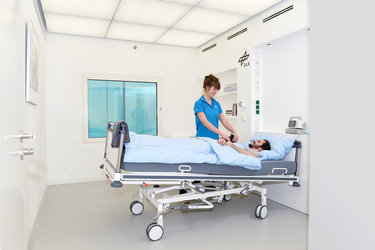
    The ‘pillownauts’ have to stay in a bed for 21 days that is inclined at 6º. The rule is that at least one shoulder and their hips must be in contact with the bed at all times, even when they eat, wash and go to the toilet.
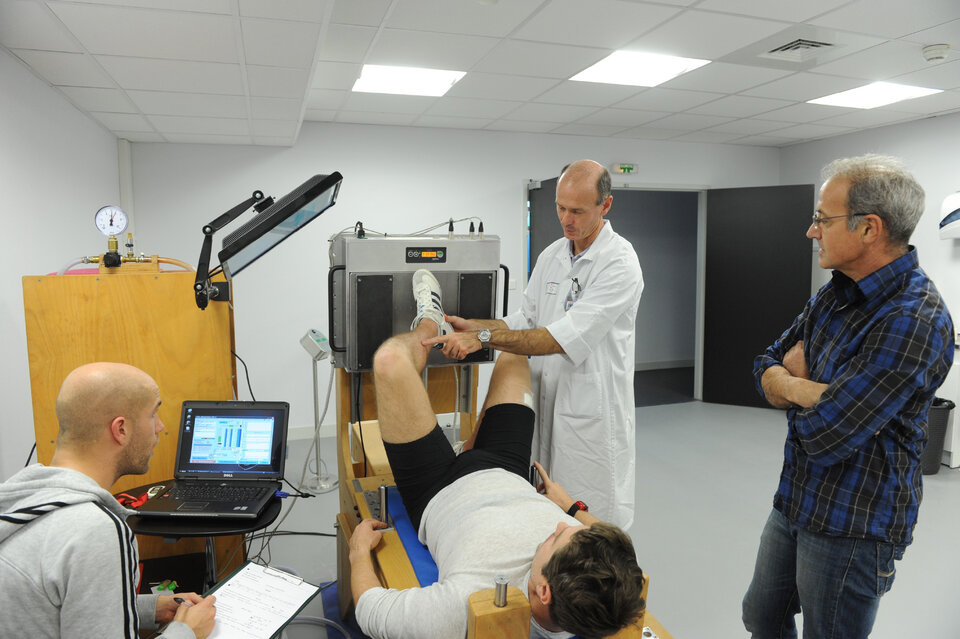
    Bedrest exercise on a resistive vibration machine
    Bedrest exercise

    As their muscles diminish – one participant has lost almost four kg – medical staff at the study clinic MEDES in Toulouse, France monitor them closely.

    “We want to find the best possible solution to counteract the effects of staying in space or being inactive when muscles and bones are not used regularly,” explains ESA specialist Vittorio Cotronei.

    Two groups of volunteers follow a short but intense exercise routine on a vibrating plate that exercises leg muscles as they absorb the up-and-down motion. Straps pull them onto the plates with a force equivalent to 100–200 kg while the pillownauts perform upside-down leg-presses for a few minutes.

    The exercise routine is repeated every three days. “It is not a lot of time but you definitely feel it,” says Eddy, from the exercise group.

    One group is doing the exercise and taking protein supplements just as bodybuilders eat to increase their muscles. The third, control, group is being monitored to compare results.

    Keeping motivated
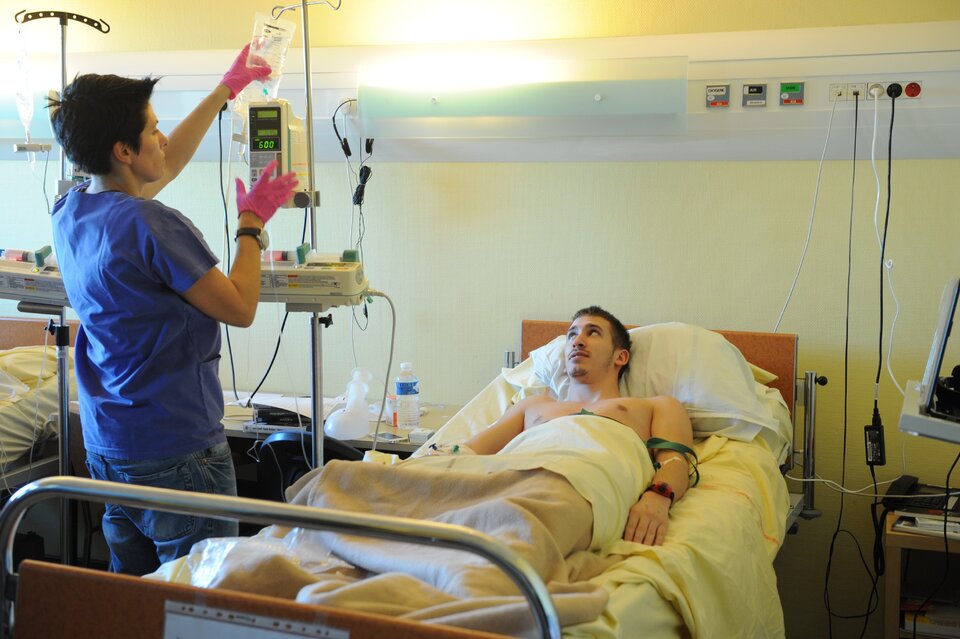
    Bedrest staff checks on volunteer
    Checking fluids

    Regular scans, blood tests, muscle biopsies, backaches and endless questionnaires can be a chore but the participants are in good spirits.

    “Some people think of us as guinea pigs, but we know exactly what we are doing and are far from being laboratory animals,” says Marc from the exercise and nutrition group.

    The pillownauts have access to the Internet and all agree that social contact is keeping them motivated.

    Rooms are shared by two volunteers and procedures are discussed between all volunteers in group chats. The experiments are run by doctors from France, Germany and Italy, Austria and Canada.
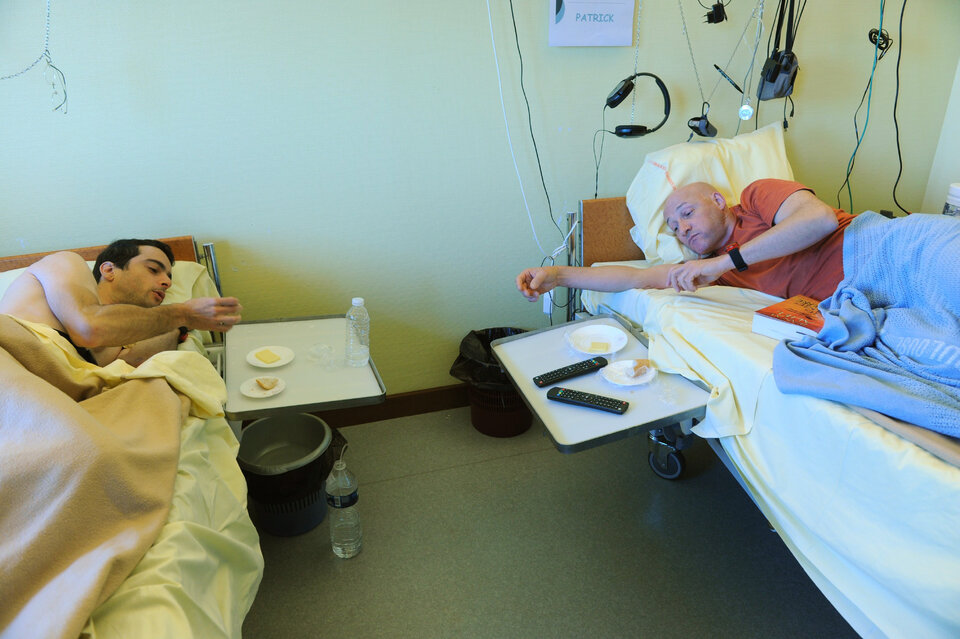
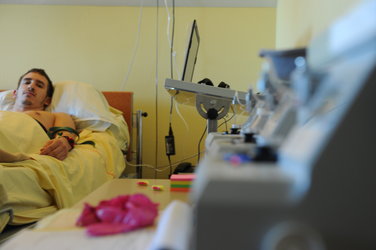
    Bedrest volunteers eating a snack
    Bedrest snack

    “The medical staff are passionate about their experiments and very friendly,” says Marc. “We are in regular contact with family and friends as well as our bedridden colleagues and this keeps us going.”

    The study is part of ELIPS, the European Programme for Life and Physical Sciences and co-funded by the French national space agency, CNES.

    Nicolas, from the control group, advises everyone to volunteer for future studies: “Bedrest is an opportunity to learn more about yourself and a great way to participate in humankind’s space adventure.”

    Eddy adds, “The research results will be used in everyday life and that makes me proud.”

    The volunteers are looking forward to the end of the year, when they can leave their sloping beds after 21 days for four months of rehabilitation. They will return for another two 21-day stints, each time taking part in another of the three groups.

    Rate this

    Views

    Share

    • Currently 5 out of 5 Stars.
    • 1
    • 2
    • 3
    • 4
    • 5
    Rating: 4.75/5 (4 votes cast)

    Thank you for rating!

    You have already rated this page, you can only rate it once!

    Your rating has been changed, thanks for rating!

    1363
    facebook
    twitter
    reddit
    google plus
    digg
    tumbler
    digg
    blogger
    myspace

    Related articles

    Checking bed angle in bedrest study

    Get some rest12 November 2012

    Checking bed angle in bedrest study

    Get some rest12 November 2012 Why are 12 volunteers about to spend 21 days in bed, lying with their heads tilted below the horizontal? Their experience will help to understand and address changes in astronauts’ bodies in space as well as in bedridden people on Earth.

    Bedrest volunteer in bed

    What are bedrest studies?10 May 2012

    Bedrest volunteer in bed

    What are bedrest studies?10 May 2012 Bedrest studies offer scientists a way to see how the human body adapts to weightlessness. They allow researchers to test techniques to counteract the negative effects of living in space. The results benefit people on Earth – many negative effects of...

    CNES–S. Levin, 2005

    Why bedrest studies?10 May 2012

    CNES–S. Levin, 2005

    Why bedrest studies?10 May 2012 Preparing for spaceflight is no easy task. Sending people into space is expensive and dangerous while the effects of living beyond the pull of gravity are not fully understood. Space agencies need to research the effects of living in space on the huma...

    • Partner institutes
    • CNES
    • MEDES
    • More information
      • ESA BR-300 ELIPS: Research in space for the future

    Connect with us

    • RSS
    • Youtube
    • Twitter
    • Flickr
    • Google Buzz
    • Subscribe
    • App Store
    • LATEST ARTICLES
    • · CryoSat hits land
    • · Ariane 5 completes seven launches …
    • · Measuring skull pressure without t…
    • · Malargüe station inauguration
    • · The solar wind is swirly
    • FAQ

    • Jobs at ESA

    • Site Map

    • Contacts

    • Terms and conditions