• → European Space Agency

      • Space for Europe
      • Space News
      • Space in Images
      • Space in Videos
    • About Us

      • Welcome to ESA
      • DG's news and views
      • For Member State Delegations
      • Business with ESA
      • Law at ESA
      • ESA Exhibitions
      • ESA Publications
      • Careers at ESA
    • Our Activities

      • Space News
      • Observing the Earth
      • Human Spaceflight
      • Space Transportation
      • Navigation
      • Space Science
      • Space Engineering & Technology
      • Operations
      • Telecommunications & Integrated Applications
      • Preparing for the Future
    • Careers at ESA

    • For Media

      • Media
      • ESA TV
      • Videos for professionals
      • Photos
    • For Educators

    • For Kids

    • ESA

    • Observing the Earth

    • Copernicus

    • Sentinel-1

    • Radar vision
    • Introducing Sentinel-1
    • Applications
    • Oceans and ice
    • Changing lands
    • Emergency response
    • About the mission
    • Facts and figures
    • Satellite constellation
    • Instrument
    • About the launch
    • Operations and data
    • Data flow
    • Data products
    • Multimedia
    • Image gallery
    • Video gallery
    • Downloads
    • Documents & publications
    • Services
    • Subscribe

    ESA > Our Activities > Observing the Earth > Copernicus > Sentinel-1

    Sentinel-1 poised to monitor motion

    New views from Sentinel-1A
    26 August 2014

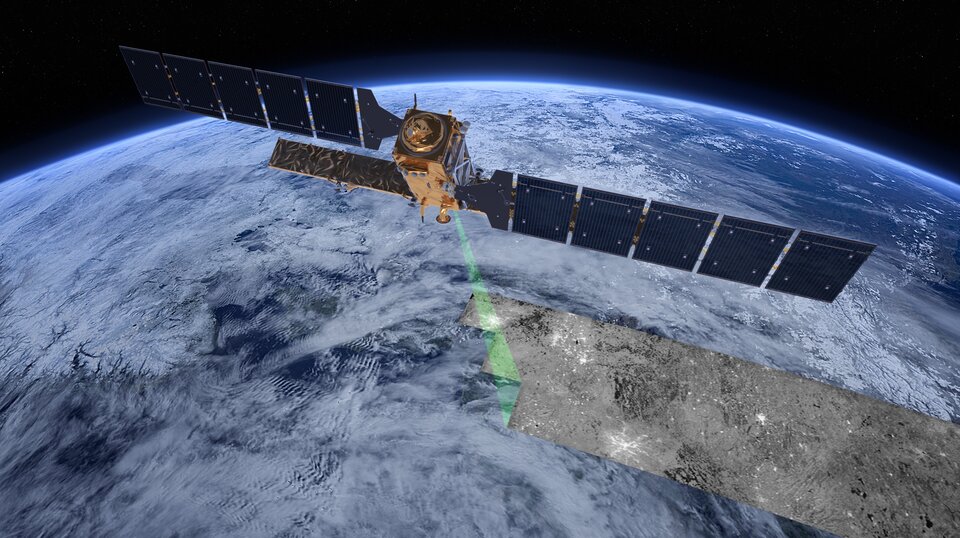
    Although it was only launched a few months ago and is still being commissioned, the new Sentinel-1A radar satellite has already shown that it can be used to generate 3D models of Earth’s surface and will be able to closely monitor land and ice surface deformation.

    As the first in a fleet of satellite missions for Europe’s Copernicus environmental monitoring programme, Sentinel-1A was launched on 3 April. It carries an advanced radar instrument to image Earth’s surface through cloud and rain, regardless of whether it is day or night.

    Among its many applications it will routinely monitor shipping zones, map sea ice and provide information on winds and waves for marine traffic, track changes in the way land is being used, provide imagery for rapid response to disasters such as floods, and monitor uplift and subsidence.

    Etna slopes

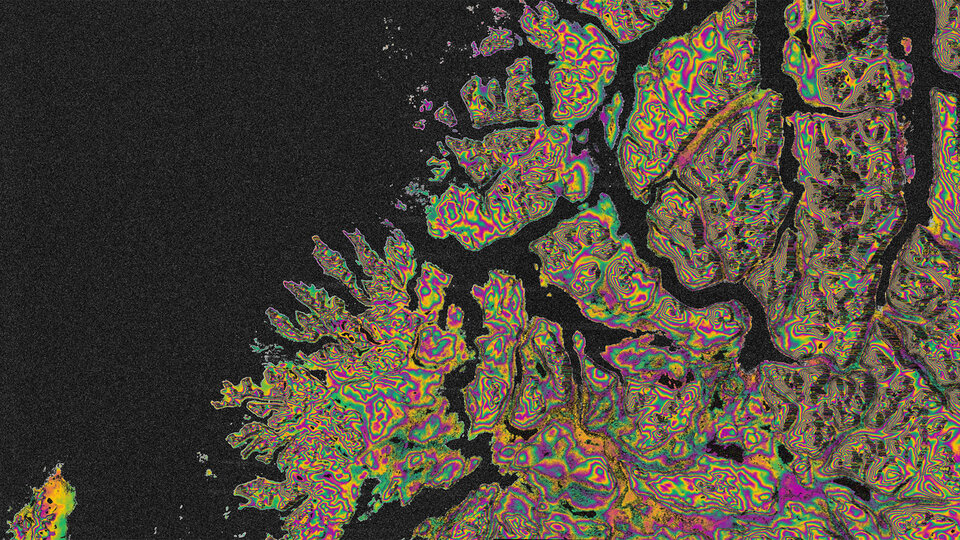
    The satellite reached its operational orbit on 7 August and just 12 days later, its radar images were used to generate ‘interferograms’ that map the topography of parts of Italy and Norway.

    Synthetic aperture radar interferometry – or InSAR – is a technique where two or more satellite radar images acquired over the same area are combined to produce an interferogram.

    These are important products for mapping topography to produce ‘digital elevation models’ and to monitor surface deformation caused by, for example, mining, earthquakes, volcanic activity, melting permafrost and glacial flow.
    Radar vision

    The rainbow-coloured fringes in these new images demonstrate the excellent phase stability of Sentinel-1A’s radar instrument and image processor, as well as that the satellite is in its correct orbit and ready for delivering data for applications and science.

    ESA’s Sentinel-1 Project Manager, Ramón Torres, said, “I’m delighted to see these first interferograms, demonstrating the excellent capabilities of Sentinel-1A’s radar instrument. They certainly show the satellite’s outstanding performance in synthetic aperture radar interferometry with its large 250 km-swath.”

    Radar images are the best way of tracking land subsidence and structural damage. Systematic observations mean that ground movement barely noticeable in everyday life can be detected and closely monitored.

    Loading...
    Norwegian fringes
    Access the video

    For example, the animation shows an area of northern Norway that is particularly prone to landslides. Large landslides that suddenly shift rock into the sea could potentially create tsunami-like waves. In 1810, such a wave destroyed a village, and, history shows that this kind of natural disaster occurs a couple of times every 100 years in Norway.

    InSAR is an important tool used by the Norwegian authorities to map rockslide hazards nationwide. The unprecedented coverage offered by the Sentinel-1 mission will significantly increase the value of InSAR data for this purpose.

    The satellite passes over the same spot on the ground every 12 days. However, once its identical twin, Sentinel-1B, is launched in 2016, this will be cut to just six days, so that changes can be mapped even faster.
    Norway relief

    Pierre Potin, ESA’s Sentinel-1 Mission Manager, noted, “It is clear that Sentinel-1 will be a fantastic tool for interferometry-based applications.

    “These first results are really promising, especially with the satellite’s mapping capability and the performance of the ground segment in mind. This will enable many operational services to be set up as well as advancing various scientific domains.”

    Rate this

    Views

    Share

    • Currently 4.5 out of 5 Stars.
    • 1
    • 2
    • 3
    • 4
    • 5
    Rating: 4.7/5 (73 votes cast)

    Thank you for rating!

    You have already rated this page, you can only rate it once!

    Your rating has been changed, thanks for rating!

    8978
    Tweet

    Related articles

    Prepping for radar vision 18 March 2014

    Prepping for radar vision 18 March 2014 Sentinel-1A, Europe’s first satellite for Copernicus, is almost ready for launch on 3 April. Meanwhile, ESA is showing how its advanced radar will map ice, monitor subsidence and much more.

    Sentinel-1 aids Balkan flood relief28 May 2014

    Sentinel-1 aids Balkan flood relief28 May 2014 Although not yet operational, the new Sentinel-1A satellite has provided radar data for mapping the floods in Bosnia and Herzegovina.

    Sentinel-1 aids response to Namibia flood09 May 2014

    Sentinel-1 aids response to Namibia flood09 May 2014 While Sentinel-1A is clearly demonstrating its versatility for monitoring many aspects of Earth, it has already been used for practical purposes. One of the satellite’s first images was crucial in helping Namibian authorities decide how to respond t...

    • Sentinel-1
    • Copernicus
    • Sentinel data access & technical information
    • Spacecraft Operations
      Spacecraft Operations
      Operations
    • Related links
    • European Commission Copernicus site
    • Northern Research Institute
    • DLR–Remote Sensing Technology Institute
    • DLR–Microwaves and Radar Institute
    • Scientific exploitation of operational missions
    • App Store
    • Subscribe
    • mobile version
    • ESA Observing the Earth Twitter

    @ESA_EO

    • LATEST ARTICLES
    • · Counting calories in space
    • · How to rescue a Moonwalker in need
    • · See our seasons change from space
    • · Preparing for Mercury: BepiColombo…
    • · Giant iceberg in the making
    • FAQ

    • Site Map

    • Contacts

    • Terms and conditions