• → European Space Agency

      • Space for Europe
      • Space News
      • Space in Images
      • Space in Videos
    • About Us

      • Welcome to ESA
      • DG's News and Views
      • For Member State Delegations
      • Business with ESA
      • ESA Exhibitions
      • ESA Publications
      • Careers at ESA
    • Our Activities

      • Space News
      • Observing the Earth
      • Human Spaceflight
      • Launchers
      • Navigation
      • Space Science
      • Space Engineering
      • Operations
      • Technology
      • Telecommunications & Integrated Applications
    • For Public

    • For Media

    • For Educators

    • For Kids

    • ESA

    • Operations

    • Ground Systems Engineering

    • Space Debris

    • SSA

    • Operations
    • Operations home
    • Background
    • About Operations
    • The Right Stuff
    • Multimedia

      • Images
      • Videos
    • SSA programme
    • Space Situational Awareness
    • Teams on ground
    • Ground Systems Engineering
    • EGOS - Ground operation system
    • Missions in space
    • Solar and planetary
    • Astronomy & fundamental physics
    • Earth observation
    • Human spaceflight
    • Technology demonstration
    • Estrack operations
    • Past missions
    • ESA mission history
    • - Find a mission: A...Z
    • Mission control centres
    • ATV Control Centre (ATV-CC)
    • Columbus Control Centre (Col-CC)
    • Ground stations
    • Estrack tracking stations
    • ESTRACK Control Centre
    • - Find a station: A...Z
    • OPS Community
    • Advanced Operations Concepts Office
    • HSO Exchange
    • Knowledge Management at ESA's Operations team

    ESA > Our Activities > Operations

    Coolest spacecraft ever in orbit around L2

    Cooling Planck’s instruments
    3 July 2009

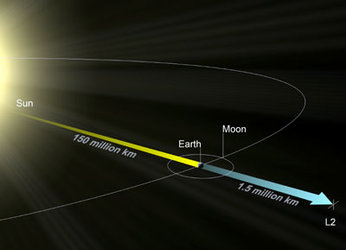
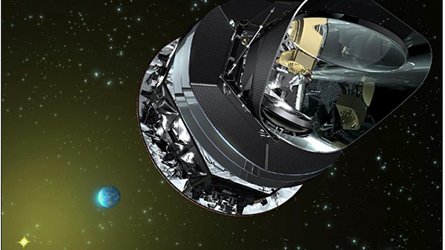
    Last night, the detectors of Planck's High Frequency Instrument reached their amazingly low operational temperature of -273.05°C, making them the coldest known objects in space. The spacecraft has also just entered its final orbit around the second Lagrange point of the Sun-Earth system, L2.

    Planck is equipped with a passive cooling system that brings its temperature down to about -230°C by radiating heat into space. Three active coolers take over from there, and bring the temperature down further to an amazing low of -273.05°C, only 0.1°C above absolute zero - the coldest temperature theoretically possible in our Universe.

    Such low temperatures are necessary for Planck’s detectors to study the Cosmic Microwave Background (CMB), the first light released by the universe only 380 000 yrs after the Big Bang, by measuring its temperature across the sky.

    Like measuring the heat of a rabbit on the Moon
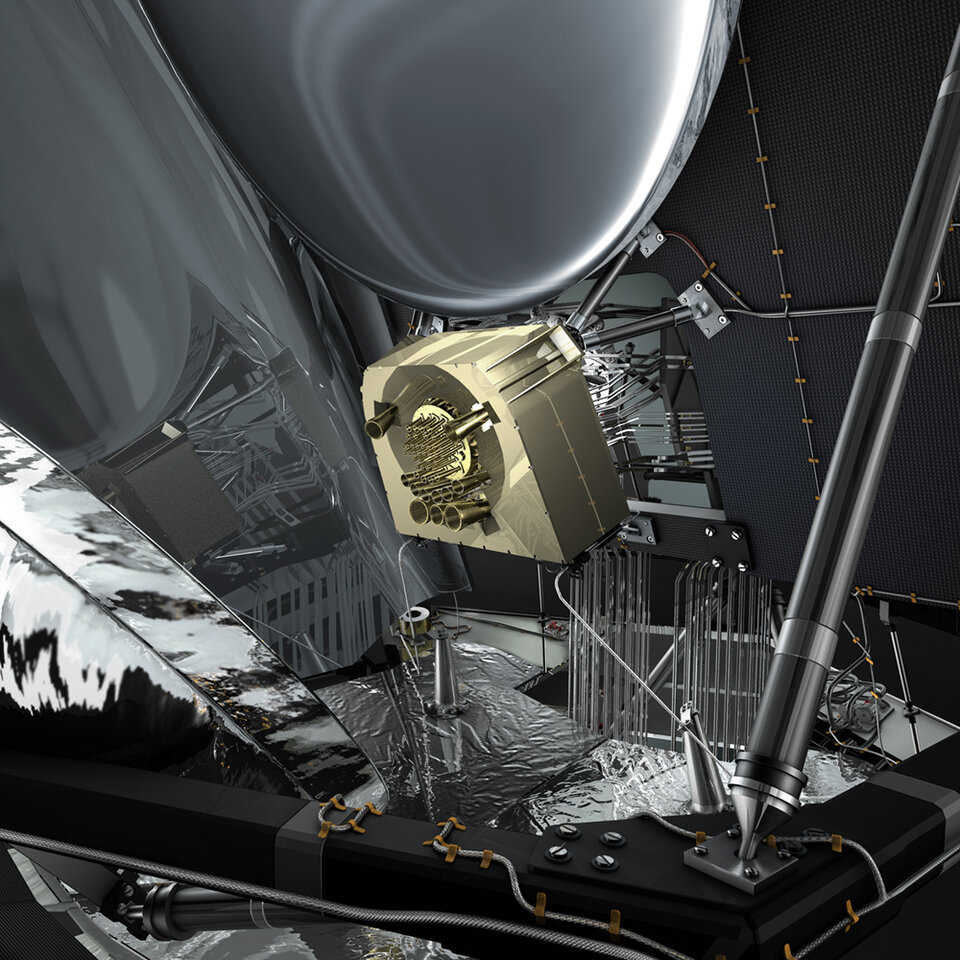
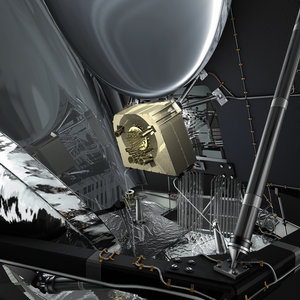
    Planck telescope focal plane unit
    Planck telescope focal plane unit

    The detectors will look for variations in the temperature of the CMB that are about a million times smaller than one degree – this is comparable to measuring from Earth the heat produced by a rabbit sitting on the Moon. This is why the detectors must be cooled to temperatures close to absolute zero (–273.15°C, or zero Kelvin, 0K).

    Details on the different stages of the cool-down process are available via the 'Planck in depth' link at right.


    Arriving at L2

    Starting at 13:15 CEST yesterday, the Planck Mission Control Team conducted a crucial orbit insertion manoeuvre designed to place the satellite into its final orbit about L2.
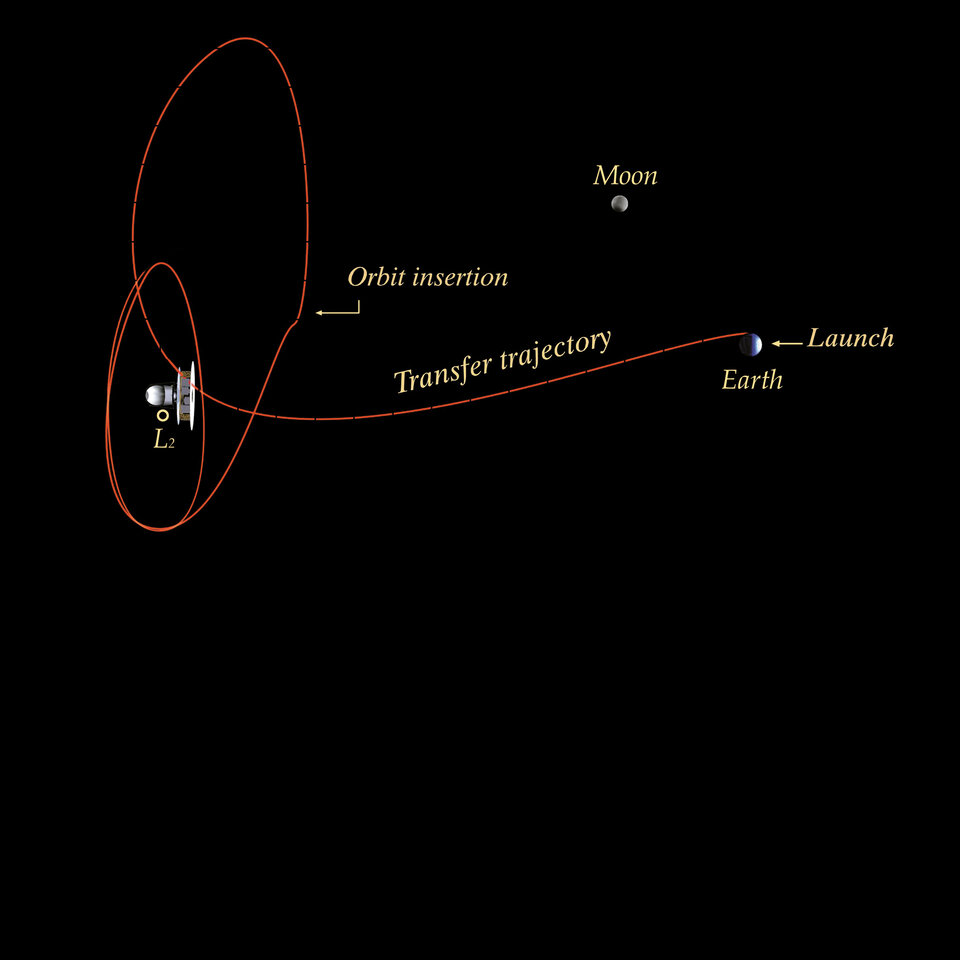
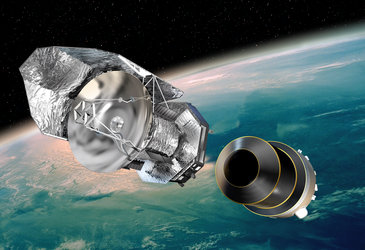
    Planck's orbit

    Once commanded, the burn was auto-controlled by Planck, with the thrusters operating for between 12 and 24 hours. The manoeuvre directed the satellite into its final operational orbit around the second Lagrange point of the Sun-Earth system, L2.

    The thruster burn was planned to deliberately underperform by a small margin, necessitating a small 'touch up' manoeuvre in the coming days to bring the satellite fully onto its planned trajectory.

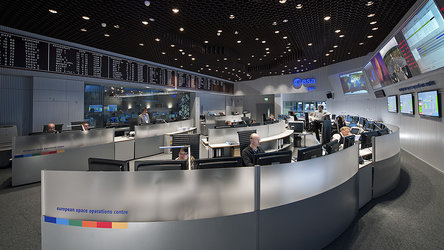
    "While this manoeuvre itself is routine, it represents the final major step in the long voyage to L2, and everyone here is quite happy to see Planck getting into its operational orbit," said Chris Watson, Spacecraft Operations Manager, speaking in the mission's Dedicated Control Room at ESA’s European Space Operations Centre, Darmstadt, Germany.
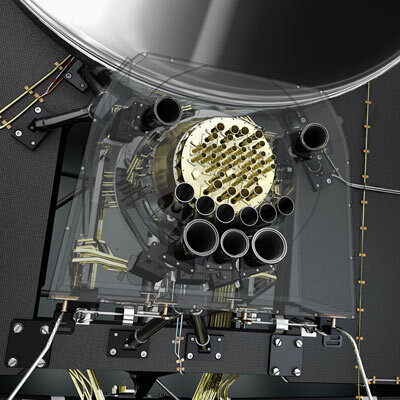
    Combined focal planes of Planck's two instruments
    Combined focal plane of Planck's two instruments

    The manoeuvre was planned to change the satellite’s speed by 211.6 km/hour, ending with a final speed of 1010 Km/hour with respect to the ground. Together with Earth and the virtual point L2, Planck will then be orbiting the Sun at a speed of 106 254 km/hour (29.5 km/second).

    At the start of yesterday’s manoeuvre, Planck was located 1.43 million km from Earth.

    Science operations to begin soon

    Planck scanning the sky

    All commissioning activities are on schedule, and this phase of the mission is practically complete. Over the next few weeks, the operation of the instruments will be fine-tuned for best performance.

    Planck will begin to survey the sky in mid-August.

    Notes for editors:

    The three cooling stages were built by different institutes, part of the two instrument consortia which manufactured and delivered Planck’s Low and High Frequency Instruments:

    • The 20K cooler: The Jet Propulsion Laboratory, California, USA
    • The 4K cooler: The Rutherford Appleton Laboratory (a member of the HFI consortium), Didcot, UK and Astrium, UK
    • The 0.1K cooler: Institut Néel, Grenoble, France and Institut d’Astrophysique Spatiale ,Orsay, France (both members of the HFI Consortium), and DTA Air Liquide, Grenoble, France
    Rate this

    Views

    Share

    • Currently 0 out of 5 Stars.
    • 1
    • 2
    • 3
    • 4
    • 5
    Rating: 0/5 (0 votes cast)

    Thank you for rating!

    You have already rated this page, you can only rate it once!

    Your rating has been changed, thanks for rating!

    312
    Tweet
    • Planck: looking back at the dawn of time
    • Spacecraft Operations
      Spacecraft Operations
      Operations
    • Related articles
      • Planck satellite manoeuvre aims at L2 arrival
        • Herschel and Planck commissioning has begun
          • Herschel and Planck: Near-perfect injection by Ariane
            • ESA's cosmic explorers in flight: stunning images from ground and space
              • ESA en route to the origins of the Universe
                • Watch Herschel-Planck launch 14 May 2009 15:12 CEST (replay)
                  • Herschel and Planck launch timeline
                  • Read more
                    • Instruments
                      • L2, the second Lagrangian Point
                      • In depth
                      • This article in depth
                      • Planck in depth
                      • Related links
                      • HFI consortium
                      • LFI consortium

    Connect with us

    • RSS
    • Youtube
    • Twitter
    • Flickr
    • G+
    • Facebook
    • Livestream
    • Subscribe
    • App Store
    • ESA Operations Twitter

    Follow ESA operations

    • LATEST ARTICLES
    • · Proba-V opens its eyes
    • · First new Galileo satellite arrive…
    • · Next destination: space
    • · Leak repaired on International Spa…
    • · After Chelyabinsk: European expert…
    • FAQ

    • Jobs at ESA

    • Site Map

    • Contacts

    • Terms and conditions