Gaia operations
Editor's note: This page is no longer being updated, but will be preserved as a record. Click here for the latest information on Gaia.
The Gaia mission is conducting a survey of one thousand million stars in our Galaxy, monitoring each target star about 70 times over a five-year period and precisely charting their positions, distances, movements and changes in brightness. Gaia may also discover hundreds of thousands of new celestial objects, such as extra-solar planets and failed 'brown dwarf' stars.
Within our own solar system, Gaia should also identify tens of thousands of asteroids, and provide stringent new tests of Albert Einstein's general relativity theory.
The mission
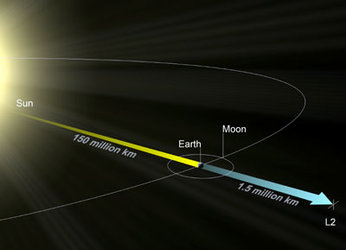
Gaia is orbiting the Sun-Earth system from the second Lagrange point L2, and the mission is designed to last for a nominal five-year period.
The spacecraft carries a single integrated instrument that comprises three major functions: astrometry, photometry and spectrometry. The three functions use two common telescopes and a shared focal plane, with each function having a dedicated area on the large 0.5 m x 1 m charge-coupled device (CCD) Focal Plane Assembly detector array.
The Gaia spacecraft was built with EADS Astrium SAS as prime contractor. The Gaia Mission Operations Centre (MOC) is located at ESOC, Darmstadt, Germany. The Gaia Science Operations Centre (SOC) is located at the European Space Astronomy Centre (ESAC), in Villafranca, Spain.
| ROLE | Orbiting observatory |
| LAUNCH DATE | 19 Dec 2013 |
| LAUNCHER/LOCATION | Soyuz-STB Fregat/Kourou, French Guiana |
| LAUNCH MASS | 2030 kg |
| ORBIT | Lagrange point L2 - 1.5 mn km from Earth |
| PERIOD | 180 days |
| NOMINAL MISSION | Five years - extended until 31 December 2020 |
| + Will compile the most precise-ever 3D map of our Galaxy by surveying over 1 thousand million stars, potentially discovering hundreds of thousands of new objects like extrasolar planets + | |
The Flight Control Team

The Flight Control Team works from the astronomy missions Dedicated Control Room located at ESOC.
The team is led by Spacecraft Operations Manager (SOM) David Milligan, from the UK; he moved over to Gaia from ERS-2 and after working as a systems engineer on Envisat and a propulsion and power specialist on SMART-1, which ended with a spectacular impact on the Moon on 3 September 2006. He joined Gaia as SOM in 2008 and was responsible for preparation of the ground segment, the selection and training of the flight control team, and preparation for launch. Now, he is responsible for Gaia operations.
Like all missions controlled from ESOC, the Gaia team will rely on experts from other ESOC teams to ensure operations success, including Flight Dynamics, Ground Facilities, Navigation and Mission Data Systems.
Mission operations overview

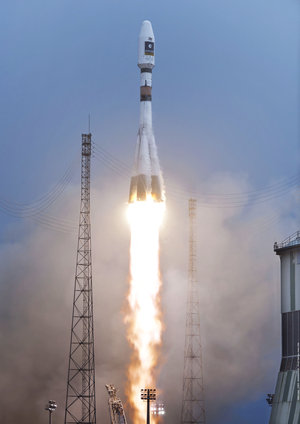
Gaia travelled into orbit on 19 December 2013 on a Soyuz-ST rocket from Kourou, Europe's Spaceport in French Guiana. Lift off took place at 10:12 CET.
Soyuz-ST, the commercial version of the Soyuz-2, is the last version of the renowned family of Russian launchers that placed the world's first satellite, Sputnik, and the first astronaut, Yuri Gagarin, into orbit.
Launch and Early Orbit
The critical Launch and Early Orbit Phase (LEOP) lasted approximately four days. In that phase, Gaia performed the first activations – transmitter switch ON, priming of the chemical thrusters, first attitude control and finding of the Sun position – followed by the sun shield deployment. Engineers on ground performed orbit determination (to fix the satellite's trajectory), then prepared and executed the critical 'Day 2' manoeuvre to inject Gaia into its final transfer trajectory toward the L2 Lagrange point.

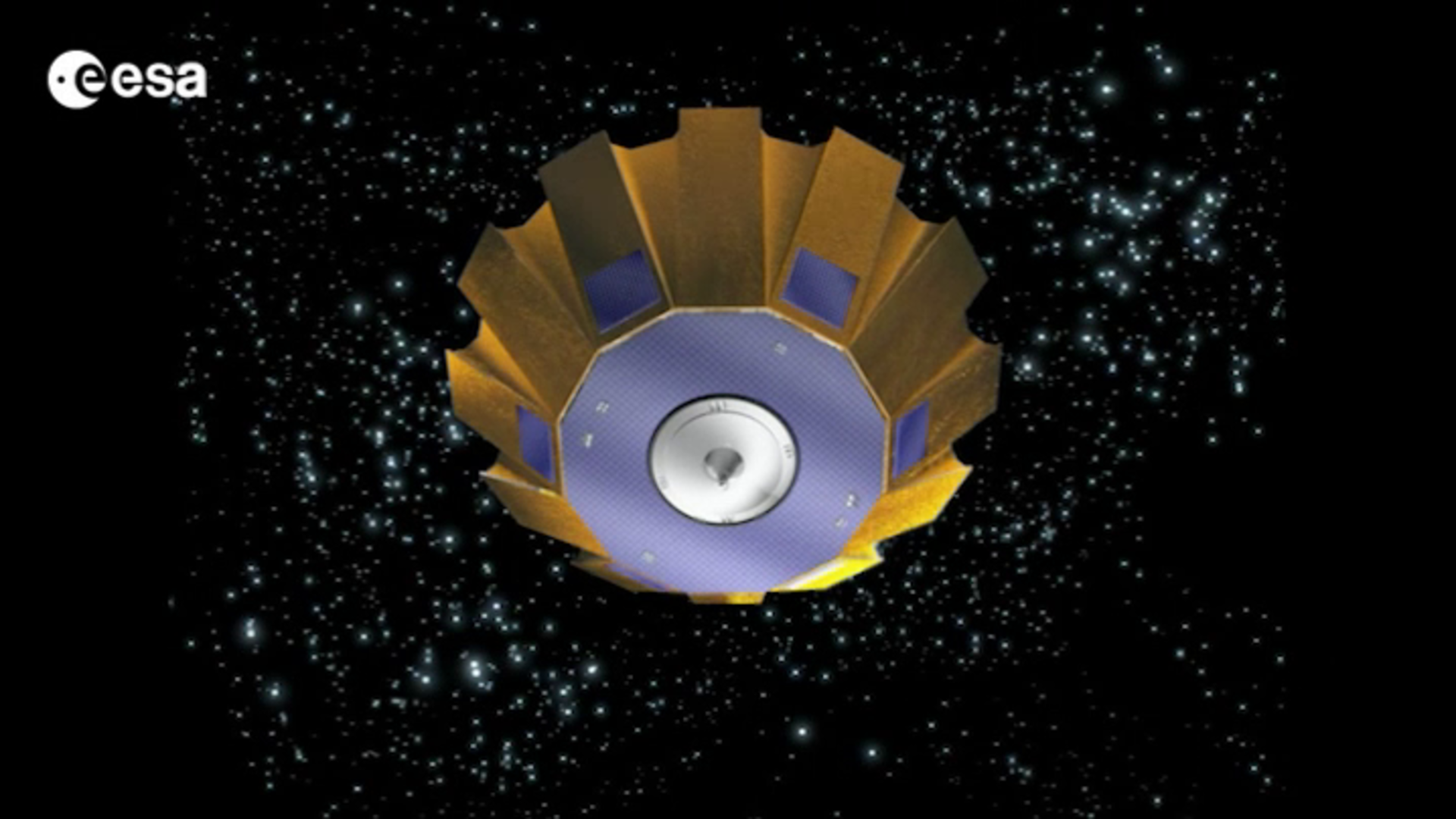
Access the video
LEOP was followed by the transfer cruise, which lasted about 30 days, an L2 orbit injection manoeuvre, on 8 January 2014, then the in-orbit commissioning phase, during which all operations to prepare for the routine operational phase are performed.
In particular, the scientific Focal Plane Assembly and related avionics will be thoroughly tested and calibrated. The commissioning is expected to last four months.
Operational Orbit
Gaia will operate in a Lissajous-type orbit, around the L2 point of the Sun-Earth system, which is located 1.5 million km from the Earth in the anti-Sun direction.
The orbit is not affected by Earth eclipses. The typical revolution period is about 180 days and the size of the orbit is typically 340 000 x 90 000 km.

Access the video
This location in space offers a very stable thermal environment, very high observing efficiency (since the Sun, Earth and Moon are behind the instrument's field of view) and a low radiation environment.
However, orbits about the L2 point are dynamically unstable; small departures from equilibrium grow exponentially overtime. Like ESA's Herschel and Planck missions, which also orbited about L2, Gaia will use its propulsion system to perform periodic orbit-maintenance manoeuvres.
Uninterrupted mapping of the sky will take place during the planned five-year operational mission phase.
Ground stations
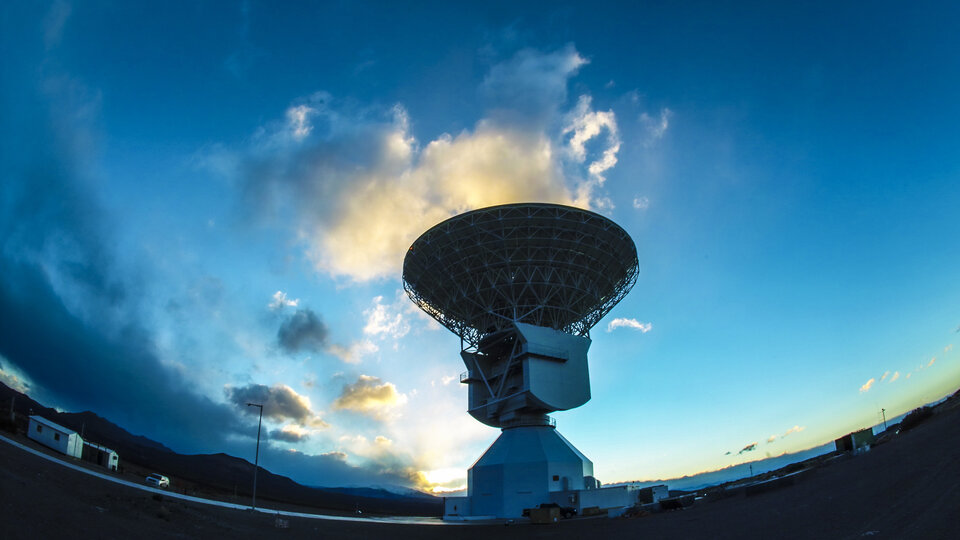
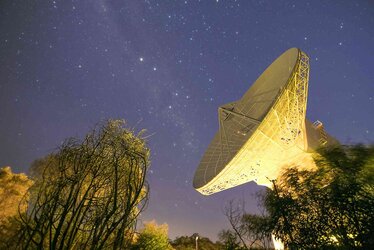
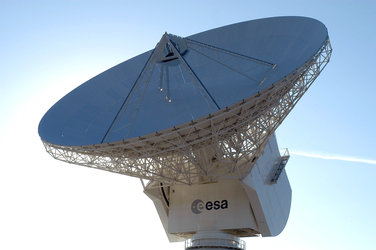
ESA's most powerful ground stations, the 35 m deep-space stations in New Norcia, Australia (DSA 1), Cebreros, Spain (DSA 2), and Malargüe, Argentina (DSA 3), are used to send commands to Gaia and receive the high volume of science data that must be returned to Earth to create Gaia’s Galactic Map. During the critical LEOP phase, additional ground station support was be provided by ESA's 15 m-diameter stations at Kourou, Maspalomas and Perth.
DSA 1 and DSA 2 entered service in 2002 and 2005, respectively, and provide state-of-the-art facilities for communications, radio range and location finding and radio science. DSA 3 entered service in 2012.
Gaia's transmitter, with around the same power as three standard 100-Watt light bulbs, must transmit at an extremely high data rate, up to 10 Mbps, from its orbit location some 1.5 million km away from Earth. To achieve this, Gaia uses a specially designed on-board phased array antenna to beam the data back (a conventional steerable antenna would have disturbed the fantastically precise measurements).
Communications and orbit tracking: Gaia has numerous firsts
The end-to-end timing of the measurements must be highly precise. To this end, Gaia carries an atomic clock to time stamp the science data, which has to be matched by ultra-precise time stamping on ground at data reception. In fact, the CCSDS (a space technical standards body) ground time-stamping standard that the space community uses was extended to pico-second resolution to meet Gaia requirements, and this capability was added to ESA's Estrack Deep Space Antennas.
The orbit of Gaia must also be determined to very high accuracy (to within 150m at 1.5 million km). The traditional radiometric methods are supplemented by optical observations from ground-based telescopes, which take pictures of Gaia against the background stars, and Delta-DOR measurements in the commissioning phase (a method where multiple DSA stations are used to precisely determine the spacecraft position with respect to a Quasar).
Ground segment & mission control system

Gaia uses the SCOS-2000 mission control system.
Mission operations are conducted by the Flight Control Team at ESOC, comprising spacecraft operations (mission planning, spacecraft monitoring and control, and all orbit and attitude determination and control) as well as scientific instrument operations (quality control and collection of the science telemetry). The ground segment at ESOC comprises all facilities, hardware, software and documentation required to conduct mission operations.
The ground operations facilities consists of:
- Ground stations and the communications network
- Mission control centre
- Flight control system
- Software-based spacecraft simulator
All mission and flight control facilities, except the ground stations, are located at ESOC, including the interfaces for the provision of science telemetry to the Science Operations Centre at ESA/ESAC.
The science data will be distributed to ESAC after being stored in dedicated Science Data Servers at ESOC, via high-speed communication lines.
The science data processing requirements for Gaia are among the most challenging of any scientific endeavour to date. Due to the immense volume of data that will be collected, for 1 billion stars, it will be a major challenge, even by the standards of computational power in the next decade, to process, manage and extract the scientific results necessary to build a 3-dimensional view of our Galaxy, the Milky Way.
A total of some 100 Terabytes of science data will be collected during Gaia's lifetime. The estimated total data archive will surpass 1 Petabyte, roughly equivalent to 1000 1-Terabyte hard drives from a top-end home PC.
The platform and payload

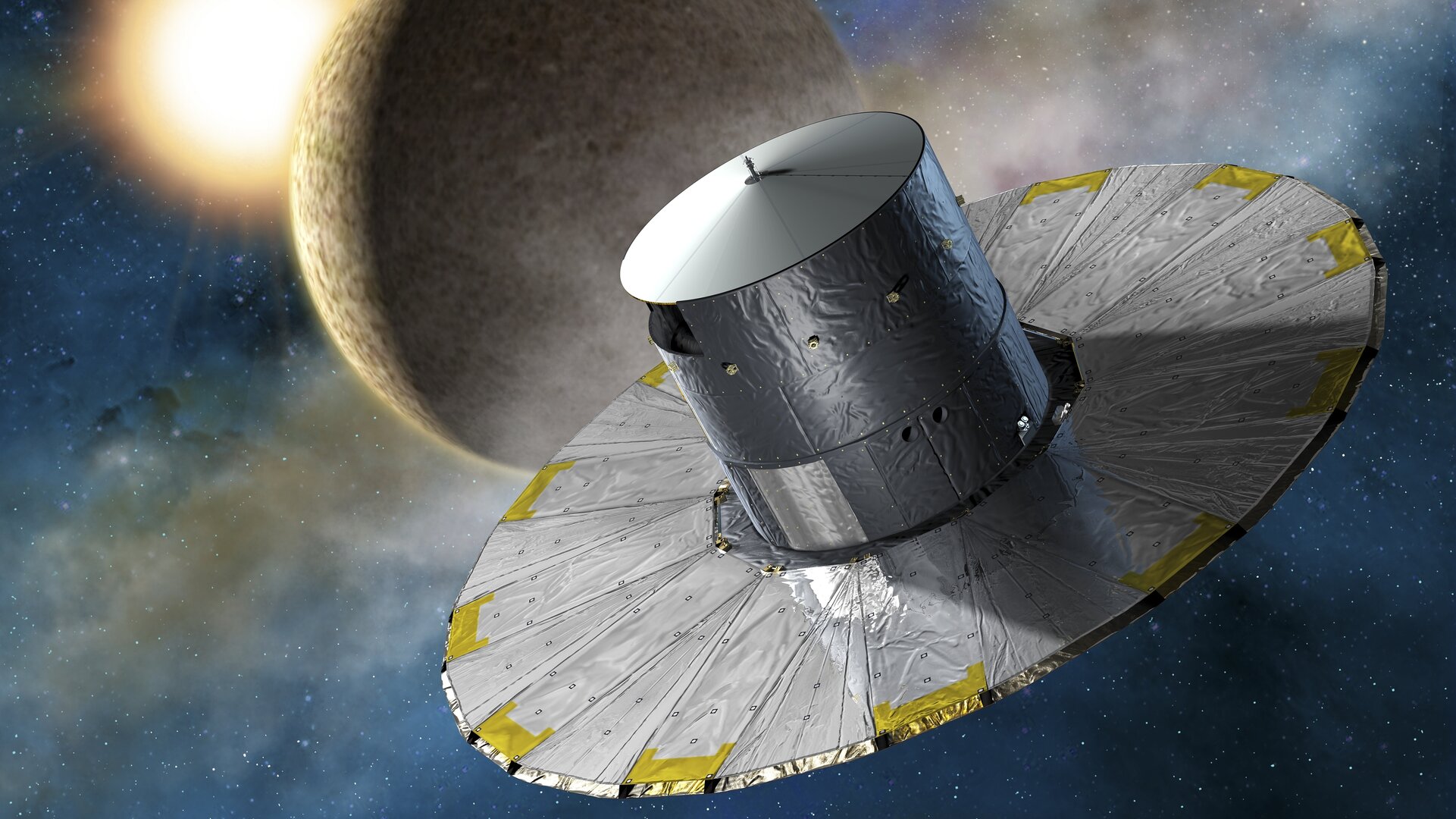
Gaia contains two optical telescopes that can precisely pinpoint the location of stars and split their light into a spectrum for analysis. The spacecraft itself can be divided into two sections: the payload module and the service module.
The platform
The service module, referred to generally as 'the platform', contains the propulsion system and the communications units, essential components that allow the spacecraft to function and return data to Earth. Beneath the service module and the payload module is the sun-shield and solar array assembly.
The payload
The payload module is housed inside a geometrical, dome-like structure called the thermal cover, and the payload consists of a single integrated instrument including the dual telescopes, with a common structure and a common focal plane. Both telescopes are based on a three-mirror anastigmat (TMA) design.
There are also three instrument functions:
- Astrometry: Accurate measurements, even in densely populated sky regions of up to 3 million stars/deg². The astrometric instrument is dedicated to the accurate measurement of stellar positions and brightnesses.
- Photometry: Continuous spectra in the band 320-1000 nm for astrophysics and chromaticity calibration of the astrometry. Photometric measurements will record the colours and brightness of all stars; this is valuable information, which astronomers will use to determine the physical parameters of celestial objects.
- Spectrometry: High resolution, grating, narrow band, at 847-874 nm. The spectroscopic instrument will detect whether celestial objects are moving toward or away from us. This information can then be combined with that from the astrometric instruments, to give a full picture of how the celestial object is moving through space.
During its life, the spacecraft spins slowly, sweeping the views of the two telescopes across the celestial sphere. As the detectors repeatedly measure the position of a celestial object over a number of years, they will detect, for example, that object's motion across the line of sight.
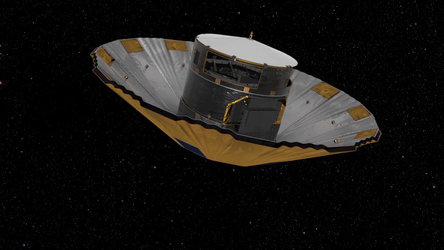
Gaia will always point its telescopes away from the Sun. After launch, it will unfold a 'skirt' that performs two functions. The first is as a sunshade. This will permanently shade the telescopes in the payload module and allows their temperature to drop to -100°C. In this way, the stability of the telescope and its optical system will be maintained at precise levels.
The other function of the sun-shield is to generate power for the spacecraft. As the underside of the shield will always be facing the Sun, its surface will be partially covered with solar panels that generate electricity from sunlight. The sun-shield 'skirt' is the only deployable structure on Gaia. It consists of twelve separate panels that will be folded for launch. Once in space, the spacecraft will unfold these panels into a roughly circular disc, just over 10 metres in diameter.