• → European Space Agency

      • Space for Europe
      • Space News
      • Space in Images
      • Space in Videos
    • About Us

      • Welcome to ESA
      • DG's News and Views
      • For Member State Delegations
      • Business with ESA
      • ESA Exhibitions
      • ESA Publications
      • Careers at ESA
    • Our Activities

      • Space News
      • Observing the Earth
      • Human Spaceflight
      • Launchers
      • Navigation
      • Space Science
      • Space Engineering
      • Operations
      • Technology
      • Telecommunications & Integrated Applications
    • For Public

    • For Media

    • For Educators

    • For Kids

    • ESA

    • Operations

    • Ground Systems Engineering

    • Space Debris

    • SSA

    • Operations
    • Operations home
    • Background
    • About Operations
    • The Right Stuff
    • Multimedia

      • Images
      • Videos
    • SSA programme
    • Space Situational Awareness
    • Teams on ground
    • Ground Systems Engineering
    • EGOS - Ground operation system
    • Missions in space
    • Solar and planetary
    • Astronomy & fundamental physics
    • Earth observation
    • Human spaceflight
    • Technology demonstration
    • Estrack operations
    • Past missions
    • ESA mission history
    • - Find a mission: A...Z
    • Mission control centres
    • ATV Control Centre (ATV-CC)
    • Columbus Control Centre (Col-CC)
    • Ground stations
    • Estrack tracking stations
    • ESTRACK Control Centre
    • - Find a station: A...Z
    • OPS Community
    • Advanced Operations Concepts Office
    • HSO Exchange
    • Knowledge Management at ESA's Operations team

    ESA > Our Activities > Operations

    Rosetta Steins fly-by timeline

    Rosetta’s trajectory towards asteroid Steins
    2 September 2008

    The Rosetta spacecraft control room is buzzing with anticipation as Rosetta closes in on asteroid 2867 Steins. The fly-by timeline includes a series of critical events, culminating with closest approach - expected at 20:58 CEST, 5 September 2008.

    At the time of closest approach, Rosetta is planned to be 800 km from the asteroid, passing by at a speed of 8.6 km/s relative to Steins. Both Rosetta and Steins will be illuminated by the Sun, providing an excellent opportunity for science observations.

    Between 40 and 20 minutes before closest approach, Rosetta will be flipped and the spacecraft will switch to a specially designed asteroid fly-by mode, an optimal configuration that supports the intensive observation and tracking activity of the on-board instruments.


    Although most scientific observations will take place in the few hours around closest approach, several instruments will be switched on for a longer time around the event.
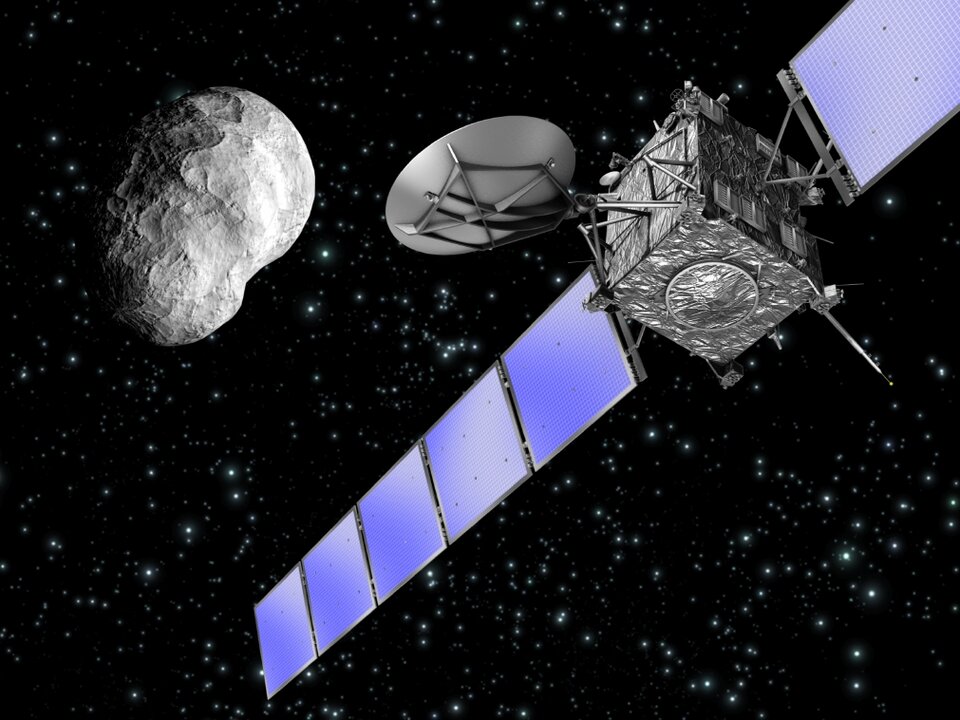
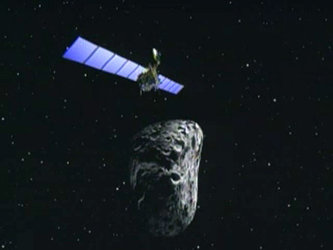
    Artist’s impression of Rosetta as it flies by asteroid Steins
    Artist’s impression of Rosetta as it flies by asteroid Steins

    ESA's Cebreros deep space antenna (DSA 2) in Cebreros, Spain, will be used for communications with Rosetta in the two days preceding closest approach. When the spacecraft is not visible from Cebreros or New Norcia, NASA's DSN (Deep Space Network) ground stations at Goldstone, Canberra and Madrid will provide support for tracking and for science operations.

    Around closest approach, Rosetta will be 2.41 Astronomical Units, or about 360 million km, from Earth. Radio signals sent to and from the spacecraft will have a 20 minute one-way travel time.

    Timeline of nominal fly-by events

    Note: All event times are stated in ground time, CEST.

    Time Event
    1 September
    02:20 Instruments switched on (except OSIRIS which was already on for the navigation campaign)
    4 September
    07:20-11:20 Slot for possible trajectory correction manoeuvre (36 hours before closest approach)
    13:20-18:20 Last opportunity to acquire images for optical navigation campaign
    5 September
    07:20-10:20 Slot for possible trajectory correction manoeuvre (12 hours before closest approach)
    10:20 Navigation cameras switch to tracking mode - initially both used, then use CAM 'A' only (to be decided)
    11:00 Uplink fly-by commands for asteroid fly-by mode (AFM)
    Includes an update to the command profile already on board & the final updated AFM commands (only if 1 CAM at least is tracking)
    20:18-20:38 Spacecraft flip over
    20:39 Spacecraft switches automatically to asteroid fly-by mode
    20:56 Sun illuminates Rosetta from the back and the asteroid fully
    20:58 Closest approach, at a planned distance of 800 km from the asteroid
    22:27 First post-fly-by acquisition of signal (AOS) - telemetry received via NASA's Goldstone ground station
    22:30 Start of science data download via Goldstone
    6 September
    12:00 Live streaming of Rosetta Steins fly-by press conference from the European Space Operations Centre begins
    13:00 Images from fly-by published on ESA web
    15:00 End of press conference streaming
    16:01 End of reception of first set of science data

    Editor's note

    An expanded version of the timeline appears in the Rosetta blog.
    Rate this

    Views

    Share

    • Currently 0 out of 5 Stars.
    • 1
    • 2
    • 3
    • 4
    • 5
    Rating: 0/5 (0 votes cast)

    Thank you for rating!

    You have already rated this page, you can only rate it once!

    Your rating has been changed, thanks for rating!

    77
    Tweet
    • ESA's ATV blog direct from ATV mission control
      ESA's ATV blog direct from ATV mission control
      Rosetta Blog
    • ESA's comet chaser: Rosetta
    • Where is Rosetta now?
    • Rosetta animation
      Rosetta animation
    • Related articles
      • Rosetta spacecraft meets asteroid Steins
        • Rosetta starts tracking asteroid Steins
          • Intense preparations for Rosetta's asteroid visit
            • Rosetta awakes from hibernation for asteroid encounter
              • The Moon and Europe - Rosetta OSIRIS images
                • Rosetta: OSIRIS’ view of Earth by night
                • Read more
                • OSIRIS (Optical, Spectroscopic, and Infrared Remote Imaging System)
                  • Debris of the Solar System: Asteroids
                    • Asteroids: The discovery of asteroids
                      • Asteroids: Families of asteroids
                        • Asteroids: Structure and composition of asteroids
                        • Related links
                        • Rosetta in depth
                        • Rosetta to meet asteroid Steins - press invitation

    Connect with us

    • RSS
    • Youtube
    • Twitter
    • Flickr
    • G+
    • Facebook
    • Livestream
    • Subscribe
    • App Store
    • ESA Operations Twitter

    Follow ESA operations

    • LATEST ARTICLES
    • · ESA astronaut Timothy Peake set fo…
    • · Space drives e-mobility
    • · Proba-V opens its eyes
    • · First new Galileo satellite arrive…
    • · Next destination: space
    • FAQ

    • Jobs at ESA

    • Site Map

    • Contacts

    • Terms and conditions