Successful Jules Verne rendezvous simulation at ATV Control Centre
For the first time, three human spaceflight mission control centres – located in three countries – have this week successfully simulated the critical rendezvous of the Automated Transfer Vehicle, the largest and most complex automatic spacecraft, with the International Space Station.
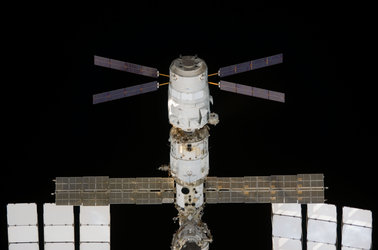
The actual rendezvous will take place early in 2008 with the launch and docking of the most sophisticated spacecraft ever built in Europe, the Jules Verne Automated Transfer Vehicle (ATV).
"We are ready for rendezvous final approach," said the ATV Control Centre (ATV-CC), at the French space agency (CNES) facility in Toulouse, with a pronounced French accent. "You have a ‘go’ for final approach from MCC-H," replied Houston’s Mission Control in a Texan drawl. And, finally, the third voice, clearly that of a Russian speaker at the Moscow Control Center (TsUP): "Okay, you have the ‘go’ for final approach up to docking".
Lead control centre

"It's a big jump for spaceflight operations in Europe, with the ATV Control Centre teams proving they can operate effectively in the ISS environment, which is not an easy thing," said Bob Chesson, ESA's manager for Human Spaceflight and Exploration Operations. "Today is our biggest achievement so far after more than seven years of efforts at the ATV Control Centre."
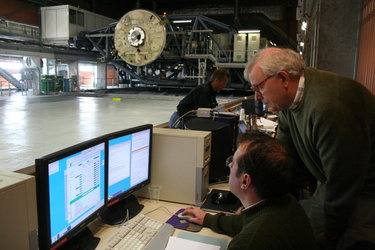
For the first time, the new ATV Control Centre in Toulouse acted as the lead mission control centre in charge of man-rated operations for the ATV while the Mission Control Centres in Moscow and in Houston supported and authorized the rendezvous to the ISS in real time. The 50-strong team in Toulouse was in charge of operating and sending the 'GO' commands to the automated spacecraft.
Orchestra
The simulation started almost eight hours before docking to the ISS and was particularly complex because it had to respect all the scheduled steps performed by the ATV-CC and all the necessary tasks to be executed in the different centres involved and by the ISS crew (who was 'simulated' by crew representatives present in Moscow). The role of each centre is clearly defined in a sequential form.
Overall, this challenging achievement can be compared to three different groups of musicians located in different parts of the world and in different time zones, and playing as one orchestra, each playing its part in time and without hitting wrong notes. Yet, these simulations prove even more difficult than such a concert rehearsal; the timeline of the critical orbital approach – with factors such as the Sun illumination restrictions in orbit and the Russian tracking ground station requirements – makes it impossible to stop a spaceflight phase and begin again if delays build up beyond 20 minutes. In that case, the rendezvous must be aborted, the simulation ending in failure.
Fine-tuning

"We are quite satisfied with the success of this first Joint Integrated Simulation which shows that the system works fine and that now everyone, including the partners, believes that we are on the right tracks to do it!," said Dominique Cornier, the ATV Project Operations Manager. He has led development, with the Russian and the U.S. partners, together with CNES and Astrium ATV specialists, of the Multi-Element Procedures (MEPs) required to allocate tasks to the different centres.
"Some improvement and fine-tuning in the synchronization of the different centres can still be achieved. That is why we are planning for a dozen more simulations including some failure scenarios before the actual Jules Verne mission. But overall we are quite happy with this success – it has also shown that our teams are able to react quickly to little bugs we faced in real time," added Hervé Côme, ESA's ATV Mission Director at ATV-CC during this first Joint Integrated Simulation.
One hundred controllers
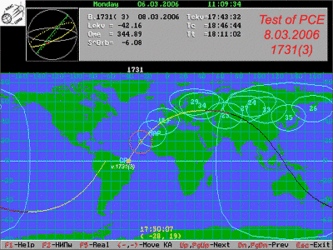
As the ATV nears the ISS during rendezvous, ATV-CC flight controllers direct the Jules Verne to a step-by-step predefined approach using specific optical sensors and GPS technology. This approach requires authorisation from the Mission Control Centre in Moscow (MCC-M) – because it docks with the Russian Svezda segment of ISS – and an overall coordination with the Mission Control Centre in Houston (MCC-H), which is responsible for the entire ISS. For each of these steps, the ATV performs automated manoeuvres which are closely monitored by almost 100 controllers in three countries.
"Even if the simulation replicates – with powerful computers – the ATV behaviour and the ISS complexity, it really tests the coherence and the full compatibility of the audio, video and huge computers of the different space agencies around the world," said Martial Vanhove, the ATV Flight Director from CNES, who was the voice of the Toulouse control centre.
Teamwork

The simulation also checks the teamwork and the interaction between real operators from several countries and different technological cultures. Finally, the ATV simulator in Toulouse operates with the actual state-of-the-art flight software of Jules Verne, which includes nearly 10 times the number of lines of code needed for Ariane 5. Billions of bits of telemetry were also exchanged between the different sites.
"We congratulate our European colleagues at ATV-CC and the Columbus Control Centre and our Russian colleagues at MCC-M on achieving this milestone in the operations preparation phase of the Jules Verne mission. We look forward to our continued participation in the Joint Integrated Simulation campaign both from MCC-H and the Space Station Training Facility (SSTF) in Houston, as well as from the ATV Control Centre," said Adam Baker, the NASA representative who worked from inside the Toulouse control room as International Liaison Officer during this simulation, and who led the ATV Multi-Element Procedure development on the NASA side.
In future joint operations, representatives from each space agency will be in each of the three control centres. For this simulation, more than 30 specialists working for NASA participated from the Mission Control Centre in Building 30 South and will be assigned to the Jules Verne mission next year.
For the next full simulation, planned in late August, future ISS crew members will also take part from Moscow. From there they will monitor the ATV during its approach to the ISS. Even though ATV is a fully automated spaceship with a multiple-fault tolerant capability, in case of emergencies the ISS crew can independently initiate the Collision Avoidance Manoeuvre (CAM) to move the 20-tonne spaceship away from the Station during the rendezvous phase.