• → European Space Agency

      • Space for Europe
      • Space News
      • Space in Images
      • Space in Videos
    • About Us

      • Welcome to ESA
      • DG's News and Views
      • For Member State Delegations
      • Business with ESA
      • ESA Exhibitions
      • ESA Publications
      • Careers at ESA
    • Our Activities

      • Space News
      • Observing the Earth
      • Human Spaceflight
      • Launchers
      • Navigation
      • Space Science
      • Space Engineering
      • Operations
      • Technology
      • Telecommunications & Integrated Applications
    • For Public

    • For Media

      • Media
      • ESA TV
      • Videos for professionals
      • Photos
    • For Educators

    • For Kids

    • ESA

    • Space Science

    • Our Universe
    • About Space Science
    • ESA's 'Cosmic Vision'
    • Science missions
    • Mission navigator
    • Target groups
    • For Media
    • For Scientists
    • For Kids
    • Multimedia
    • Science images
    • Science videos
    • Animations
    • Downloads
    • Sounds from space
    • Resources
    • Reference section
    • Services
    • FAQs
    • Glossary
    • Help
    • Portal terms of use
    • Comments
    • Follow us
    • RSS feeds
    • ESA Sci on Twitter
    • ESA Space Science Images on Flickr
    • ESA 3D on Flickr

    ESA > Our Activities > Space Science

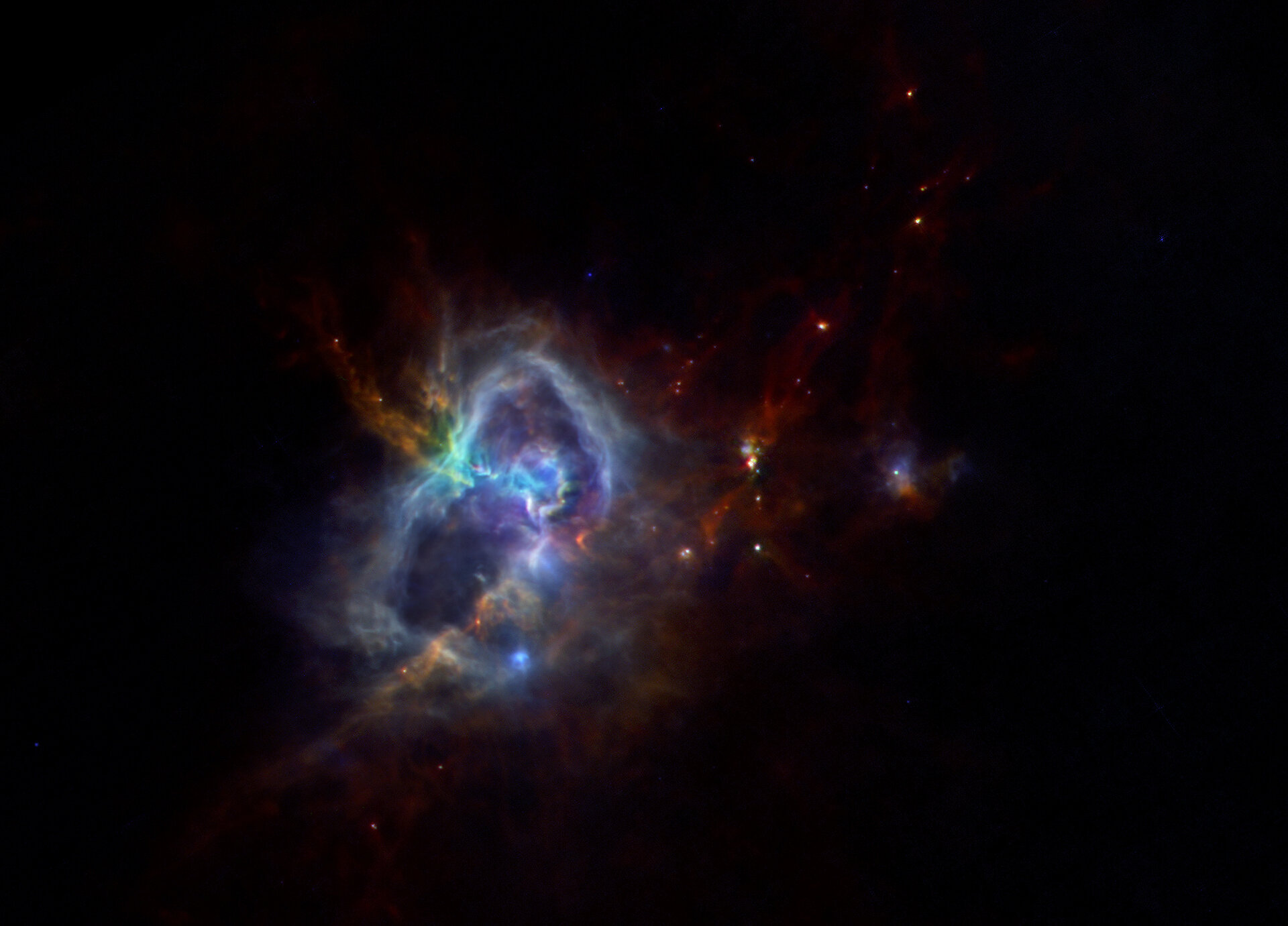
    W40’s cradle of stars

    A cradle of stars

    7 January 2013

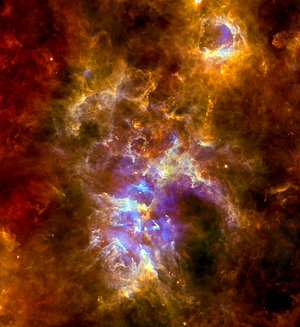
    Six hundred newly forming stars are crowded into intricate filaments of gas and dust that makes up this stellar nursery, seen for the first time by ESA’s Herschel space observatory.

    The nebulous area coloured in blue, known as W40 or Sharpless 2-64, is roughly 1000 light-years away in the constellation Aquila, and is about 25 light-years across.

    It is a vast cloud of hydrogen gas, illuminated by the radiation streaming out from at least three young massive stars embedded in the cloud.

    The nebula is expanding into the surrounding medium, compressing the ambient gas on its way and triggering the formation of a second generation of even younger stars.

    In total, around 600 condensations of dust and gas have been estimated in this field of view, the majority of which will eventually collapse to form stars.

    Already about 150 objects are in the final stages of forming stars. Once nuclear fusion kicks in, their cores will ignite and they will become fully fledged stars.

    W40 is part of a giant ring of stars and star-forming clouds known as Gould’s Belt that appears to circle the night sky. These stellar nurseries are key targets for Herschel, allowing astronomers to compare the differences in star formation from region to region and to identify the role of the local environment in the process.

    This image is from our archives; it was created from observations by Herschel’s PACS and SPIRE instruments on 24 October 2009 and published on OSHI in 2011.
    Rate this

    Views

    Share

    • Currently 4.5 out of 5 Stars.
    • 1
    • 2
    • 3
    • 4
    • 5
    Rating: 4.51/5 (39 votes cast)

    Thank you for rating!

    You have already rated this page, you can only rate it once!

    Your rating has been changed, thanks for rating!

    6348
    Tweet

    Related articles

    W44 and its environment

    Life and death in a star-forming cloud14 November 2012

    W44 and its environment

    Life and death in a star-forming cloud14 November 2012 The aftershock of a stellar explosion rippling through space is captured in this new view of supernova remnant W44, which combines far-infrared and X-ray data from ESA’s Herschel and XMM-Newton space observatories.

    Flying along the Vela ridge09 July 2012

    Flying along the Vela ridge09 July 2012 A beautiful blue butterfly flutters towards a nest of warm dust and gas, above an intricate network of cool filaments in this image of the Vela C region by ESA’s Herschel space observatory.

    Blowing bubbles in the Carina Nebula

    Blowing bubbles in the Carina Nebula04 June 2012

    Blowing bubbles in the Carina Nebula

    Blowing bubbles in the Carina Nebula04 June 2012 Giant bubbles, towering pillars and cascading clouds of dust and gas fill the star-forming nursery of the Carina Nebula seen here in a stunning new view from Herschel to launch ESA Space Science’s image of the week feature.

    Cygnus-X: the cool swan glowing in flight10 May 2012

    Cygnus-X: the cool swan glowing in flight10 May 2012 Chaotic networks of dust and gas signpost the next generations of massive stars in this stunning new image of the Cygnus-X star-nursery captured by ESA’s Herschel space observatory.

    Baby stars in Orion Nebula

    Fledgling stars flicker in the heart of Orion29 February 2012

    Baby stars in Orion Nebula

    Fledgling stars flicker in the heart of Orion29 February 2012 Astronomers using ESA’s Herschel and NASA’s Spitzer space telescopes have detected surprisingly rapid changes in the brightness of embryonic stars within the well-known Orion Nebula.

    Stunning new Herschel and XMM-Newton image

    A New View of an Icon17 January 2012

    Stunning new Herschel and XMM-Newton image

    A New View of an Icon17 January 2012 The Eagle Nebula as never seen before. In 1995, the Hubble Space Telescope's 'Pillars of Creation' image of the Eagle Nebula became one of the most iconic images of the 20th century. Now, two of ESA's orbiting observatories have shed new light on this...

    • Space Science Image of the Week Archive
    • Space Live
      Space Live
      Space science image gallery
    • Herschel: ESA's giant infrared observatory
    • More about...
    • Herschel overview
    • Online Showcase of Herschel Images OSHI
      • Herschel operations
      • Herschel on YouTube
      • Inside Herschel
      • Herschel mission objectives
      • Follow us
      • ESA Space Science Image of the Week on Flickr
      • ESA 3D on Flickr
      • ESA Sci on Twitter

    Connect with us

    • RSS
    • Youtube
    • Twitter
    • Flickr
    • G+
    • Facebook
    • Livestream
    • Subscribe
    • App Store
    • ESA Science Twitter

    Follow ESA science

    • LATEST ARTICLES
    • · Rare merger reveals secrets of gal…
    • · Watching for hazards: ESA opens as…
    • · ESA astronaut Timothy Peake set fo…
    • · Space drives e-mobility
    • · Proba-V opens its eyes
    • FAQ

    • Jobs at ESA

    • Site Map

    • Contacts

    • Terms and conditions