• → European Space Agency

      • Space for Europe
      • Space News
      • Space in Images
      • Space in Videos
    • About Us

      • Welcome to ESA
      • DG's News and Views
      • For Member State Delegations
      • Business with ESA
      • ESA Exhibitions
      • ESA Publications
      • Careers at ESA
    • Our Activities

      • Space News
      • Observing the Earth
      • Human Spaceflight
      • Launchers
      • Navigation
      • Space Science
      • Space Engineering
      • Operations
      • Technology
      • Telecommunications & Integrated Applications
    • For Public

    • For Media

    • For Educators

    • For Kids

    • ESA

    • Space Science

    • Our Universe
    • About Space Science
    • ESA's 'Cosmic Vision'
    • Science missions
    • Mission navigator
    • Target groups
    • For Media
    • For Scientists
    • For Kids
    • Multimedia
    • Science images
    • Science videos
    • Animations
    • Downloads
    • Sounds from space
    • Resources
    • Reference section
    • Services
    • FAQs
    • Glossary
    • Help
    • Portal terms of use
    • Comments
    • Follow us
    • RSS feeds
    • ESA Sci on Twitter
    • ESA Space Science Images on Flickr
    • ESA 3D on Flickr

    ESA > Our Activities > Space Science

    Betelgeuse’s enigmatic environment

    Betelgeuse braces for a collision

    22 January 2013

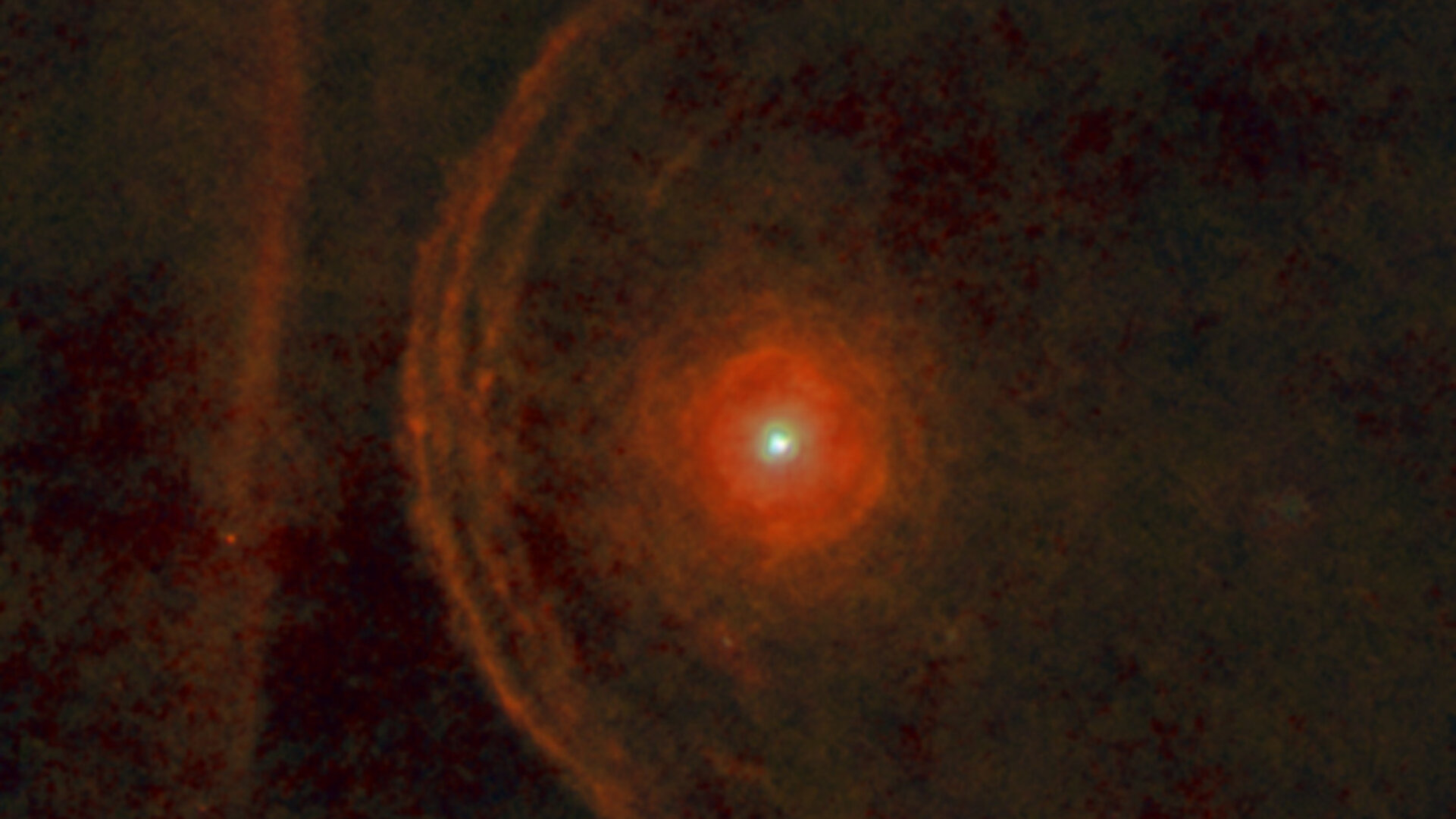
    Multiple arcs are revealed around Betelgeuse, the nearest red supergiant star to Earth, in this new image from ESA’s Herschel space observatory. The star and its arc-shaped shields could collide with an intriguing dusty ‘wall’ in 5000 years.

    Betelgeuse rides on the shoulder of the constellation Orion the Hunter. It can easily be seen with the naked eye in the northern hemisphere winter night sky as the orange–red star above and to the left of Orion’s famous three-star belt.

    Roughly 1000 times the diameter of our Sun and shining 100 000 times more brightly, Betelgeuse’s impressive statistics come with a cost. For this star is likely on its way to a spectacular supernova explosion, having already swelled into a red supergiant and shed a significant fraction of its outer layers.

    The new far-infrared view from Herschel shows how the star’s winds are crashing against against the surrounding interstellar medium, creating a bow shock as the star moves through space at speeds of around 30 km/s.

    A series of broken, dusty arcs ahead of the star’s direction of motion testify to a turbulent history of mass loss.

    Closer to the star itself, an inner envelope of material shows a pronounced asymmetric structure. Large convective cells in the star’s outer atmosphere have likely resulted in localised, clumpy ejections of dusty debris at different stages in the past.

    An intriguing linear structure is also seen further away from the star, beyond the dusty arcs. While some earlier theories proposed that this bar was a result of material ejected during a previous stage of stellar evolution, analysis of the new image suggests that it is either a linear filament linked to the Galaxy’s magnetic field, or the edge of a nearby interstellar cloud that is being illuminated by Betelgeuse.

    If the bar is a completely separate object, then taking into account the motion of Betelgeuse and its arcs and the separation between them and the bar, the outermost arc will collide with the bar in just 5000 years, with the red supergiant star itself hitting the bar roughly 12 500 years later.


    Notes for editors:

    “The enigmatic nature of the circumstellar envelope and bow shock surrounding Betelgeuse as revealed by Herschel,” by L. Decin et al, was published in Astronomy & Astrophysics, December 2012.

    For further information, please contact:

    Markus Bauer

    ESA Science and Robotic Exploration Communication Officer

    Tel: +31 71 565 6799

    Mob: +31 61 594 3 954

    Email: markus.bauer@esa.int

    Leen Decin
    Institute of Astronomy, KU Leuven, Belgium
    Email: Leen.Decin@ster.kuleuven.be 

    Göran Pilbratt
    ESA Herschel Project Scientist

    Tel: +31 71 565 3621

    Email: gpilbratt@rssd.esa.int
    Rate this

    Views

    Share

    • Currently 5 out of 5 Stars.
    • 1
    • 2
    • 3
    • 4
    • 5
    Rating: 5/5 (8 votes cast)

    Thank you for rating!

    You have already rated this page, you can only rate it once!

    Your rating has been changed, thanks for rating!

    34273
    Tweet

    Related articles

    Herschel intercepts asteroid Apophis09 January 2013

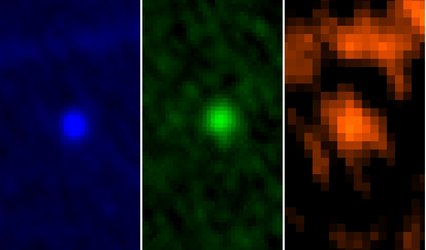
    Herschel intercepts asteroid Apophis09 January 2013 ESA’s Herschel space observatory made new observations of asteroid Apophis as it approached Earth this weekend. The data shows the asteroid to be bigger than first estimated, and less reflective.

    Herschel and Keck take census of the invisible Universe04 December 2012

    Herschel and Keck take census of the invisible Universe04 December 2012 By combining the observing powers of ESA’s Herschel space observatory and the ground-based Keck telescopes, astronomers have characterised hundreds of previously unseen starburst galaxies, revealing extraordinary high star-formation rates across the h...

    Do missing Jupiters mean massive comet belts?28 November 2012

    Do missing Jupiters mean massive comet belts?28 November 2012 Using ESA’s Herschel space observatory, astronomers have discovered vast comet belts surrounding two nearby planetary systems known to host only Earth-to-Neptune-mass worlds. The comet reservoirs could have delivered life-giving oceans to the innermos...

    W44 and its environment

    Life and death in a star-forming cloud14 November 2012

    W44 and its environment

    Life and death in a star-forming cloud14 November 2012 The aftershock of a stellar explosion rippling through space is captured in this new view of supernova remnant W44, which combines far-infrared and X-ray data from ESA’s Herschel and XMM-Newton space observatories.

    Taurus molecular cloud

    Large water reservoirs at the dawn of stellar birth09 October 2012

    Taurus molecular cloud

    Large water reservoirs at the dawn of stellar birth09 October 2012 ESA’s Herschel space observatory has discovered enough water vapour to fill Earth’s oceans more than 2000 times over, in a gas and dust cloud that is on the verge of collapsing into a new Sun-like star.

    Comet crystals found in a nearby planetary system03 October 2012

    Comet crystals found in a nearby planetary system03 October 2012 Pristine material that matches comets in our own Solar System have been found in a dust belt around the young star Beta Pictoris by ESA’s Herschel space observatory.

    • Herschel: ESA's giant infrared observatory
    • More about...
    • Herschel overview
    • Online Showcase of Herschel Images OSHI
      • Herschel operations
      • Herschel on YouTube
      • Inside Herschel
      • Herschel mission objectives
      • Related links
      • Herschel postcard gallery
      • The Milky Way Project
      • In depth
      • Herschel in depth
      • Herschel Science Centre

    Connect with us

    • RSS
    • Youtube
    • Twitter
    • Flickr
    • G+
    • Facebook
    • Livestream
    • Subscribe
    • App Store
    • ESA Science Twitter

    Follow ESA science

    • LATEST ARTICLES
    • · ESA astronaut Timothy Peake set fo…
    • · Space drives e-mobility
    • · Proba-V opens its eyes
    • · First new Galileo satellite arrive…
    • · Next destination: space
    • FAQ

    • Jobs at ESA

    • Site Map

    • Contacts

    • Terms and conditions