• → European Space Agency

      • Space for Europe
      • Space News
      • Space in Images
      • Space in Videos
    • About Us

      • Welcome to ESA
      • DG's News and Views
      • For Member State Delegations
      • Business with ESA
      • ESA Exhibitions
      • ESA Publications
      • Careers at ESA
    • Our Activities

      • Space News
      • Observing the Earth
      • Human Spaceflight
      • Launchers
      • Navigation
      • Space Science
      • Space Engineering
      • Operations
      • Technology
      • Telecommunications & Integrated Applications
    • For Public

    • For Media

    • For Educators

    • For Kids

    • ESA

    • Cluster

    • ESA Science

    • About Cluster

      • Cluster at a glance
    • Vital Stats

      • Spacecraft
      • Wave Experiment Consortium
      • Other Instruments
    • The Sun-Earth Connection

      • The Sun
      • Space Weather
    • Cluster Science

      • Science objectives
      • Science highlight - Black Auroras
      • Science highlight - Wagging Earth's Magnetotail
      • Science highlight - Joining Forces
      • Science highlight - Whirlpools at the Edge of Space
      • Science highlight - Rise of the Killer Electrons
    • Multimedia
    • Cluster images
    • Cluster videos
    • Services
    • Comments

    ESA > Our Activities > Space Science > Cluster

    Cluster encounters a natural particle accelerator

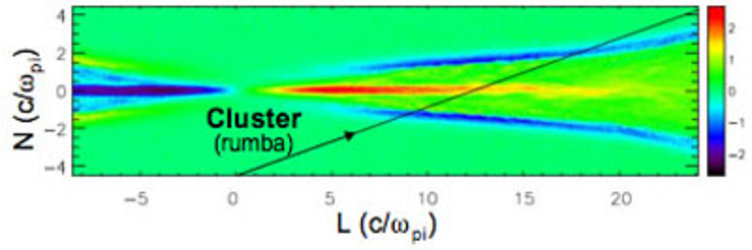
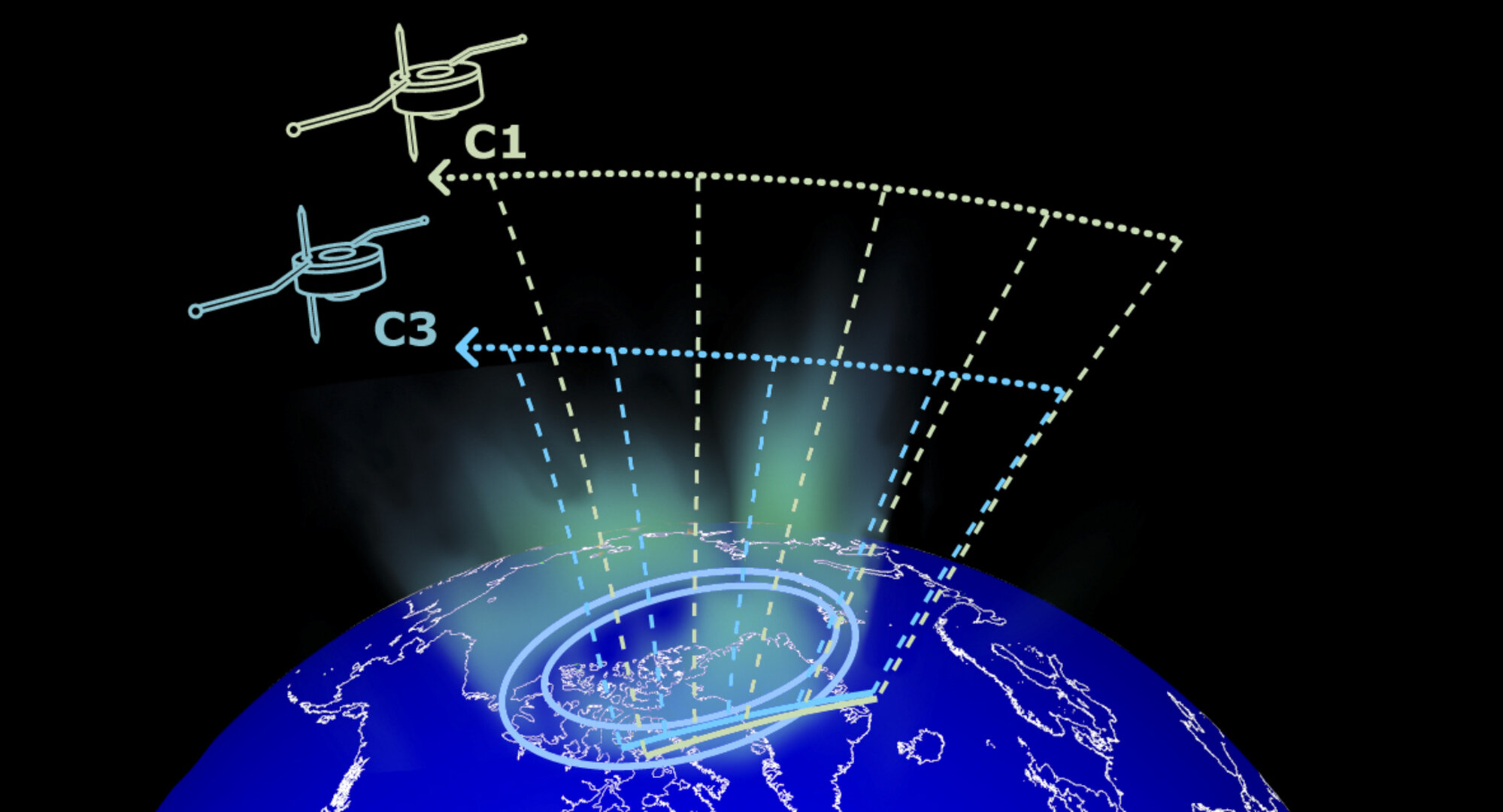
    Cluster path through aurora region
    1 February 2011

    ESA’s Cluster satellites have flown through a natural particle accelerator just above Earth’s atmosphere. The data they collected are unlocking how most of the dramatic displays of the northern and southern lights are generated.

    Two of Cluster’s four satellites found themselves in a natural particle accelerator above the northern hemisphere on 5 June 2009. The first to cross was satellite C3 at an altitude of 6400 km, followed five minutes later by C1 at 9000 km.

    This is the first time that scientists have measured such a region simultaneously using more than one satellite. The readings allow the electrical landscape of the acceleration region to be mapped.

    “This is like geography, only instead of the contours being the height of a landscape, they are the electrical potentials that span the region,” says Göran Marklund from the Royal Institute of Technology, Stockholm, Sweden.
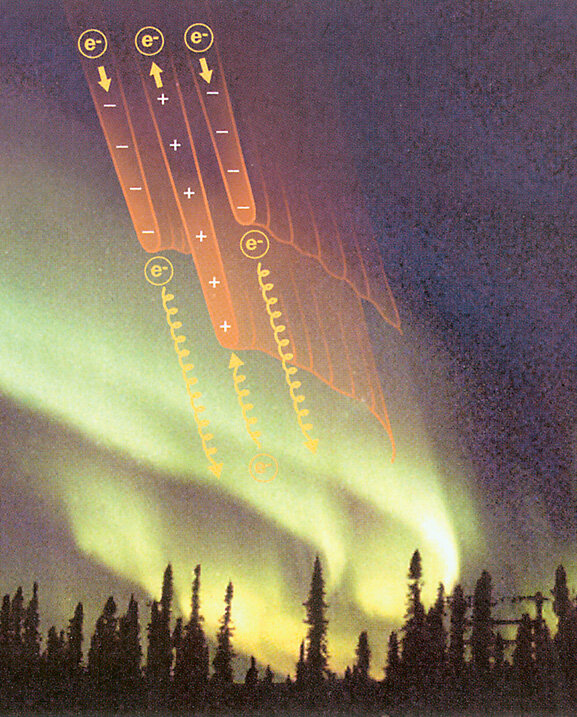
    Energetic electrons creating aurora

    These electrical potentials act in both uphill and downhill directions, accelerating particles towards and away from Earth, according to their charges.

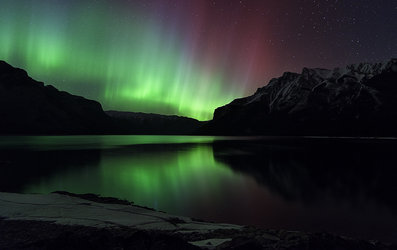
    When particles strike the atmosphere, they create the shimmering curtains of light known as the aurora, or more commonly the northern and southern lights. About two-thirds of the bright auroras are estimated to be produced in this way.

    Since 2006, the Cluster satellites have been drifting away from their initial orbits because they are being constantly nudged by the gravity of the Moon and the Sun. Fortuitously, the current orbit occasionally passes through the Auroral Acceleration Region, which spans 4000 km to 12000 km above our planet.

    The satellites do not encounter a natural particle accelerator on every orbit. Those responsible for the bright auroras are temporary alignments of the electrical fields around Earth. They are highly variable in altitude and so not always present.

    This first encounter with a natural particle accelerator associated with a large-scale aurora has proved that they may be stable for at least five minutes. A few more encounters are expected in the near future before Cluster’s orbit drifts back out of the region.

    “Cluster has now shown us the very heart of the acceleration process responsible for most bright auroras. It has given us our first look at the electrical structure and stability of such an accelerator,” says Prof. Marklund.

    Such natural particle accelerators pop up ubiquitously throughout the Solar System, especially in the strong magnetic fields of the gas giants Jupiter and Saturn.

    The new results from Cluster allow theoreticians to place much tighter constraints on their models of exactly how such accelerators work and give greater insight into the workings of space plasma.


    Contact for further information

    Rate this

    Views

    Share

    • Currently 0 out of 5 Stars.
    • 1
    • 2
    • 3
    • 4
    • 5
    Rating: 0/5 (0 votes cast)

    Thank you for rating!

    You have already rated this page, you can only rate it once!

    Your rating has been changed, thanks for rating!

    17
    facebook
    twitter
    reddit
    google plus
    digg
    tumbler
    digg
    blogger
    myspace
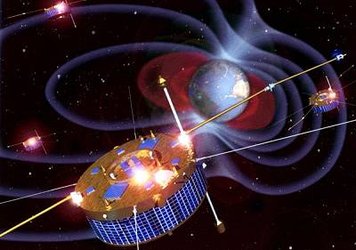
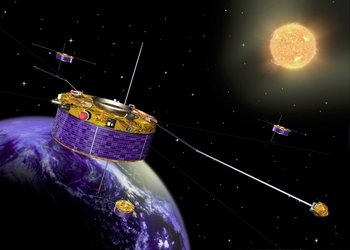
    • An artist's impression of the Cluster quartet
      An artist's impression of the Cluster quartet
      Exploring the Sun-Earth connection
    • More about...
    • Chinese National Space Administration (CNSA)
    • ESA at the IAC
    • International Academy of Astronautics (IAA)
      • Cluster overview
        • Double Star overview
          • SOHO overview
            • Solar Orbiter
              • Space weather
              • Related articles
                • Laurels for Cluster-Double Star teams
                  • Cluster turns the invisible into the visible
                    • Cluster's decade of discovery
                      • Shocking recipe for making killer electrons
                        • Watching solar activity muddle Earth’s magnetic field
                          • ESA extends missions studying Mars, Venus and Earth’s magnetosphere
                            • Cluster watches Earth’s leaky atmosphere
                              • Cluster listens to the sounds of Earth
                                • Solitary waves in translation
                                  • New discovery on magnetic reconnection to impact future space missions
                                    • High-speed beams of charged particles accelerate towards Earth
                                      • Solar outburst pulls a magnetic slingshot
                                      • In depth
                                      • This story in depth

    Connect with us

    • RSS
    • Youtube
    • Twitter
    • Flickr
    • Google Buzz
    • Subscribe
    • App Store
    • LATEST ARTICLES
    • · CryoSat hits land
    • · Ariane 5 completes seven launches …
    • · Measuring skull pressure without t…
    • · Malargüe station inauguration
    • · The solar wind is swirly
    • FAQ

    • Jobs at ESA

    • Site Map

    • Contacts

    • Terms and conditions